







Question: Regarding the converse stated in Exercise 6, if the events A n ,n 1, are not independent, then P(lim sup n A n )
Regarding the converse stated in Exercise 6, if the events An,n ≥ 1, are not independent, then P(lim supn→∞ An) = 0 need not imply that 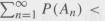 ∞. Give one or two concrete examples to demonstrate this assertion. Take (Ω, A, P) = ((0, 1), B(0,1), λ),λ being the Lebesgue measure. Then
(a) Take
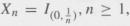
and show that

so that

Then, by Exercise 5, P(lim supn→∞, An) = 0, where An = (|Xn| ≥ l/k) for any arbitrary but fixed k = 1, 2,... Also, show that

(b) Take
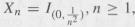
and show that

so that

Again, P(lim sup n→∞ An) = = , as in (a). Also show that
 P(An)
P(An)
2n=1 P(A,)
Step by Step Solution
3.57 Rating (168 Votes )
There are 3 Steps involved in it
a Observe that for any 0 1 X n 0 for all sufficiently large n n n say Then X n n 0 ... View full answer

Get step-by-step solutions from verified subject matter experts
Document Format (1 attachment)

742-M-S-P (7001).docx
120 KBs Word File
 Study Help