New Semester
Started
Get
50% OFF
Study Help!
--h --m --s
Claim Now
Question Answers
Textbooks
Find textbooks, questions and answers
Oops, something went wrong!
Change your search query and then try again
S
Books
FREE
Study Help
Expert Questions
Accounting
General Management
Mathematics
Finance
Organizational Behaviour
Law
Physics
Operating System
Management Leadership
Sociology
Programming
Marketing
Database
Computer Network
Economics
Textbooks Solutions
Accounting
Managerial Accounting
Management Leadership
Cost Accounting
Statistics
Business Law
Corporate Finance
Finance
Economics
Auditing
Tutors
Online Tutors
Find a Tutor
Hire a Tutor
Become a Tutor
AI Tutor
AI Study Planner
NEW
Sell Books
Search
Search
Sign In
Register
study help
business
accounting
Financial statements 5th Edition Stephen Barrad - Solutions
An analyst presents you with the following preform a (in millions of dollars) that gives her forecast of earnings and dividends for 2010-2014. She asks you to value the 1,380 million shares outstanding at the end of 2009, when common shareholders' equity stood at $4,310 million. Use a required
The following forecasts of earnings per share (EPS) and dividend per share (DPS) were made at the end of 2009 for a firm with a book value per share of $22.00:The firm has an equity cost of capital of 12 percent per annum.a. Calculate the residual earnings that are forecast for each year, 2010 to
A firm with a book value of $15.60 per share and 100 percent dividend payout is expected to have a return on common equity of 15percent per year indefinitely in the future. Its cost of equity capital is 10 percent.a. Calculate the intrinsic price-to-book ratio.b. Suppose this firm announced that
A firm announces that it will invest $150 million in a project that is expected to generate a 15 percent rate of return on its beginning-of-period book value each year for the next five years. The required return for this type of project is 12 percent; the firm depreciates the cost of assets
A new firm announces that it will invest $150 million in projects each year forever. All projects are expected to generate a 15 percent rate of return on its beginning-of-period book value each year for five years. The required return for this type of project is 12 percent; the firm depreciates the
The prototype one-period project at the beginning of the chapter was booked at its historical cost of $400. Suppose, instead, that the accountant wrote down the investment to $360 on the balance sheet at the beginning of the period. See the investment as consisting of $360 of plant (booked to the
A share traded at $26 at the end of 2009 with a price-to-book ratio of 2.0. Analysts are forecasting earnings per share of $2.60 for 2010. The required equity return is 10 percent. What is growth in residual earnings that the market expects beyond 201 O?
Black Hills Corporation is a diversified energy corporation and a public utility holding company. The following gives the firm's earnings per share and dividends per share for the years 2000-2004Suppose these numbers were given to you at the end of 1999, as forecasts, when the book value per share
In September 2008 the shares of Dell, Inc., the computer maker, traded at $20.50 each. Analysts were forecasting earnings per share of $1.47 for fiscal year 2009 and $1.77 for 2010. Refer to Dell's balance sheet in Exhibit 2.1 in Chapter 2 to calculate its book value at the end of the fiscal year
Mark Sellers, a hedge fund manager with Sellers Capital in Chicago, wrote a piece in the Financial Times on September 9, 2006, arguing that Home Depot, the warehouse retailer, was worth $50 per share. Home Depot traded at $34 per share at the time. Analysts were forecasting a consensus $2.98
General Electric Co. reported a per-share book value of $10.47 in its balance sheet on December 31, 2004. In early 2005, analysts were forecasting consensus earnings per share of $1.71 for 2005 and $1.96 for 2006.a. Calculate the value per share in early 2005 with a forecast that residual earnings
With the S&P price index at 1270 in early 2006, the S&P 500 stocks traded at 2.5 times book value. On most recent (2005) annual earnings, the stocks in the index earned a weighted average return on their common equity of 18 percent. Use a required equity return of 10 percent for this
On January 1, 2008, the S&P 500 index stood at 1468 with a price-to-book ratio of 2.6. Expected earnings for the index for calendar year 2008 were 72.56. These earnings estimates, compiled from analysts' consensus earnings forecasts for the 500 stocks in the index, are in the same dollar units
In April 2005, General Motors traded at $28 per share on book value of $49 per share. Analysts were estimating that GM would earn 69 cents per share for the year ending December 2005. The firm was paying an annual dividend at the time of $2.00 per share.a. Calculate the price-to-book ratio (P/B)
Refer back to the valuation in Exercise 5.3. In that pro form a, an analyst forecast $388 million of earnings for 2010 on a book value at the end of 2009 of $4,310 million, that is, a return on common equity of 9 percent. The forecasts were made at the end of 2009 based on preliminary reports from
A firm made an acquisition at the end of 2008 and recorded the acquisition cost of $428 million on its balance sheet as tangible assets of $349 million and good will of $79 million. The firm used a required return of 10 percent as a hurdle rate when evaluating the acquisition and determined that
Cisco Systems, Inc. (CSCO), manufactures and sells networking and communications equipment for transporting data, voice, and video and provides services related to that equipment. Its products include routing and switching devices, home and office networking equipment, Internet protocol, telephony,
PepsiCo, Inc. (PEP) is a global snack and beverage company operating in nearly 200 countries. It is organized into four divisions: Frito-Lay North America, PepsiCo Beverage North America, PepsiCo International, and Quaker foods. Products include convenience snacks, sweet and grain-based snacks,
In an article in Barron’s on April 21, 2008, a commentator remarked, "As one of the world's largest makers of bathroom tissue and baby diapers, Kimberly-Clark knows a thing or two about bottoms. Lately, however, shares of the venerable household-products company, whose Kleenex brand is virtually
Explain why analysts' forecasts of earnings-per-share growth typically underestimate the growth that an investor values if a firm pays dividends.
The historical earnings growth rate for the S&P 500 companies has been about 8.5 percent. Yet the required growth rate for equity investors is considered to be about 12 percent. Can you explain the inconsistency?
The following formula is of ten used to value shares, where Earn, is forward earnings, r is the cost of capital, and g is the expected earnings growth rate.Value of equity = Eam1/r – gExplain why this formula can lead to errors.
A firm's earnings are expected to grow at a rate equal to the required rate of return for its equity, 12 percent. What is the trailing P/E ratio? What is the forward P/E ratio?
The normal forward P/E and the normal trailing P/E always differ by 1.0.Explain the difference.
Explain why, for purposes of equity valuation, earnings growth forecasts must be for cum-dividend earnings growth, yet neither cum-dividend growth rates nor valuation are affected by expected dividends.
Abnormal earnings grow this always equal to growth of (change in) residual earnings. Correct?
A P/E ratio for a bond is always less than that for a stock. Correct?
In an equity research report, an analyst calculates a forward earnings yield of 12 percent. Noting that this yield is considerably higher than the 7 percent yield on a 10-year Treasury, she heads her report with a buy recommendation. Could she be making a mistake?
How do you interpret a PEG ratio?
Look at Figure in Chapter 2, which tracks median P/E ratios from 1963 to 2003. Explain why P/E ratios were low in the 1970s and high in the 1960s and 1990s.
The earnings-to-price ratio for the S&P 500 stocks declined significantly from the late 1970s to the late 1990s. As this ratio is a "return" per dollar of price, some claimed that the decline indicated that the required return for equity investing had declined, and they attributed the increase in
Why might an analyst refer to a leading (forward) P/E ratio rather than a trailing P/E ratio?
Cana firm increase its earnings growth yet not affect the value of its equity?
The following are earnings and dividend forecasts made at the end of 2008. The firm has a required equity return of 10 percent per year.a. Forecast the ex-dividend earnings growth rate and the cum-dividend earnings growth rate for 2010 and 2011.b. Forecast abnormal earnings growth for 2010 and
Suppose you own a savings account that earned $10 over the past year. Your only transaction in the account has been to withdraw $3 on the last day of this 12-month period. The account bears an interest rate of 4 percent per year.a. What is the value of the account after the $3 withdrawal?b. What is
An analyst presents you with the following pro forma (in millions of dollars). The pro forma gives her forecasts of earnings and dividends for 2010-2014. She asks you to value the 1,380 million shares outstanding at the end of 2009. Use a required return for equity of 10 percent in your
The following forecasts of earnings per share (EPS) and dividend per share (DPS) were made at the end of 2009:The firm has an equity cost of capital of 12 percent per annum. (This is the same pro forma used in the residual earnings valuation in Exercise E5.4.)a. Calculate the abnormal earnings
Two firms, A and B, which have very similar operations, have the same book value of 100 at the end of 2009 and their cost of capital is 11 percent. Both are forecast to have earnings of $16.60 in 2010. Firm A, which has 60 percent dividend payout, is forecast to have earnings of $17.80 in 2011.
Prepare a schedule that gives the normal trailing and forward P/E ratios for the following levels of the cost of equity capital: 8, 9, 10, 11, 12, 13, 14, I5, and 16 percent.
In early fiscal year 2009, analysts were forecasting $3.90 for Nike's earnings per share for the fiscal year ending May 2009 and $4.45 for 2010, with a dividend per share of 92 cents expected for 2009. Compare the cum-dividend earnings growth rate forecasted for 2010 with ex-dividend earnings
General Mills reported earnings and paid dividends from 2004 to 2008 as follows:Calculate cum-dividend earnings for General Mills for each year, 2005-2008. Also calculate abnormal earnings growth for each of these years. Assume a reinvestment rate for dividends of 10percent.
Consider the following pro forma for International Business Machines (IBM) based on analysts' forecasts in early 2003.The book value of IBM's common equity at the end of 2002 was $23.4 billion, or $13.85 per share. Use a required return for equity of 12 percent in calculations.a. Forecast residual
In early 2008, General Electric (GE) shares were trading at $26.75 each. Analysts were forecasting $2.21 in EPS for 2008 and $2.30 for 2009. A dividend of $1.24 was indicated for 2008. Use a required return of 9 percent for the questions below.a. What is GE's normal forward P/E? What was the P/E at
This exercise extends there verse engineering example for the S&P 500 in this chapter. At the end of 2003, the S&P 500 index stood at 1000. The chief economist of a leading Wall Street investment bank was forecasting 2004 earnings for the S&P stocks of $53.00 and $58.20 for 2005. These
The S&P 500 index stood at 1271 in early 2006. Based on analysts' consensus EPS forecasts for calendar year 2006, the forward P/E ratio for the index was 15.0 at the time. Those same analysts were giving the S&P 500 a PEG ratio of 1.47, based on forecasts for 2007. The payout ratio for this
In 2006, some fundamental investors believed that Microsoft, after being overpriced in the stock market for many years, was now a firm to buy. Microsoft's shares traded at $27.20 on September 26, 2006, down from a peak of $60 (split-adjusted) in January 2000. Analysts' consensus earnings-per-share
In March 2005, analysts were forecasting consensus earnings per share for Kimberly Clark (KMB) of $3.81 for fiscal year ending December 31, 2005, and $4.14 for 2006, up from $3.64 for 2004. KMB traded at $64.81 per share at the time. The firm paid a dividend of $1.60 in 2004 and a dividend of $1.80
Taro Company, a lawn products maker based in Minnesota, traded at $55 per share in October 2002. The firm had maintained a 20 percent annual EPS growth rate over the previous five years, and analysts were forecasting $5.30 per share earnings for the fiscal year ending October 2003, with a 12
Refer back to the valuation in Exercise E6.3. In the pro forma there, an analyst forecasted earnings of $388 million for 2010. The forecast was made at the end of 2009 based on preliminary reports from the firm. When the final report was published, however, the analyst discovered that the firm had
A share of Maytag Corp., another appliance manufacturer, traded at $28.80 in January 2003. Analysts were forecasting earnings per share of $2.94 for 2003 and $3.03 for 2004, with dividends per share of 72 cents indicated for 2003. Analysts' 3-5 year growth rate for earnings per share after 2004 was
Cisco Systems, Inc. (CSCO), manufactures and sells networking and communications equipment for transporting data, voice, and video and provides services related to that equipment. Its products include routing and switching devices; home and office networking equipment; and Internet protocol,
PepsiCo, Inc. (PEP), is a global snack and beverage company operating in nearly 200 countries. His organized into four divisions: Frito-Lay North America, PepsiCo Beverage North America, PepsiCo International, and Quaker foods. Products include convenience snacks, sweet and grain-based snacks,
Valuation models can be dangerous if used naively: An analyst can plug in any growth rate or required return estimate to get a desired valuation. Indeed, a valuation model can be a vehicle to build speculation into the valuation: Choose a speculative growth rate-or speculative near-term
Why is a simple forecast of operating income based on book value usually not a good forecast? When might such a forecast be a good forecast?
A valuation that simply capitalizes a forecast of operating income for the next year implicitly assumes that residual operating income will continue as a perpetuity. Is this correct?
What is the difference between an SF2andan SF3 forecast?
An analyst forecasts that next year's core operating income for a firm will be the same as the current year's core operating income. Under what conditions is this a good forecast?
When is the forecasted growth rate in residual operating income the same as the forecasted growth rate in sales?
Would you call a firm that is expected to have a high sales growth rate a growth firm?
The higher the anticipated return on net operating assets (RNOA) relative to the anticipated growth in net operating assets, the higher will be the unlevered price-to- book ratio. Is this correct?
An analyst calculates residual operating income of $35.7 million from financial statements for 2009, using a required return for operations of 10 percent. She also forecasts residual operating income at the same level for 2010 and years after on net operating assets of $1,257 million at the end of
An analyst prepares the following reformulated balance sheet (in millions of dollars):Core operating income (after tax) for 2009 was $990 million. The required return for operations is 9 percent. For ease, use beginning-of-year balance sheet numbers where pertinent in calculations.a. What was the
An analyst develops the following pro forma at the end of 2009 for a firm that uses a 9 percent hurdle rate for its operations (in millions);a. Forecast the cum-dividend operating income growth rate for 2011.b. Using the two-stage growth model 14.7, value the equity with a long-term growth rate of
A firm reports $3,721 million of net operating assets and $560 million of net financial obligations at the end of 2008. Its 105 million shares outstanding trade at $53 each. You expect its current core RNOA of 18.6 percent to continue at the same level in the future and also expect net operating
An analyst develops the following pro forma at the end of 2009 (in millions):a. Forecast the cum-dividend operating income growth rate for 2011 using a 9 percent return for reinvesting cash flows.b. You consider 9 percent to be a reasonable return for investing in the operations of this firm and
An analyst forecasts that the current core return on net operating assets of 15.5 percent will continue indefinitely in the future with a 5 percent annual sales growth rate. She also forecasts that the current asset turnover ratio of 2.2 will persist. Calculate the enterprise price-to-book ratio
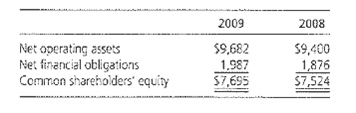
An analyst uses the following summary balance sheet to value a firm at the end of 2009 (in millions of dollars):The analyst forecasts that the firm will earn a return on net operating assets (RNOA) of 12 percent in 2010 and a residual operating income of $9l.4 million.a. What is the implied rate
The following are from the financial statements for General Mills (in millions):There were 337.5 million shares outstanding at the end off is cal year 2008 and they traded at $60 each. Use a required return for operations of 8 percent in answering the following questions:a. What is General Mills's
In early 2006, the 2,369 million outstanding shares of the Coca Cola Company traded at $48.91 each. The price-to-book ratio was 6.3 and the forward P/E was 19.3 based on analysts' consensus EPS forecast for 2007. An analyst extracted the following numbers from Coke's financial statements (in
In January 2008, the 738.3 million outstanding shares of Starbucks Corporation traded at $20 each. Analysts' consensus earning per-share estimates of $1.03 for the fiscal year ending September 30, 2008, gave the firm, a forward P/E of 19.4. The firm reported earnings per share for 2007of $0.90, up
The following are key numbers from IBM's financial statements for 2004.IBM's shares traded at $95 when 2004 results were announced. Use a required return for operations of 12.3 per cent to answer the following questions:a. Forecast operating income and residual operating income for 2005 if IBM
In late 2002, analysts were forecasting fiscal 2003 and 2004 earnings per share for Cisco Systems of $0.54 and $0.61, respectively. Cisco's shares traded at $15 at the time. Assuming the long-term growth rate will be at 4 percent, the average rate of growth for gross national product. Value Cisco
Home Depot, the warehouse retailer, traded at $42 per share when its 2005 financial statements were published. Analysts were forecasting $2.59 earnings per share for 2006 and $2.93 for 2007. There were 2,185 million shares outstanding at the time. Below are income statements for fiscal years
Valuation Grid and Reverse Engineering for Home Depot, Inc. (Medium)a. Using the information in Exercise 14.13, calculate the implied growth rate in residual operating income that is implicit in the market price of $42 per share.b. If you forecast that the growth rate in residual earnings after
This case continues the financial statement analysis of Procter & Gamble Co. begun in Minicase 9.1 and developed further in Minicases 11.1 and12.1. This installment focuses on forecasting and valuation, with further development in Minicase 15.1 in the next chapter.Financial statements for
Cisco Systems, Inc. (CSCO), manufactures and sells networking and communications equipment for transporting data, voice, and video and provides services related to that equipment Its products include routing and switching devices; home and office networking equipment; and Internet protocol,
Why is it important to understand the “business concept” before valuing a firm?
Explain why a fade diagram is helpful for forecasting.
What factors determine the rate at which high operational profitability declines over time?
What is meant by the “integrity” of a pro forma?
Forecasted dividends affect forecasted shareholders’ equity but do not affect the value calculated from forecasted financial statements. Why?
What is a red-flag indicator?
What is an unarticulated strategy?
Why must the effect of a merger or acquisition on shareholder value be calculated on a per-share basis?
When might management of a firm consider a leveraged buyout?
Why might the shares of the acquiring from in an acquisition decline on announcement of the acquisition?
An analyst predicted the following:1. Sales of $1,276 million.2. Core profit margin of 5 percent.3. Asset turnover of 2.2.4. Core other operating income and unusual items are zero.The firm's required return for operations is 9 percent.a. Apply formula 15.1 to calculate the residual operating
Refer to the pro forma for PPE, Inc. in Exhibit 15.1. Modify this pro forma for the following revised forecasts:1. Sales are expected to grow at 6 percent from their Year 0 level of $124.90 million.2. Core profit margins are expected to be 7.0 percent.3. Asset turnovers (on beginning-of-year net
The following forecasts were prepared in 2008 for a firm with a cost of capital for its operations of 12 percent. Amounts are in millions of dollars.The common stockholders' equity at the beginning of 2009 is 596 and there is no net debt.a. Forecast cash flow from operations and free cash flow
A firm has the following summary balance sheet (in millions of dollars):Net operating assets............441Net financial obligations........... 52Common shareholders’ equity........389The firm is currently earning a return on net operating assets (RNOA) of 14 percent from sales of $857 million
A firm with a current return on net operating assets of 15 percent anticipates growth insalesof6 percent per year from its current net operating asset base of $498 million. It also anticipates that sales will deliver 7.5 percent after-tax profit margins and an RNOA of 15 percent on a consistent
There formulated balance sheet and income statement for a firm's 2009 fiscal year are given below.At the end of 2009, sales were forecasted to grow at 6 percent per year on a constant asset turnover of 1.25. Operating profit margins of 14 percent (after tax) are expected each year. The firm's tax
The following summarizes the balance sheet and income statement for a property-casualty insurer. Numbers are in millions of dollars.Net income of $848 million for 2009 come from the following to which taxes have been allocated.Loss on underwriting activities, after tax..........$ 43Investment
An analyst developed the following set of pro forma financial statements as an input into a valuation:a. Spot the errors in the pro forma.b. The analyst forecasts from these pro formas that residual operating income will grow at a rate of 8 percent per year. Do the pro formas justify this
This exercise comes in two parts. Part I involves an analysis of a set of financial statements and Part II involves forecasting and valuation based on those financial statements.Part I: analysisThe following is a comparative balance sheet for a firm for fiscal year 2009 (in millions of
The following are from the financial statements for General Mills (in millions):At the end of fiscal year 2008, 337.5 million shares were outstanding, and they traded at $60 each. The following forecasts were prepared:Sales growth rate, 2009-2010...........9% per yearSales growth rate,
At the end of fiscal year 2008, Nike reported $5,806 million in net operating assets and common shareholders' equity of $7,797 million. Develop a pro forma and valuation at the end of fiscal year 2008 with the following forecasts. Then calculate the per-share value of the 491. 1 million shares
The Coca-Cola Company reported an after-tax profit margin of 20.0 percent on its sales of $24,088 million in 2006. It also reported $102 million of other core income, mainly from equity investments in its bottling companies. Further analysis of the financial statements reveals an asset turnover
Box 15.3 in this chapter values Nike's shares using residual operating income methods.a. Modify the pro forma in Box 15.3 to forecast abnormal operating income growth, and value the shares from these forecasts.b. Apply the simple forecast model (equation 14.7 in Chapter 14) that combines short term
PPE, Inc. is considering an acquisition. The acquisition, to be completed within one year, will bring the acquired firm onto PPE's balance sheet using the purchase method. Management has prepared the following pro forma, which anticipates this acquisition at the end of Year 1.This pro forma
Showing 18600 - 18700
of 107766
First
180
181
182
183
184
185
186
187
188
189
190
191
192
193
194
Last
Step by Step Answers

 Get 50% OFF
Claim Now
Get 50% OFF
Claim Now


.png)
.png)
.png)
.png)
.png)
.png)
.png)
.png)
.png)
.png)
.png)
.png)
.png)
.png)
.png)
.png)
.png)
.png)
.png)
.png)
.png)
.png)
.png)
.png)
.png)


