New Semester
Started
Get
50% OFF
Study Help!
--h --m --s
Claim Now
Question Answers
Textbooks
Find textbooks, questions and answers
Oops, something went wrong!
Change your search query and then try again
S
Books
FREE
Study Help
Expert Questions
Accounting
General Management
Mathematics
Finance
Organizational Behaviour
Law
Physics
Operating System
Management Leadership
Sociology
Programming
Marketing
Database
Computer Network
Economics
Textbooks Solutions
Accounting
Managerial Accounting
Management Leadership
Cost Accounting
Statistics
Business Law
Corporate Finance
Finance
Economics
Auditing
Tutors
Online Tutors
Find a Tutor
Hire a Tutor
Become a Tutor
AI Tutor
AI Study Planner
NEW
Sell Books
Search
Search
Sign In
Register
study help
business
auditing
Auditing a business risk appraoch 6th Edition Larry e. rittenberg, bradley j. schwieger, karla m. johnston - Solutions
Describe the following types of computer software and their importance to processing and controls:• Operating systems software• Communications software• Application program software• Access control software
What is a virtual private network (VPN)? What are the primary characteristics of such networks? What major risks are associated with VPNs?
What are general controls? Do the general controls directly affect computer applications? How does the auditor determine whether general control procedures should be tested?
Explain why there should be a segregation of duties between data processing and users. Should data processing be allowed to initiate transactions (for example, automatically initiating a purchase order when inventory falls to a pre specified level)?
Identify the seven fundamental concepts important to evaluating the organization's data processing control structure, and briefly indicate the importance of each to the auditor's risk assessment process.
Briefly describes the purposes of the following control procedures and how each works: (1) financial total, (2) hash total and (3) record count.
What are the major elements of an audit trail? How does an audit trail in a computerized environment differ conceptually from an audit trail in a manual environment?
What is a self-checking digit? Why is its use such an important control procedure? What happens to a transaction if it is rejected from processing because it fails the self-checking digit test?
Briefly describe how each of the following edit controls works and the types of errors each is designed to detect. Give one example of each for a retail organization.a. Limit testb. Reasonableness testc. Validity testd. Missing data teste. Invalid combination of items
What major principles should guide the development of a comprehensive access control program for a data processing center? Assume that the organization uses automated access control software to implement the principles.
Identify the three primary methods for authenticating a user attempting to gain access to a restricted program or file. Briefly identify the major advantages and disadvantages of each method.
What is the potential danger of using a physical attribute, such as a retina scan or a fingerprint, to authenticate a user?
Briefly describe encryption and why it is important to controlling validity of transactions sent over a public network.
During a discussion between two staff auditors, one remarks:"The only way computer control procedures can be adequately tested for operation is to actually process test data through the computer application. Otherwise, there is no effective way to know that the designed control procedures are
What is a monitoring control? Identify a monitoring control that might be used to inform a company whether its access controls are working effectively. How would the auditor evaluate the effectiveness of the monitoring control?
What are the major objectives of the ITF approach? Would an ITF be well suited to monitoring an organization for fraud? Explain.
Compare and contrast the tagging and tracing technique with an ITF. In your comparison, specifically address:• Differences in audit approach• Assurances that can be gathered from each approach• Mechanics of implementation
Assume the auditor wants to implement a tagging and tracing approach for a highly integrated system that accepts orders from customers, ships the orders, and bills the orders. What audit objectives would the tagging and tracing approach address?
What is generalized audit software (GAS)? What are the major audit tasks for which an auditor would use it? What are its major advantages?
How might an auditor perform an "overall file validity analysis" using GAS? What does the auditor expect to learn from such an analysis? How would such information be utilized in conducting the audit?
Why might some CPA firms develop customized audit software rather than using GAS? Compare and contrast the relative advantages of GAS and customized audit software. Indicate the type of client environment in which each type of software may have a competitive advantage.
What risks are unique to auditing a client who engages in electronic commerce that might not be present in other clients?
1. In an automated payroll system, all employees in the finishing department were paid at the rate of $7.45 per hour when the authorized rate was $7.15 per hour. Which of the following controls would have been most effective in preventing such an error?a. Access controls that would restrict access
You have been assigned to the audit of Mid-State Electronics Corporation, a medium-size distributor of electronics equipment serving a geographic area within a radius of 150 miles. Mid-State has installed a client-server computer and provides remote access to its sales people on the road.
Bass Pro Shops is a catalog retailer concentrating on fishing and hunting equipment. It prints an annual catalog containing over 200 pages of products, as well as approximately six special sale catalogs during the year. Products range from fishing lures retailing for $1.29 to boat packages for over
The following represent errors that could occur in a computerized environment.RequiredFor each error, identify a control procedure that would have been effective in either preventing or detecting the error.Errors Founda. The selling price for all products handled by company salespersons was
A comprehensive program for controlling access to the computer equipment, computer programs, and data is an important control. In evaluating the comprehensiveness of an access policy, the auditor considers both physical and data access (that is, access to data by gaining access to computer files
Assume that the client has an adequate access control plan and, based on your interviews, the access policies are operating as described. The control procedures identified by the auditor include restricted use of passwords, frequent changes in passwords to keep pace with job changes, and monitoring
Ajax, Inc., an audit client, recently installed a new computer system to more efficiently process its shipping, billing, and accounts receivable records. During interim work, an assistant reviewed the accounting system and the internal controls. The assistant determined the following information
Paper-based documentation might not exist in an e-commerce environment, with the exception of the trading partner agreement and a separate agreement with an intermediate processor describing the confidentiality of data, control procedures by the processor, and the right to audit by the client. In
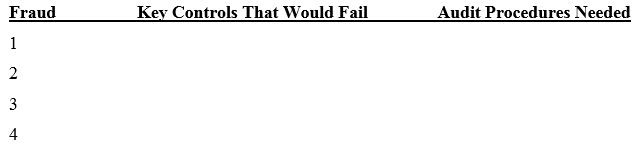
For each of the following situations involving computer fraud, briefly describe the following:a. A control procedure that would have been effective in preventing or detecting the fraud.b. An audit procedure that would have detected the fraud.Computer Fraudsa. A computer programmer added a module to
Saris manufacture bicycle racks and wants to market on the Web. It also wants to cut production cost by manufacturing various bicycle racks that are custom designed for cars by manufacturing them after an order is received and shipping the bicycle rack to the customer within 48 hours of receipt.
Hastings Manufacturing Company makes special-order equipment to be used by other manufacturers. The company has three major product lines and approximately 10 variations of each product line. The company uses a job cost accounting system in which all labor and materials are directly charged to the
The Integrated Test Facility (ITF) and the Tagging and Tracing approach have been identified as audit approaches designed to test accuracy of computer processing of transactions.Requireda. Explain how the ITF and Tagging and Tracing audit approaches work, including an identification of:(i) How each
IDS Corporation processes mortgage payments and updates for itself, as well as for a number of other mortgage service companies. The program tables are updated frequently for changes in interest rates for variable mortgages, but not for the fixed rate mortgages. Because there are a number of
The auditor has identified each of the following control procedures as important in reducing control risk in major accounting applications.RequiredFor each control procedure identified, indicate how the auditor would test the control. Assume that all controls pertain to the input, processing, and
A CPA's client, Boos & Baumkirchner, Inc., is a medium-size manufacturer of products for the leisure-time activities market (camping equipment, scuba gear, bows and arrows, and so forth). During the past year, a computer system was installed, and inventory records of finished goods and parts
Woodman's Grocery is a small chain of grocery retailers with four mega size stores. Each store has a networked computer that runs the automated cash registers. The merchandising manager, on the recommendation of the section managers, approves all price changes. The authorized prices are maintained
Big Mart is one of the largest retail organizations in the country. It has implemented POS to record sales, bar codes, and EDI. Some vendors are given the authority to manage store space, for example, making decisions about the style and size of jeans to stock in the store. Other vendors fill
Dreyfet Department Store maintains online prices on minicomputers in stores connected to the automatic cash registers. For most products, the product and price are read into the cash register by scanning devices that read the bar codes on the merchandise. The product name (abbreviated) and the
The Saginaw Steering Gear Company makes automotive steering gears that it supplies to automobile manufacturers. The company, in turn, purchases a number of its component parts from other suppliers. The company requires all its suppliers to utilize EDI and has established trading agreements with all
You have been assigned to the audit of Ford Motor Co. Ford is quite complex. In preparing for the audit, the partner describes the following characteristics about the audit client:• Ford is moving into e-business via the Web. It will allow vendors to bid on supplying products to Ford. However,
How prevalent is fraud? What is the effect of fraud on the profitability of U.S. business?
Define the following types of fraud:• Defalcation• Asset misappropriation• Corruption• Financial reporting fraud Does the auditor's responsibility for detecting a fraud differ by the type of fraud that is perpetrated? Explain.
What are the most common approaches taken to commit financial reporting fraud?
You are asked to be interviewed by a student newspaper regarding the nature of accounting fraud. The reporter says, "As I understand it, defalcations are more likely to be found in small businesses, but not in larger businesses. On the other hand, financial reporting fraud is more likely to be
Define the term "materiality" as it applies to the concept of the auditor's responsibility for detecting material fraud. What are the factors that would cause the materiality threshold in dollars to be lower than might have otherwise been used in a financial statement audit?
Why has financial reporting fraud become more prevalent as the financial markets have expanded? What is the motivation for privately owned businesses to commit financial reporting fraud; aren't the owners just fooling themselves?
What was the nature of the fraud at Equity Funding? How was the fraud covered up? What type of business analysis would have revealed the fraud?
What are the major lessons for the accounting profession that have been learned (or should have been learned) from Equity Funding?
What were the major findings of the second COSO Report on fraudulent financial reporting?
How has the responsibility of auditors for planning and conducting the audit to detect fraud changed over the past 30 years?
In what ways is the auditor required to increase the amount of fraud skepticism on every financial statement audit engagement?
Why is it important that the auditor review all major journal entries?
Does the auditor presume that there is a fraud in some specific accounts? Which accounts? How does this presumption change the nature of audit procedures?
What are the ten major steps that are included in the fraud risk model?
The fraud risk model identifies motivations, incentives, opportunities, and capabilities as being the major components of the fraud diamond. Define what is meant by each of these four factors and explain how they work together to build a fraud risk profile.
Identify five factors that would be strong indicators of opportunities to commit fraud.
Is the "ability to rationalize" the fraud an important aspect of a fraud profile? What are some of the common rationales used by fraud perpetrators?
What major groups failed in the Enron case? How did each group fail? What were the motivations that influenced each group that partially led to the failure? To what extent did Sarbanes-Oxley address many of the factors that caused the failures?
Explain how "brainstorming" is supposed to work as part of the audit planning process. What are the advantages of using a "brainstorming" approach to identify the possible existence of fraud?
Explain why the auditor needs to examine the "tone at the top" in evaluating fraud risk. Identify the key information the auditor should gather on each of the following areas:• Corporate governance• Management• Audit committee• Corporate culture• Internal auditing• Top level monitoring
Explain the important role analytical procedures play in identifying fraud risk. Identify three examples of analytical analysis that would increase the auditor's assessment of fraud risk.
How should the audit be adjusted when the auditor has identified a high risk of fraud occurring?
Why is it important for the auditor to develop a list of "hypothesized frauds" as opposed to first seeking management's explanations of differences in account balances?
An auditor may have to perform "extended audit procedures" if the auditor identifies fraud risk as high. Identify five examples of extended audit procedures that might be performed if the auditor suspects there may be fraud in the revenue account.
What is the auditor's primary responsibility for reporting a fraud that has been detected and corrected?
Explain the auditor's responsibility for reporting the following:• A defalcation that the client is willing to correct and portray in the financial statements• A defalcation that is material, but the client wishes to bury in an "other expense" category• A financial reporting fraud that the
Although each fraud is unique, there are commonalities among many of the major financial reporting frauds that have taken place in the past decade. What are the major commonalities and lessons that can be learned through an examination of the frauds at Enron, HealthSouth, WorldCom, Addeco, Lucent,
Explain how a fraud perpetrator could use a disbursement scheme to misappropriate assets from the company.
Explain how an auditor should link control deficiencies to the design of audit tests. Identify the logic process utilized by the auditor to make the linkage.
Explain how audit procedures should be linked to the identification of fraud risk indicators.
Audit software can be very useful in reading a computer file and identifying potential fraud. Identify the major fraud-related procedures that can be performed using audit software.
What are illegal acts? What is the auditor's responsibility for detecting illegal acts? Does this responsibility differ from the auditor's responsibility for detecting fraud?
What is forensic accounting? How does it differ from auditing?
The auditing literature had traditionally classified fraud as either “defalcations” or “financial reporting fraud.”Requireda. What is the difference between the two types of fraud?b. Does the auditor’s responsibility for detecting fraud vary with the nature of the fraud committed?c. Is a
The responsibility of auditors for detecting fraud has increased as users have made it clear that they expect auditors to detect material fraud.Requireda. In addition to dollar amounts, what other factors should an auditor consider in determining materiality for planning an engagement to detect
The Equity Funding fraud was the first major financial reporting fraud. It was a fraud that people believed would change auditing forever. However, the profession has taken a while to learn the lessons from Equity Funding.Requireda. The following describes some of the major mechanisms used in
The wauditor is to presume that there is fraud in revenue. Consider a company that manufactures high-tech fiber-optic gear. Assume that the Wall Street analysts believe the industry has good growth prospects. The audit client is predicting a 20% increase in sales and a 27% increase in profits for
The following scenario and analytical information describe a company. Three sets of facts are presented about this company. At the end of each set, perform a brainstorming analysis identifying all the factors that will affect the planning and conduct of the audit.a. Company Background. Brandon
The ten step audit process is a systematic approach to ensure that every audit engagement considers the possibility of fraud and how fraud might occur.Requireda. Identify the ten steps in the process and the decisions the auditor makes at the end of each step. Identify the key pieces of information
There are a number of factors that an auditor may consider when identifying opportunities to commit fraud. The following represent areas that have often been associated with frauds.Situations often associated with Fraud1. Related-party transactions2. Industry dominance3. Numerous subjective
Approximately a decade ago, the following comments appeared in the The Wall Street Journal. In the article, the participants were talking about users expecting the auditors to do a better job of finding fraud.Comment 1: (An accounting professor at Dartmouth College):"The very time an auditor should
The existence of fraudulent financial reporting has been of great concern to both the accounting profession and regulatory agencies such as the SEC. It has been asserted that companies in trouble frequently go bankrupt shortly after receiving unqualified opinions from auditors. The auditing
Most of the legislation has dealt with financial reporting fraud that has taken place in publicly traded companies. However, there has not been such legislation for non-public companies or for audits of non-public companies.Requireda. Is the auditor's responsibility for detecting fraud any
Kent, CPA, is the engagement partner on the financial statement audit of Super Computer Services Co. (SCS) for the year ended April 30, 2007. On May 6, 2007, Smith, the senior auditor assigned to the engagement, had the following conversation with Kent concerning the planning phase of the
The auditor should consider known internal control deficiencies as part of the process of planning the audit.Requireda. The following is a list of internal control deficiencies that were found at a small manufacturing business. For each deficiency identify the fraud risk, and identify the extended
Most CPA firms have responded to SAS 99 by performing detailed file validity analysis using audit software.Requireda. Identify the ways in which audit software might be used to perform file validity analysis.b. Why is the file validity analysis an effective audit approach to search for the
An audit client of the Peninsula CPA firm is extensively involved in defense contracting. During the past year, the Defense Department has conducted an ongoing investigation of the client for possible overbillings on governmental contracts.Most of these overbillings would be considered illegal.
The facts below represent the audited financial statements of a public company for 2005 and 2006, along with management's representation regarding the unaudited amounts (i.e., the UNAUDITED column) and the auditors' projected amounts for 2007 (i.e., the PROJECTED column, which represents their
Dot-com companies grew rapidly in the late 1990s. Many opened up “shopping malls” through which they serve as a portal into several different companies. The SEC has expressed concerns about revenue recognition at a variety of dot-com companies. Explicitly, the SEC is concerned that some
The following is a list of defalcations that have occurred within various organizations. You may assume that the amounts involved are material.RequiredFor each defalcation, briefly indicate:a. How the auditor would have identified the risk that led to the defalcation; that is, would the auditor
Multiple Choice Questions1. Which of the following statements regarding the incidence of fraud is incorrect?a. Fraud is estimated to costs U.S. businesses less than 1 cent of every dollar of sales.b. Defalcations occur more often than financial reporting fraud.c. Financial reporting frauds are
When is sampling appropriate to use in an audit?
What are non-sampling and sampling risks? How can each be reduced?
Why is it so important that a sample be as representative of the population as possible?
What factors should be considered when determining whether to use non-statistical or statistical sampling?
When using sampling to test control procedures, what factors should the auditor consider in setting the:a. Tolerable deviation rateb. Expected failure ratec. Allowable risk of assessing control risk too low
What is the effect of increasing each of the following on an attribute estimation sample size?a. The allowable risk of assessing control risk too lowb. The tolerable failure ratec. The expected failure rated. Population size
How does random-number sample selection differ from systematic selection? What precaution(s) must the auditor take when using systematic selection?
Showing 1200 - 1300
of 10291
First
6
7
8
9
10
11
12
13
14
15
16
17
18
19
20
Last
Step by Step Answers

 Get 50% OFF
Claim Now
Get 50% OFF
Claim Now


.png)
.png)
.png)


