New Semester
Started
Get
50% OFF
Study Help!
--h --m --s
Claim Now
Question Answers
Textbooks
Find textbooks, questions and answers
Oops, something went wrong!
Change your search query and then try again
S
Books
FREE
Study Help
Expert Questions
Accounting
General Management
Mathematics
Finance
Organizational Behaviour
Law
Physics
Operating System
Management Leadership
Sociology
Programming
Marketing
Database
Computer Network
Economics
Textbooks Solutions
Accounting
Managerial Accounting
Management Leadership
Cost Accounting
Statistics
Business Law
Corporate Finance
Finance
Economics
Auditing
Tutors
Online Tutors
Find a Tutor
Hire a Tutor
Become a Tutor
AI Tutor
AI Study Planner
NEW
Sell Books
Search
Search
Sign In
Register
study help
business
economics
Economics Principles Applications And Tools 7th Edition Stephen J. Perez - Solutions
1. Consider the example of Xena€™s copy shop. Adding a second worker increased output by 300 pages. If she added a third worker, her output would increase by fewer than ________ pages.2. If a firm is subject to diminishing marginal returns, an increase in the number of workers decreases
1. Your savings account pays 4 percent per year: Each $100 in the bank grows to $104 over a one-year period. If prices increase by 3 percent per year, by keeping $100 in the bank for a year you actually gain $ _____.2. You earn 5 percent interest on funds in your money market account. If consumer
About 90 percent of the world s candy canes are consumed in the United States, and until recently most were produced domestically. Domestic producers were closer to consumers, so they had lower transportation costs and lower prices than their foreign competitors. Domestic firms used their superior
As an example of a market that results from comparative advantage, consider the market for virtual currency. Firms in China pay workers (called gold farmers) to play the online game World of War craft (WoW). In the game, workers earn virtual currency in the form of gold coins by killing monsters.
In 1802, a new market developed in the United States garden seeds sold in small packets. The new market was developed by the Shakers, a religious group whose members took a vow of celibacy and lived in communes ranging in size from 10 to about 100 believers. The Shakers were committed to common
1. Consider an accounting firm with two accountants.a. Fill in the blanks in the following table.b. Quigley has a comparative advantage in_____________, while Slokum has a comparative advantage in______.2. Mike, the manager of a car wash, is more productive at washing cars than any potential
1. Arrows up or down: Outsourcing _____ production costs and _____ consumer prices.2. In the first three months of 2004, the number of jobs moving to another state was _____ (larger/smaller) than the number of jobs moving to another country.3. Approximately what percentage of job losses in the
1. Four social inventions that support markets are (1) ______, which specify the terms of exchange; (2) ______, which reduce the risk of entrepreneurs; (3) ______, which increases the profitability of inventions; and (4) ______ rules, which provide potential investors with reliable information
1. For markets to operate efficiently, the people making consumption and production decisions must bear the full _____and reap the full _____from their decisions.2. Pollution from a paper mill is an example of market failure because people living downwind of the mill bear part of _____of
In the late summer of 2005, Hurricane Katrina caused a storm surge and levee breaks that flooded much of New Orleans and destroyed a large fraction of the city s housing. Hundreds of thousands of residents were displaced, and about 250,000 relocated to nearby Baton Rouge. The increase in population
In the last few years thousands of honeybee colonies have vanished, a result of bee colony collapse disorder (CCD). Roughly one-third of the U.S. food supply including a wide variety of fruits, vegetables, and nuts depends on pollination from bees. The decline of honeybees threatens $15 billion
What happens when an increase in supply is combined with a decrease in demand? In 2009 the cruise industry invested $4.7 billion on 14 new ships, and in 2010 the industry launched 12 additional new ships. While the supply of cruise berths increased, the demand for cruises decreased a result of a
The price of vanilla beans has been bouncing around a lot. The price was $50 per kilogram (2.2 pounds) in 2000, then rose to $500 in 2003, then dropped to $25 in 2006. We can use the model of demand and supply to explain the bouncing price. Figure shows the changes in the vanilla market in recent
1. Arrow up or down: According to the law of demand, an increase in price ____ the quantity demanded.2. From the following list, choose the variables that are held fixed in drawing a market demand curve:The price of the productConsumer incomeThe price of other related goodsConsumer expectations
1. Arrow up or down: According to the law of supply, an increase in price ___ the quantity supplied. 2. From the following list, choose the variables that are held fixed when drawing a market supply curve: The price of the product Wages paid to workers The price of materials used in production
1. The market equilibrium is shown by the intersection of the ____ curve and the ____ curve.2. Excess demand occurs when the price is (less/greater) than the equilibrium price; excess supply occurs when the price is ____ (less/greater) than the equilibrium price.3. Arrow up or down: An excess
1. A change in demand causes a ____ (movement along/shift of) the demand curve. A change in quantity demanded causes a ______ (movement along/ shift of ) the demand curve.2. Circle the variables that change as we move along the demand curve for pencils and cross out those that are assumed to be
1. A change in supply causes a ______ (movement along/shift of) the supply curve. A change in quantity supplied causes a ____ (movement along/shift of) the supply curve.2. Circle the variables that change as we move along the supply curve for pencils and cross out those that are assumed to be
1. Fill in the blanks in the following table. Note that the ordering of the first column has been scrambled.2. When _____ (supply/demand) changes, the equilibrium price and the equilibrium quantity change in the same direction. When_____ (supply/demand) changes, the equilibrium price and the
1. Arrow up or down: Hurricane Katrina ____ the demand for housing in Baton Rouge, so the price of housing and the quantity of housing ____.2. Arrows up or down: The decrease in the number of bee colonies _____ the supply of fruits and berries, ____ the cost of producing ice cream, and ______ the
Was the most recent recession the most severe economic downturn since the Great Depression? With the data now in, it appears that the recession starting in December 2007 will rival the recession starting in November 1973, which was caused by a sharp and unexpected rise in oil prices. From Table, we
Two economists, David Blanch flower of Dartmouth College and Andrew Oswald of Warwick University in the United Kingdom, have systematically analyzed surveys over a nearly 30-year period that ask individuals to describe themselves as happy, pretty happy, or not too happy. The results of their work
1. The circular flow describes the process by which GDP generates____, which is spent on goods and services.2. Labor and capital are exchanged in _________markets.3. Which government department produces the National Income and Product Accounts?a. The Department of Educationb. The Department of
1. Which of the following is not a component of GDP?a. Consumptionb. Investmentc. Producer Price Indexd. Government purchasese. Net exports2. What part of government spending is excluded from GDP because it does not correspond to goods and services currently being produced?a. National defenseb.
1. What do we add to GDP to reach GNP?a. Net income earned abroad by U.S. householdsb. Personal incomec. Depreciationd. Net exports2. What is the largest component of national income?a. Compensation of employees (wages and benefits)b. Corporate profitsc. Rental incomed. Proprietors income (income
1. The GDP deflator is calculated for any given year by dividing nominal GDP by ______GDP and multiplying by 100.2. If the base year is 2010, then real and nominal GDP in 2010 will be equal. ____ (True/False)3. Measured price changes do not depend on the particular base year chosen when
1. The date that a recession begins is called the__________.2. Since World War II, the United States has experienced seven recessions. ______ (True/False)3. The ______ marks the date that ends a recession and output starts to increase again.4. The organization that officially dates recessions in
1. Which of the following are not included in GDP?a. Leisure timeb. Sales of new carsc. Strawberries sold in a grocery stored. Economics textbooks sold in the bookstore2. Men s reported happiness has increased relative to women’s reported happiness in the last several decades _____ (True/False)
Dumping is selling a product in a foreign market at a lower price than a firms own domestic market. You might think that this would require a comparison of actual prices charged in home markets compared to foreign markets. But that is rarely the case in the United States. For example, from 1995 to
1. A country has a comparative advantage if it has a lower ________ cost of producing a good 2. The terms of trade is the rate at which two goods can be ________ for one another.3. Suppose a country has a comparative advantage in shirts but not computer chips. Workers in the chip industry will be
1. If a country bans the importation of a particular good, the market equilibrium is shown by the intersection of the _____curve and the_____ curve.2. The equilibrium price under an import quota is _____ (above/below) the price that occurs with an import ban and _____ (above/below) the price that
1. The -industry argument is often given to provide a rationale for tariffs for new firms.2. Knowledge gained during production is known as by doing. 3. If only one firm can exist in a market, a government may try to subsidize the firm so that the country can share in the profits 4. In the 1950s
1. The latest trade round is called the_________ round.2. The _________ was formed in 1995 to oversee GATT.3. NAFTA is a free-trade agreement between the United States, Mexico, and _____________.4. The average tariff rate in the United States is roughly ____________ percent.5. A Major Change in
1. Pricing below production cost or selling at prices in foreign markets less than those in domestic markets is known as __________.2. Under global trade rules, the United States was allowed to ban Mexican tuna because Mexico used fishing nets that killed dolphins. __________ (True/False)3. Suppose
In recent years, the U.S. and Chinese governments have been at odds about the appropriate value of the exchange rate between the Chinese yuan and the U.S. dollar. The United States believes that the Chinese government is holding the yuan below its true value. Can the price of a Big Mac in China
The 2006 Economic Report of the President directly addressed whether the United States can continue to run large current account deficits and, of course, financial account surpluses. In the report, the government recognized that the current account deficits would eventually be reduced. However, it
When the euro was launched, countries with typically weaker currencies or fiscal discipline benefited from the discipline of one currency and a strong, single central bank. No longer would investors fear, for example, that Greece or Spain would pursue inflationary monetary polices, as monetary
During the late 1980s, Argentina suffered from hyperinflation. As part of its financial reforms, it pegged its currency to the U.S. dollar, making pesos convertible into dollars. To issue pesos, the central bank had to have an equal amount of dollars, or its equivalent in other hard currencies, on
1. The dollar _______ against the euro when the European central bank lowers interest rates.2. If the dollar appreciates against the euro, then the euro also _______ against the dollar.3. The dollar _______ against the euro when the inflation rate in the United States increases.4. A shift in the
1. When the U.S. price level increases but the nominal exchange rate remains the same, the real exchange rate will ________.2. When the U.S. and foreign price levels remain the same but the dollar appreciates, the real exchange rate will ________.3. The law of one price provides accurate
1. Net transfers from abroad are a(n) _______ entry on the current account.2. The current, financial, and capital accounts must sum to_______.3. According to latest data on the U.S. international investment position, the United States is a net________. 4. The United States has a large ______ on the
1. The government _______ foreign currency for dollars if it wants to peg the exchange rate at a higher rate than would normally prevail in the market.2. If there is an excess supply of a country s currency at the fixed exchange rate, there is a balance of payments_______.3. The Bretton Woods
1. When prices rose in Mexico faster than in the United States and the nominal exchange rate remained constant, the real exchange rate _________.2. If a country borrows in dollars, a depreciation of its own currency against the dollar will_________ the burden of its debt.3. Milton Friedman is the
Economists have taken a number of different approaches to analyze the behavior of retail prices. Anil Kashyap of the University of Chicago examined prices in consumer catalogs. In particular, he looked at the prices of 12 selected goods from L.L. Bean, Recreational Equipment, Inc. (REI), and The
Economists have used the basic framework of aggregate demand and supply analysis to explain recessions. Recessions can occur either when there is sharp decreases in aggregate demand a leftward shift in the aggregate demand curve or a decrease in aggregate supply an upward shift in the short-run
During the 1970s, the world economy was hit with a series of unfavorable supply shocks that raised prices and lowered output, including spikes in oil prices and the prices of many agricultural commodities due to hurricanes, droughts, and floods that destroyed crops or land. As we have discussed,
1. Arthur Okun distinguished between _____prices, which changed rapidly, and custom prices, which are slow to change.2. For most firms, the biggest cost of doing business is _____.3. The price system always coordinates economic activity, even when prices are slow to adjust to changes in demand and
1. Which of the following is not a component of aggregate demand?a. Consumptionb. Investmentc. Government expendituresd. The supply of moneye. Net exports2. In the Great Depression, prices in the United States fell by 33 percent. Ceteris paribus, this led to an increase in aggregate demand through
1. The long-run aggregate supply curve is _____ (vertical/horizontal).2. A decrease in material costs will shift the short-run aggregate supply _____.3. Using the long-run aggregate supply curve, a decrease in aggregate demand will _____ prices and _____ output.4. A negative supply shock, such as
1. Suppose the supply of money increases, causing output to exceed full employment. Prices will ______ and real GDP will ______ in the short run, and prices will ______ and real GDP will in the long run.2. Consider a decrease in the supply of money that causes output to fall short of full
As life expectancies increase, the population ages, and new medical technologies become available to help people live longer, economists and budget analysts predict that spending on federal retirement and health programs will grow extremely rapidly. Today, Social Security, Medicare, and Medicaid
As part of President Obama s fiscal stimulus package, the Council of Economic Advisers was required to make quarterly reports to the Congress on the role that the stimulus package played in economic recovery. The chairperson of the council, Christina Romer from U.C., Berkeley, was charged with the
1. To decrease aggregate demand, a government can either decrease spending or ____ taxes.2. Contractionary fiscal policy shifts the aggregate demand curve to the ____, ____ prices, and ____ real GDP.3. If the multiplier for taxation is 1.10, then a $110 billion increase in taxes will ultimately
1. Fiscal year 2009 began on October 1________.2. Discretionary spending is the largest component of federal spending. ________ (True/False)3. Two examples of entitlement spending are ________and ________.4. The two primary sources of federal government revenue are ________and ________.5. The
1. ________ was the first president to consciously use fiscal policy to stabilize the economy.2. Walter Heller was President Lyndon Johnson s chief economic adviser. ________ (True/False)3. The U.S. economy witnessed federal budget surpluses in ________.4. Long-run average income is known as
1. Find the Multiplier. An economy has a marginal propensity to consume (b) of 0.6 and a marginal propensity to import (m) of 0.2. What is the multiplier for government spending for this economy?2. The Effects of Taxes and Spending. Suppose the economy has a marginal propensity to consume (b) of
The value of homes in excess of what people borrow with a mortgage is known as their home equity. Home equity is the single largest component of net wealth for most families in the United States. Compared to wealth holdings in the stock market, which tend to be concentrated in the highest income
One of the difficulties in estimating multipliers is that during normal times, government spending and taxes do not change too much so it is difficult to isolate their effects on the economy. Economists Robert Barro and Charles Redlick went back in the historical record to look at times when
1. The income-expenditure model is most appropriate for long-run analysis. ____ (True/False)2. Equilibrium output occurs when real output equals planned expenditures. ____ (True/False)3. If output is currently higher than planned expenditures, inventories are ____ (increasing/ decreasing).4. At any
1. The slope of the consumption function is called.2. A decrease in consumer confidence will shift the consumption function (upward/downward).3. If housing prices fall, you would expect the consumption function to shift (upward/downward).4. If the MPC increases, the slope of the consumption
1. In our simple model, if C = 100 + 0.8y, and I = 50, equilibrium output will be ______.2. If in Exercise 3.1 I increase to 100,a. The equilibrium income will be ______.b. The multiplier is ______.3. If the marginal propensity to save is 0.3, the MPC must be ______.4. If the MPC decreases, the
1. The multiplier for taxes is greater than the multiplier for government spending. _______ (True/False)2. A decrease in the tax rate will_______ the government spending multiplier.3. Economic fluctuations have _______ since World War II.4. An increase in both government spending and taxes by the
1. An increase in the marginal propensity to import will _____ the multiplier for investment spending.2. An increase in exports will lead to a(n) _____ in GDP.3. Use the income-expenditure graph to illustrate how an increase in exports will affect GDP.4 As a country s income increases imports will
1. An increase in the price level will GDP and thereby move the economy the aggregate demand curve.2. At any price level, the income-expenditure model determines the level of equilibrium output and the corresponding point on the curve.3. A decrease in the price level will not shift the aggregate
The lucky winner of a lottery was given an option. She could either receive $1 million a year for 20 years, for a total of $20 million, or simply receive $10 million today. Why would anyone take the $10 million today?To answer this question, we need to use the concept of present value. A dollar
In early 2010, one quarter of all U.S. homes were underwater. No, there was not massive flooding across the entire country. The term underwater means that homeowners owed more on their mortgages than their home was worth. How did this happen?Consider someone who purchased a $600,000 home in 2007
As securitization developed, it allowed financial intermediaries to provide new funds for borrowers to enter the housing market. This led to a rise in the rate of homeownership and was hailed as a positive development. But there was a dark side to this process as well.As the housing boom began in
1. Investment is a larger component of GDP than consumption, but it is much more volatile. _____ (True/False)2. Investment spending is very_______, since it moves in conjunction with GDP.3. The economist who developed the multiplier-accelerator model was _______.4 Since investment spending rises
1. If the interest rate is 10 percent, the present value of $200 paid one year from now equal’s ______.2. If the interest rate is 5 percent, the present value of $200 paid one year from now equals’ ______. If the $200 is received in two years, the present value will equal ______.3. If interest
1. If a project costs $100 and pays $107 next year, the maximum interest rate at which the present value of the investment exceeds its cost is _________________.2. As real interest rates rise, investment spending in the economy _______.3. Corporate bonds, retained earnings, and tax deductions are
1. An illiquid financial asset is one that can easily be used to buy goods and services. _____ (True/False)2. Creation of _____ following the Great Depression has greatly reduced the likelihood of runs on banks today.3. Financial intermediaries reduce the risk of assets through _____.4. If a
As banks failed during the Great Depression, residents in many cities and towns faced a shortage of money to make transactions. Both individuals and businesses lost funds in failed banks or had their funds frozen during banking closure. While some businesses and individuals resorted to barter, this
During the height of the financial crisis in September 2008, the Fed injected large amounts of reserves into banks, and in the next month, it started paying interest to banks on these reserves. Prior to this time, banks earned no interest on either required or excess reserves. This created an
The Fed was tested on September 11, 2001, following the terrorist attacks against the United States. Many financial firms keep little cash on hand and expect to borrow on a daily basis to pay their ongoing bills and obligations. When the financial markets closed after September 11, many of these
Sunday, March 16, 2008, was not a peaceful day for the Board of Governors. Over the prior week, one of Wall Street s most famous investment houses, Bear Stearns, had gone into full collapse. Although Bears Stearns had roughly $17 billion in readily available assets, it appeared this was not enough
1. Money solves the problem of double coincidence of wants that would regularly occur under a system of _______.2. Gold is a good example of fiat money. _______ (True/False)3. Deposits in checking accounts are included in the definition of money because they are a very liquid asset. _______
1. Banks are required by law to keep a fraction of their deposits as ______.2. When reserves do not pay interest, banks prefer to keep reserves rather than make loans. ______ (True/False) 3. If the reserve ratio is 0.2 and a deposit of $100 is made into a bank, the bank can lend out ______.4. If
1. The Federal Reserve is the ________of last resort.2. The San Francisco Federal Reserve Bank is the only one in the West because San Francisco outbid Los Angeles to be its host. ________ (True/False)3. The ________votes on monetary policy. 4. ________ -year terms help ensure the political
1. The Federal Reserve arranged for JPMorgan Chase & Co._________ to Bears Stearns during the financial crisis in 2008. 2. The float in the banking system is the difference between the Federal Reserve’s _________and _________when clearing checks.3. Two actions the Fed took after September 11,
Economists have often noticed that as an economy recovers from a recession, interest rates start to rise. And, in general, interest rates tend to rise as the economy grows quickly. An example occurred during 2005, when interest rates on three-month Treasury bills rose from 2.3 percent at the
When Professor Alan Blinder returned to teaching after serving as vice-chairman of the Federal Reserve from 1994 to 1996, he was convinced that committees were not effective for making decisions about monetary policy. With another researcher, Blinder developed an experiment to determine whether
Traditionally, to conduct monetary policy and to expand the money supply, the Fed purchased either outright or on temporary basis Treasury securities. When it purchased these securities for the public, it credited the reserve accounts in banks and the amount of these reserves in banks would, in
1. We measure the opportunity cost of holding money with ________.2. Money demand will________ (increase/decrease) as prices fall.3. The principle of ________suggests that the demand for money should increase as prices increase.4. The ________demand for money arises because individuals and
1. To increase the supply of money, the Fed should_______ bonds.2. Increasing reserve requirements _______ the supply of money.3. Banks trade reserves with one another in the _______ market.4. Banks borrow from the Fed at the rate. 5. Purchasing Foreign Currency. What would happen to the supply of
1. Interest rates typically fall in a recession because the demand for money depends______ on changes in real income.2. If interest rates are 9 percent per year, the price of a bond that promises to pay $109 next year will be equal to ______.3. Through its effect on money demand, an increase in
1. When the Federal Reserve sells bonds on the open market, it leads to ______ (higher/lower) levels of investment and output in the economy.2. To decrease the level of output, the Fed should conduct an open market______ (sale/purchase) of bonds.3. An open market purchase ______the supply of money,
1. ___________ (Inside/Outside) lags are longer for the Fed.2. Experimental evidence shows us that individuals perform ________ than committees in making monetary policy decisions.3. Long-term interest rates can be thought of as ________of short-term rates.4. The Fed directly controls long-term
As a keen student of the Great Depression, Federal Reserve Chairman Ben Bernanke became concerned when short term interest rates such as the federal funds rate fell below 0.5 percent in late 2008 as the Fed responded to the financial crisis. Bernanke recognized that with interest rates already so
The original political business cycle theories focused on incumbent presidents trying to manipulate the economy in their favor to gain reelection. Subsequent research began to incorporate other, more realistic factors. The first innovation was to recognize that political parties could have
In 1950 health-care expenditures in the United States were 5.2 percent of GDP; by 2000 this share had risen to 15.4 percent. Driving these increases were several factors: increasing relative prices of health care compared to other goods, a larger population of the elderly, and increased longevity.
1. Wages and prices will increase when actual output exceeds potential. __________(True/False)2. The short run in macroeconomics is the time period over which __________do not adjust to economic conditions.3. According to the logic of the wage price spiral, an increase in wages leads to a(n)
1. The short-run aggregate supply curve will move_________ if the economy s actual output is below full-employment output.2. If the adjustment process works slowly, then economic policy is less necessary. _________ (True/False)3. A political business cycle may occur because policymakers are willing
1. As the price level increases, the demand for money ________and interest rates __________.2. If output is above full employment, we expect wages and prices to rise, money demand to increase, and interest rates to fall. ____________(True/False)3. An increase in the money supply will have no effect
1. Professors Don _________ and Franco _________developed the adjustment-process model used in this chapter.2. Keynes s objection to Say s law was that it is possible for demand to create its own supply. _________ (True/False)3. Today, some economists might claim that Says law holds in the
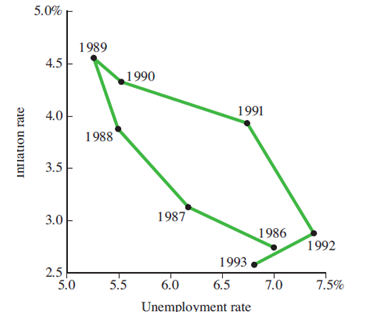
Economists believe that the natural rate of unemployment changes over time, although they often have difficulty pinning down an exact estimate. Policymakers need to have an accurate assessment of the natural rate to avoid any unnecessary unemployment or prevent inflation from emerging. But how can
On May 6, 1997, the then-chancellor of the exchequer in Great Britain, Gordon Brown, announced a major change in monetary policy. From that time forward, the Bank of England would be more independent from the government. Although the government would still retain the authority to set the overall
In June 2008 the consumer price index in Zimbabwe was 8 million percent higher than it was a year before. A $12 lunch in local currency cost 1.1 trillion Zimbabwe dollars. What caused Zimbabwe to suffer from this crippling hyperinflation? The simple answer is that the political and economic system
1. The expected real rate of interest is the nominal interest rate minus the expected inflation rate. ____________(True/False)2. Countries with higher rates of money growth have____________ interest rates.3. If the growth rate of money increases from 3 to 5 percent, initially interest rates will
1. If inflation increases less than expected, the actual unemployment rate will be ________ (above/below) the natural rate.2. Robert E, Lucas, Jr., explained business cycles by rules of thumb._____ (True/False)3. The increase in the fraction of young people in the labor force that occurred when the
1. An aggressive union will shift the aggregate supply curve_________, causing prices to and real GDP to ________.2. In the face of an upward shift in the aggregate supply curve, the Fed can increase the supply of money. This will prevent a recession, but will cause an increase in _________.3. The
Showing 2200 - 2300
of 28054
First
16
17
18
19
20
21
22
23
24
25
26
27
28
29
30
Last
Step by Step Answers

 Get 50% OFF
Claim Now
Get 50% OFF
Claim Now


.png)
-1.png)
-2.png)
-3.png)
-1.png)
-2.png)
-3.png)
.png)
.png)
.png)
.png)
.png)
.png)
-1.png)
-2.png)
-1.png)
-2.png)
.png)
.png)
.png)
-1.png)
-2.png)
.png)
.png)
.png)
.png)
.png)