







Question: Conductivity sum rule and super conductivity we write the electrical conductivity as ?(w) = ?' ( w ) + i?'' (w) where ?', ? are
Conductivity sum rule and super conductivity we write the electrical conductivity as ?(w) = ?' (w) + i?'' (w) where ?', ?" are real.?
(a) Show by a Kramer?s- Kronig relation that
This result is used m the theory of super conductivity. If at very high frequencies (such as x-ray frequencies) ?"(w) is identical for the superconducting and normal states, then we must have but at frequencies 0 nwg. ?There must be an additional contribution to aj to balance this deficiency.?
(b) Show that if ?'s (w g) n (w g), as is observed experimentally, then ??s (w) car1 have a delta function contribution at w = 0, and from the delta function there is a contribution ?''s (w) = ?'n?wg/w. The delta function corresponds to infinite conductivity at zero frequency.?
(c) By elementary consideration of the classical motion of conduction electrons at very high frequencies, show that result found by Ferrell and Glover.
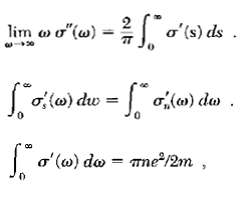
lim wo" (w) 255 o'(s) ds. ["0" (w) dw = f* ; (e) des [*o' (w) dw = mne /2m,
Step by Step Solution
3.47 Rating (173 Votes )
There are 3 Steps involved in it
a From 11 we have o 0 200 T ds In the limit the denominator comes ... View full answer

Get step-by-step solutions from verified subject matter experts
Document Format (1 attachment)

14-P-S-S-G-P (110).docx
120 KBs Word File
 Study Help