







Question: Consider a rigid body of arbitrary shape which is attached at its mass center O and subjected to no force other than its weight and
(a) Prove that the angular momentum HO of the body about the fixed point O is constant in magnitude and direction, that the kinetic energy T of the body is constant, and that the projection along HO of the angular velocity ω of the body is constant.
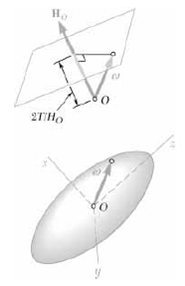
(b) Show that the tip of the vector ω describes a curve on a fixed plane in space (called the invariable plane), which is perpendicular to HO and at a distance 2T/HO from O.
(c) Show that with respect to a frame of reference attached to the body and coinciding with its principal axes of inertia, the tip of the vector ω appears to describe a curve on an ellipsoid of equation Ixω2x + Iyω2y + Izω2z = 2T= constant. The ellipsoid (called the Poinsot ellipsoid) is rigidly attached to the body and is of the same shape as the ellipsoid of inertia, but of a different size.
,
Step by Step Solution
3.39 Rating (165 Votes )
There are 3 Steps involved in it
a From Equation 1827 Conservation of energy Since For a rigid bod... View full answer

Get step-by-step solutions from verified subject matter experts
Document Format (1 attachment)

4-E-M-E-VM (2705).docx
120 KBs Word File
 Study Help