







Question: Falling-cylinder viscometer (see Fig. 2C.4) A falling-cylinder viscometer consists of a long vertical cylindrical container (radius R), capped at both ends, with a solid cylindrical
Falling-cylinder viscometer (see Fig. 2C.4) A falling-cylinder viscometer consists of a long vertical cylindrical container (radius R), capped at both ends, with a solid cylindrical slug (radius KR). The slug is equipped with fins so that its axis is coincident with that of the tube. One can observe the rate of descent of the slug in the cylindrical container when the latter is filled with fluid. Find an equation that gives the viscosity of the fluid in terms of the terminal velocity v0 of the slug and the various geometric quantities shown in the figure.
(a) Show that the velocity distribution in the annular slit is given by in which s c = r/R is a dimensionless radial coordinate.
(b) Make a force balance on the cylindrical slug and obtain in which p and P0 are the densities of the fluid and the slug, respectively.
(c) Show that, for small slit widths, the result in (b) may be expanded in powers of ε = 1 – k to give See SC.2 for information on expansions in Taylor series.
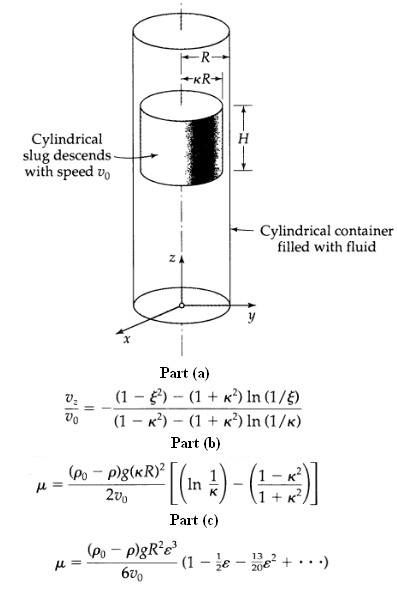
FR- +KR- Cylindrical slug descends with speed vo Cylindrical container filled with fluid ZA Part (a) (1 ) - (1 + K) In (1/) (1 x) (1 + K) In (1/k) Part (b) ()-(4-=) (po p)g(R)? In 2v, Part (c) (Po p)gRe (1 e - e + ) 20 6v,
Step by Step Solution
3.38 Rating (176 Votes )
There are 3 Steps involved in it
Fallingcylinder viscometer a Equation 242 is valid for this problem but the pressure difference is n... View full answer

Get step-by-step solutions from verified subject matter experts
Document Format (1 attachment)

6-E-C-E-T-P (35).docx
120 KBs Word File
 Study Help