







Question: Figure shows details of a finger in the crimp hold of the climber in Figure. A tendon that runs from muscles in the forearm is
Figure shows details of a finger in the crimp hold of the climber in Figure. A tendon that runs from muscles in the forearm is attached to the far bone in the finger. Along the way, the tendon runs through several guiding sheaths called pulleys. The A2 pulley is attached to the first finger bone; the A4 pulley is attached to the second finger bone. To pull the finger toward the palm, the forearm muscles pull the tendon through the pulleys; much like strings on a marionette can be pulled to move parts of the marionette. Figure is a simplified diagram of the second finger bone, which has length d. The tendon's pull F on the bone acts at the point where the tendon enters the, A4 pulley, at distance d/3 along the bone. If the force components on each of the four crimped fingers in Figure are Fh = 13.4 N and Fy = 162.4 N, what is the magnitude of F1? The result is probably tolerable, but if the climber hangs by only one or two fingers, the A2 and A4 pulleys can be ruptured, a common ailment among rockclimbers.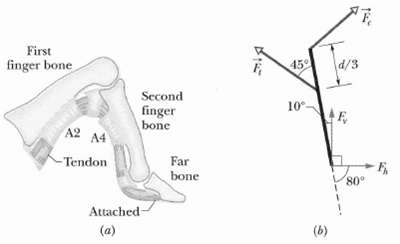
First finger bone Second finger bone 10 A2 A4 - Tendon Far bone 80 Attached (a) (b)
Step by Step Solution
3.39 Rating (161 Votes )
There are 3 Steps involved in it
Our system is the second finger bone Since the system is in static equilibrium ... View full answer

Get step-by-step solutions from verified subject matter experts
Document Format (1 attachment)

2-P-M-EE (264).docx
120 KBs Word File
 Study Help