



Question: Figure shows an overhead view of two particles sliding at constant velocity over a frictionless surface. The particles have the same mass and the same
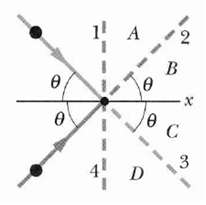
Figure shows an overhead view of two particles sliding at constant velocity over a frictionless surface. The particles have the same mass and the same initial speed v = 4.00 m/s, and they collide where their paths intersect. An x axis is arranged to bisect the angle between their incoming paths, so that θ = 40.0o. The region to the right of the collision is divided into four lettered sections by the x axis and four numbered dashed lines. In what region or along what line do the particles travel if the collision is?
(a) Completely inelastic,
(b) Elastic, and
(c) Inelastic? What are their final speeds if the collision is
(d) Completely inelastic and
(e) Elastic?
B D
Step by Step Solution
3.33 Rating (153 Votes )
There are 3 Steps involved in it
a This is a highly symmetric collision and when we analyze the ycomponents of momentum we find their ... View full answer

Get step-by-step solutions from verified subject matter experts
Document Format (1 attachment)

2-P-M-L-M (284).docx
120 KBs Word File