







Question: For the nylon polymer, whose stress strain behavior may be observed in the Tensile Tests module of Virtual Materials Science and Engineering (VMSE), determine the
For the nylon polymer, whose stress strain behavior may be observed in the "Tensile Tests" module of Virtual Materials Science and Engineering (VMSE), determine the following:
(a) The yield strength, and
(b) The approximate ductility, in percent elongation.
How do these values compare with those for the nylon material presented in Table15.1?
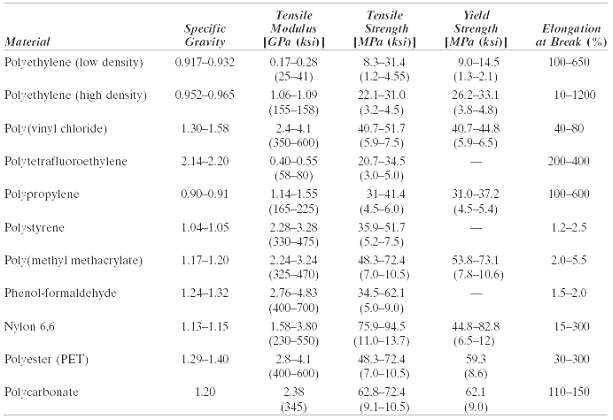
Tensile Modulus |GPa (ksi)| Tensile Yield Specific Gravity Strength |MPa (ksi) Strength [MPa (ksi)| Elongation at Break (%) Material Polyethylene (low density) 0.917-0,032 0.17-0.28 (25-41) 8.3-31.4 (1.2-4.55) 0.0-14.5 (1.3-2.1) 100-650 1.06-1.09 (155-158) 0.952-0,965 26.2-33.1 10-1200 Polyethylene (high density) 22.1-31.0 (3.2-4.5) (3.8-4.8) Poly (vinyl chloride) 40-80 1.30-1.58 2.4-4.1 40.7-51.7 40.7-44.8 (350-600) (5.9-7.5) (5.9-6.5) Polytetrafluoroethylene 2.14-2.20 0.40-0.55 20.7-34.5 200-400 (58-80) (3.0-5.0) Polypropylene 0.90-0.91 1.14-1.55 31-41.4 31.0-37.2 100-600 (165-225) (4.5-6.0) (4.5-5.4) Polystyrene 1.2-2.5 1.04-1.05 2.28-3.28 35.9-51.7 (330-475) (5.2-7.5) Poly(methyl methacrylate) 1.17-1.20 2.24-3.24 (325-470) 48.3-72.4 (7.0-10.5) 53.8-73.1 2.0-5.5 (7.8-10.6) Phenol-formaldehyde 1.24-1.32 2.76-4.83 34.5-62.1 1.5-2.0 (400-700) (5.0-9.0) 1.58-3.80 Nylon 6,6 L.13-1.15 75.9-94.5 44.8-82.8 15-300 (230-550) (11.0-13.7) (6.5-12) Polyester (PET) 1.29-1.40 30-300 2.8-4.1 (400-600) 48.3-72.4 (7.0-10.5) 59.3 (8.6) Polcarbonate 1.20 2.38 62.8-72.4 62.1 110-150 (345) (9.1-10.5) (9.0)
Step by Step Solution
3.40 Rating (178 Votes )
There are 3 Steps involved in it
a The yield strength corresponds to the first maximum just beyond the initial linearelastic region o... View full answer

Get step-by-step solutions from verified subject matter experts
Document Format (1 attachment)

33-E-M-S-E-M-S (563).docx
120 KBs Word File
 Study Help