







Question: In a queuing system, new jobs must wait for a while before being served. While a job waits, its priority increases linearly with time from
In a queuing system, new jobs must wait for a while before being served. While a job waits, its priority increases linearly with time from zero at a rate α. A job waits until its priority reaches the priority of the jobs in service; then, it begins to share the processor equally with other jobs in service using round robin while its priority continues to increase at a slower rate β. The algorithm is referred to as selfish round robin, because the jobs in service try (in vain) to monopolize the processor by increasing their priority continuously.
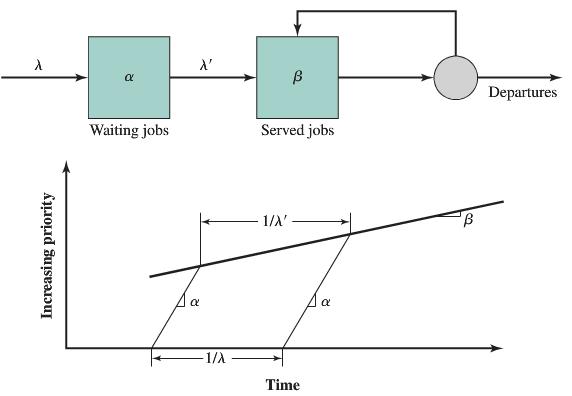
Use Figure to show that the mean response time Rx for a job of service time x is given by:
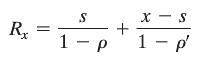
Where

Assuming that arrival and service times are exponentially distributed with means 1/λ and s, respectively.
X' Departures Waiting jobs Served jobs 1/A' Time
Step by Step Solution
3.44 Rating (154 Votes )
There are 3 Steps involved in it
First we need to clarify the significance of the parameter The rate at which items arrive at the fir... View full answer

Get step-by-step solutions from verified subject matter experts
Document Format (1 attachment)

451-C-S-D-B-O-S (165).docx
120 KBs Word File
 Study Help