



Question: In a game of billiards, ball A is given an initial velocity v0 along the longitudinal axis of the table. It hits ball B and
In a game of billiards, ball A is given an initial velocity v0 along the longitudinal axis of the table. It hits ball B and then ball C, which are both at rest. Balls A and C are observed to hit the sides of the table squarely at A?? and C??, respectively, and ball B is observed to hit the side obliquely at B??. Knowing that v0 = 4 m/s, vA =1.92 m/s, and a = 1.65 m, determine (a) The velocities vB and vC of balls B and C, (b) The point C?? where ball C hits the side of the table. Assume frictionless surfaces and perfectly elastic impacts (that is, conservation of energy).
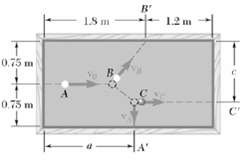
0.75 m 0.75 m 1.8 m B' 1.2 m ("
Step by Step Solution
3.43 Rating (172 Votes )
There are 3 Steps involved in it
Velocities in ms Lengths in meters Assume masses are 10 f... View full answer

Get step-by-step solutions from verified subject matter experts
Document Format (1 attachment)

4-E-M-E-VM (1960).docx
120 KBs Word File