







Question: In this problem we derive the formulas used to compute the power spectra of Figure for the five Line codes described in Section 3.7. In
In this problem we derive the formulas used to compute the power spectra of Figure for the five Line codes described in Section 3.7. In the case of each line code, the bit duration is Tb and the pulse amplitude A is conditioned to normalize the average power of the line code o unity as indicated in Figure. Assume that the data stream is randomly generated, and symbols 0 and 1 are equally likely.
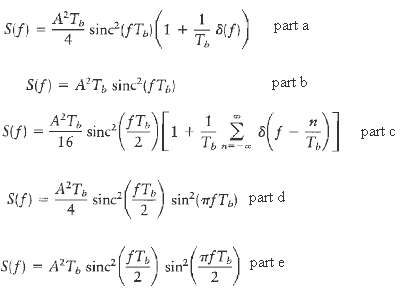
Derive the power spectral densities of these line codes as summarized here:
(a) Unipolar non-return-to-zero signals:
(b) Polar non-return-to-zero signals:
(c) Unipolar return-to-zero signals:
(d) Bipolar return-to-zero signals:
(e) Manchester-encoded signals: Hence, confirm the spectral plots displayed inFigure.
A'T, sinetfT(1 + B) Sif) = part a 4 Sif) = A'T, sinc (ST) part b A'T, sinc 16 fTb |1 + To Sf) part c A'T fT sin (mfT) part d Sf) =4 sinc fTB S(f) = A'T, sinc nf T sin part e
Step by Step Solution
3.48 Rating (168 Votes )
There are 3 Steps involved in it
In general a line code can be represented as N st angtnTp nN Let g1 Gf We may then define the Fourier transform of st as N Sf a Gfe nN jonT S f N Gf ane nN where w 2nf The power spectral density of s1 ... View full answer

Get step-by-step solutions from verified subject matter experts
Document Format (1 attachment)

19-E-T-E-C-S (257).docx
120 KBs Word File
 Study Help