







Question: Let (X, Y,Z) be the position of an object's CM, and let (x, y, z) be the position relative to the CM. Prove the parallel-axis
Let (X, Y,Z) be the position of an object's CM, and let (x, y, z) be the position relative to the CM. Prove the parallel-axis theorem, equation. (8.17), by setting x = X + x, y = Y + y, and z = Z + z in equation.(8.8).
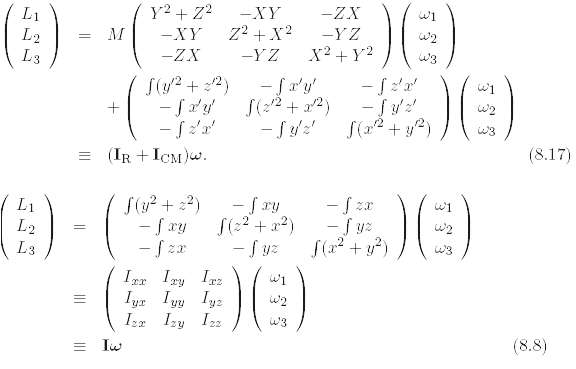
Y2 + Z2 L1 L2 L3 -ZX -XY w1 Z2 + X? -XY -YZ X2 + Y2 -ZX -YZ w3 - S'y' S(:2 + a2) - Sy/2' S(? + ) - fa'y - fr' = (IR + ICM)w. - Sy2 S(22 + y2) (8.17) (E) S(1? + 22) - f ry - f zx - fyz S(? + y?) -fry S(22 +x2) L1 w1 L2 L3 Iyx Iny Iz Iyr Iyy Iyz Iz Izy Izz w3 = Iw (8.8)
Step by Step Solution
3.32 Rating (161 Votes )
There are 3 Steps involved in it
Consider one of the diagonal entries in I say I11 f y 2 In terms of the new variables this equals ... View full answer

Get step-by-step solutions from verified subject matter experts
Document Format (1 attachment)

36-P-M-A-M (202).docx
120 KBs Word File
 Study Help