







Question: Let X 1 ,¦, X n be independent identically distributed (i.i.d.) r.v.s defined on the probability space (W, A , P ) and having d.f.
LetX1,€¦,Xnbe independent identically distributed (i.i.d.) r.v.s defined on the probability space (W,A,P) and having d.f.F. LetFnbe empirical d.f. defined in terms of theXis; i.e.,
![Fn(x, w) = -[number of X1(@), ..., X„(@) < x], п](https://dsd5zvtm8ll6.cloudfront.net/si.question.images/images/question_images/1542/8/8/0/2205bf67bdcc40451542880220376.jpg)
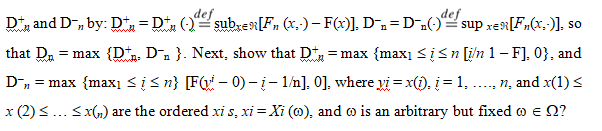
Then show that

is a r.v. That is, although Dn(×) is arrived at through non-countable operations, it is still a r.v.
Define
Fn(x, w) = -[number of X1(@), ..., X(@) < x],
Step by Step Solution
★★★★★
3.44 Rating (180 Votes )
There are 3 Steps involved in it
1 Expert Approved Answer
Step: 1 Unlock

Consider the quantities D n D n D n and y i i 1 n mentioned in the hint ... View full answer
Question Has Been Solved by an Expert!
Get step-by-step solutions from verified subject matter experts
Step: 2 Unlock
Step: 3 Unlock
Document Format (1 attachment)

742-M-S-P (6948).docx
120 KBs Word File
 Study Help