







Question: Electromagnetic waves propagate much differently in conductors than they do in dielectrics or in vacuum. If the resistivity of the conductor is sufficiently low (that
Electromagnetic waves propagate much differently in conductors than they do in dielectrics or in vacuum. If the resistivity of the conductor is sufficiently low (that is, if it is a sufficiently good conductor), the oscillating electric field of the wave gives rise to an oscillating conduction current that is much larger than the disp1acement current. In this case, the wave equation for an electric field E(x, t) = E,(x, t)J propagating in the +x-direction within a conductor is where ? is the permeability of the conductor and p is its resistivity.(a) A solution to this wave equation is where kc = ?w?/2p. Verify this by substituting E, (x, t) into the above wave equation.(b) The exponential term shows that the electric field decreases in amplitude as it propagates. Explain why this happens.(c) Show that the electric field amplitude decreases by a factor of 1/e in a distance 1/kc = ?2plw?, and calculate this distance for a radio wave with frequency f = 1.0 MHz in copper (resistivity 1.72 x 10⁻⁸ ? ? m; permeability ? = ?0). Since this distance is so short, electromagnetic waves of this frequency can hardly propagate at all into copper. Instead, they are reflected at the surface of the metal. This is why radio waves cannot penetrate through copper or other metals, and why radio reception is poor inside a metal structure.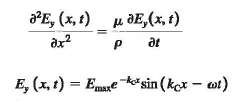
aE, (x, t) E,(x, t) ax P at E, (x, t) Emaxeosin (kex-cot)
Step by Step Solution
3.42 Rating (171 Votes )
There are 3 Steps involved in it
IDENTIFY and SET UP Follow the steps specified in the problem EXECUTE ... View full answer

Get step-by-step solutions from verified subject matter experts
Document Format (1 attachment)

P-E-E-W (185).docx
120 KBs Word File
 Study Help