







Question: Purchasing Department cost drivers, activity-based costing, simple regression analysis. Fashion Flair operates a chain of 10 retail department stores. Each department store makes its own
Purchasing Department cost drivers, activity-based costing, simple regression analysis. Fashion Flair operates a chain of 10 retail department stores. Each department store makes its own purchasing decisions. Barry Lee, assistant to the president of Fashion Flair, is interested in better understanding the drivers of Purchasing Department costs. For many years, Fashion Flair has allocated Purchasing Department costs to products on the basis of the dollar value of merchandise purchased. A $100 item is allocated 10 times as many overhead costs associated with the Purchasing Department as a $10 item.
Lee recently attended a seminar titled “Cost Drivers in the Retail Industry.” In a presentation at the seminar, Couture Fabrics, a leading competitor that has implemented activity-based costing, reported number of purchase orders and number of suppliers to be the two most important cost drivers of Purchasing Department costs. The dollar value of merchandise purchased in each purchase order was not found to be a significant cost driver. Lee interviewed several members of the Purchasing Department at the Fashion Flair store in Miami. They believed that Couture Fabrics’s conclusions also applied to their Purchasing Department Lee collects the following data for the most recent year for Fashion Flair’s 10 retail department stores:
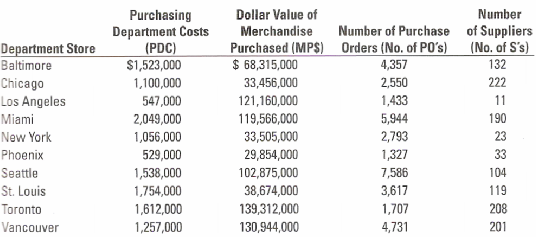
Lee decides to use simple regression analysis to examine whether one or more of three variables (the last three columns in the table) are cost drivers of Purchasing Department costs. Summary results for these regressions are as follows:
Regression 1: PDC = a + (b × MP$)

Regression 2: PDC = a + (b × No. of P0’s)

Regression 3: PDC = a + (b × No. of S’s)

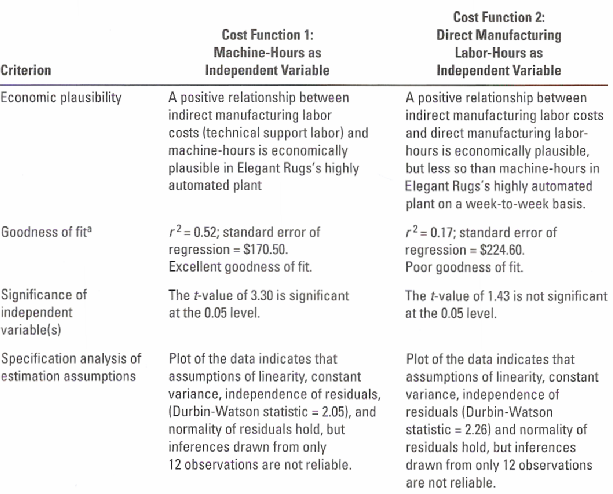
1. Compare and evaluate the three simple regression models estimated by Lee. Graph each one. Also, use the format employed in Exhibit 10-18 to evaluate the information.
2. Do the regression results support the Couture Fabrics’s presentation about the Purchasing Department’s cost drivers? Which of these cost drivers would you recommend in designing an ABC system?
3. How might Lee gain additional evidence on drivers of Purchasing Department costs at each of Fashion Flair’s stores?
Purchasing Department Costs (PDC) $1,523,000 Dollar Value of Number Number of Purchase of Suppliers (No. of S's) Merchandise Department Store Baltimore Purchased (MPS) $ 68,315,000 Orders (No. of PO's) 4,357 132 33,456,000 121,160,000 119,566,000 33,505,000 29,854,000 2,550 222 Chicago Los Angeles 1,100,000 1,433 547,000 11 5,944 190 Miami 2,049,000 New York 2,793 23 1,056,000 1,327 7,586 3,617 1,707 33 Phoenix 529,000 Seattle St. Louis 1,538,000 102,875,000 104 38,674,000 139,312,000 130,944,000 119 1,754,000 208 Toronto 1,612,000 Vancouver 1,257,000 4,731 201
Step by Step Solution
3.33 Rating (186 Votes )
There are 3 Steps involved in it
Purchasing Department cost drivers activitybased costing simple regression analysis The problem reports the exact tvalues from the computer runs of th... View full answer

Get step-by-step solutions from verified subject matter experts
Document Format (1 attachment)

24-B-C-A-C-B-M (55).docx
120 KBs Word File
 Study Help