







Question: Before starting this problem, you should consult the customer master data record layout in Figure 5.2. Using the database software indicated by your instructor: a.
Before starting this problem, you should consult the customer master data record layout in Figure 5.2.
Using the database software indicated by your instructor:
a. Create the “structure” for the records in the customer data. Use Figure 5.2 as a general guide to the data elements to be included in the customer records. However, observe the following specific requirements:
(1) For the customer address, use five separate fields, one each for street address, additional address information (e.g., apartment number), city, state, and ZIP code.
(2) Provide for three additional data elements that are not shown in Figure 5.2 (because they normally would be accessed from other files)—open sales orders, back orders, and accounts receivable balance.
b. If the software package supports a function to design input screens, create the screen format to be used for entering customer data.
c. Create example customer records and enter them into the database. Use a variety of names, street addresses, states, ZIP codes, open sales order amounts, accounts receivable balances, and credit limits. (The number of records will be indicated by your instructor.)
d. Obtain a printout of the database records.
These problems should be completed with a database software package, such as Access. For Problems 5-1 through 5-3, you may use data that you (or your instructor) have downloaded from an accounting database. Problem 5-4 provides an alternative to Problems 5-1 through 5-3 by using the database structure and sample data from Figure 5.10. This problem also may be completed using the software of your choosing.
Figure 5.2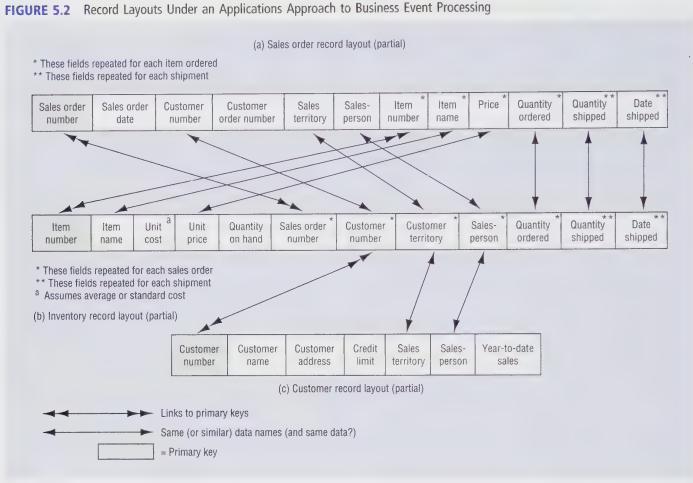
Figure 5.10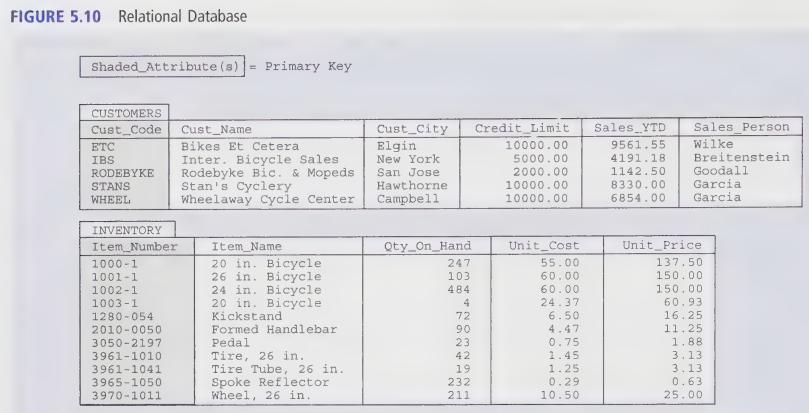
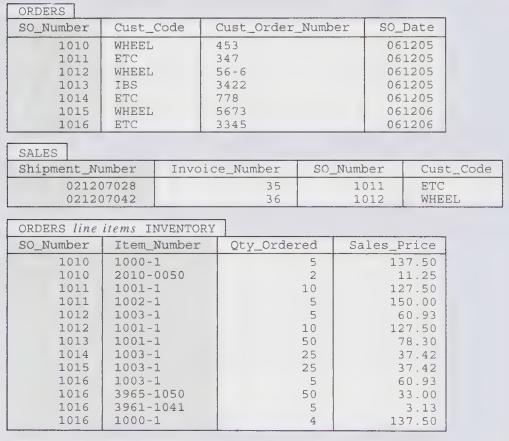

Problem 5-4
Using the database structure and sample data in Figure 5.10 as a starting point, complete the requirements of Problems 5-1 through 5-3 (or whatever portions of those problems your instructor may indicate).
FIGURE 5.2 Record Layouts Under an Applications Approach to Business Event Processing (a) Sales order record layout (partial) *These fields repeated for each item ordered ** These fields repeated for each shipment Sales order number Item number Sales order Customer date number Item Unit Unit name cost price *These fields repeated for each sales order ** These fields repeated for each shipment 3 Assumes average or standard cost (b) Inventory record layout (partial) Customer Sales Sales- Item order number territory Customer number Quantity on hand Sales order number Item person number name Customer name: Customer Customer number territory Price Quantity ordered Customer Credit Sales Sales- Year-to-date limit territory person address sales (c) Customer record layout (partial) Links to primary keys Same (or similar) data names (and same data?) Primary key Quantity Date shipped shipped Sales- Quantity Quantity Date person ordered shipped shipped
Step by Step Solution
3.50 Rating (150 Votes )
There are 3 Steps involved in it
The solutions provided by your students will vary depending on which database ... View full answer

Get step-by-step solutions from verified subject matter experts
 Study Help