







Question: Gausss hypergeometric ODE is (15) x(1 x)y + [c (a + b + 1)x]y' aby = 0. a(a + 1)b(b + 1) 2! c(c +
Gauss€™s hypergeometric ODE is

Here, a, b, c are constants. This ODE is of the form P2y" + P1y' + P0y = 0, where P2, P1, P0 are polynomials of degree 2, 1, 0, respectively. These polynomials are written so that the series solution takes a most practical form, namely,
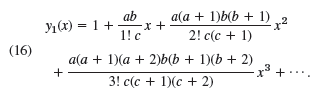
This series is called the hyper geometric series. Its sum y1(x) is called the hyper geometric function and is denoted by F(a, b, c; x). Here, c ‰ 0, -1, -2, . . . By choosing specific values of a, b, c we can obtain an incredibly large number of special functions as solutions of (15). This accounts for the importance of (15).
(a) Convergence. For what a or b will (16) reduce to a polynomial? Show that for any other a, b, c (c ‰ 0, -1, -2,. . .) the series (16) converges when |x|
(b) Show that
![(15) x(1 x)y" + [c (a + b + 1)x]y' aby =](https://dsd5zvtm8ll6.cloudfront.net/si.question.images/images/question_images/1542/1/0/4/3355beaa50f934a41542032905286.jpg)
Find more such relations from the literature on special functions.
(c) Show that for r2 = 1 - c the Frobenius method yields the following solution (where c ‰ 2, 3, 4, . . . ):
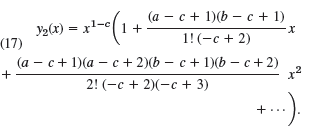
Show that

(15) x(1 x)y" + [c (a + b + 1)x]y' aby = 0. a(a + 1)b(b + 1) 2! c(c + 1) ala + 1)(a + 2)b(b + 1)(b + 2) 3! c(c + 1)(c + 2) y, (x) = 1+ x + (16) ab 1! c x* +....
Step by Step Solution
3.43 Rating (166 Votes )
There are 3 Steps involved in it
a In 11b of Sec 51 hence R 1 b In the third ... View full answer

Get step-by-step solutions from verified subject matter experts
 Study Help