







Question: What is the system in Example 1.3? Example 1.3 With respect to Figure 1.1, consider the two parallel flat surfaces spaced 1 mm apart, with
What is the "system" in Example 1.3?
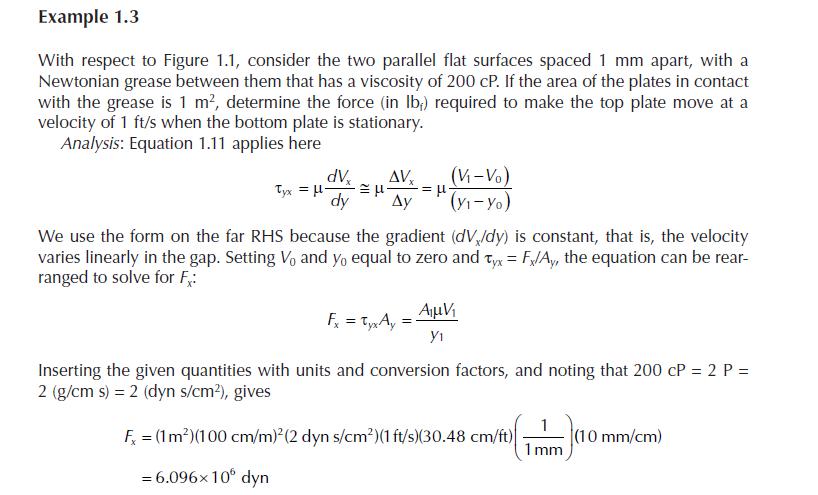
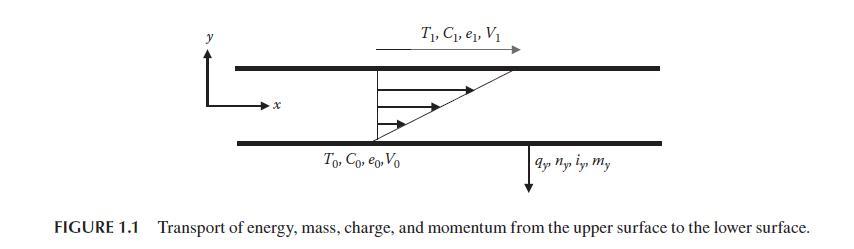

Example 1.3 With respect to Figure 1.1, consider the two parallel flat surfaces spaced 1 mm apart, with a Newtonian grease between them that has a viscosity of 200 CP. If the area of the plates in contact with the grease is 1 m, determine the force (in lb) required to make the top plate move at a velocity of 1 ft/s when the bottom plate is stationary. Analysis: Equation 1.11 applies here dVx AVX Tyx - dy Ay - (V-Vo) (y-Yo) We use the form on the far RHS because the gradient (dVx/dy) is constant, that is, the velocity varies linearly in the gap. Setting Vo and yo equal to zero and tx = FX/Ay, the equation can be rear- ranged to solve for Fx: Fx = Tyx Ay AV Inserting the given quantities with units and conversion factors, and noting that 200 cP = 2 P = 2 (g/cm s) = 2 (dyn s/cm), gives Fx (1m)(100 cm/m)2(2 dyn s/cm)(1 ft/s)(30.48 cm/ft)| (10 mm/cm) 1 mm = 6.09610 dyn
Step by Step Solution
There are 3 Steps involved in it

Get step-by-step solutions from verified subject matter experts
 Study Help