







Question: Use the fitted model from the previous exercise to compute the linear trend coefficient [ frac{sum tleft(hat{gamma}_{1}(t)-hat{gamma}_{0}(t)ight)}{sum t^{2}} ] and its standard error. You should
Use the fitted model from the previous exercise to compute the linear trend coefficient
\[
\frac{\sum t\left(\hat{\gamma}_{1}(t)-\hat{\gamma}_{0}(t)ight)}{\sum t^{2}}
\]
and its standard error. You should find both numbers in the range \(0.013-0.015\) per month, similar to, but not exactly the same as those reported in the text.
Data From previous exercise
According to the text in Sect. 5.5, Virtual randomization requires the timezero average for feral hosts to be the same as that for giant runts, but the temporal trends are otherwise unconstrained. It appears that the model matrix spanning this subspace is not constructible using factorial model formulae. Explain how to construct the desired matrix including a constant additive sex effect. What is its rank? Fit the model as described in the text following Table 5.4. Include independent Brownian motions for aviaries and lineages, plus an additional baseline error term with independent and identically distributed components.
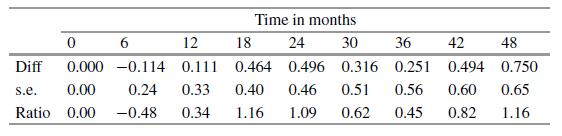
0 Diff 0.000 s.e. 0.00 Ratio 0.00 Time in months 24 6 12 18 -0.114 0.111 0.464 0.24 0.33 0.40 -0.48 0.34 1.16 30 36 42 48 0.496 0.316 0.251 0.494 0.750 0.46 0.51 0.56 0.60 0.65 1.09 0.62 0.45 0.82 1.16
Step by Step Solution
3.32 Rating (158 Votes )
There are 3 Steps involved in it
To compute the linear trend coefficient and its standard error using the provided formula and data we first need to understand what each symbol repres... View full answer

Get step-by-step solutions from verified subject matter experts
 Study Help