







Question: Order Statistics. Let X 1 , X 2 , ¦. X n be a random sample of size n from X, a random variable having
Order Statistics. Let X1, X2, €¦. Xnbe a random sample of size n from X, a random variable having distribution function F(x). Rank the elements in order of increasing numerical magnitude, resulting in X(1), X(2),€¦, X(n), where X(1)is the smallest sample element (X(1)= min{X1, X2,€¦, Xn}) and X(n)is the largest sample element (X(n)= max{X1, X2,€¦, Xn}). X(i)is called the ith order statistic. Often the distribution of some of the order statistics is of interest, particularly the minimum and maximum sample values X(1)and X(n), respectively.
(a) Prove that the cumulative distribution functions of these two order statistics, denoted respectively by FX(1) (t) and FX(n) (t), are
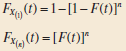
(b) Prove that if X is continuous with probability density function f (x), the probability distributions of X(1) and X(n) are
![fx(1) = n[1– F(0)]](https://dsd5zvtm8ll6.cloudfront.net/si.question.images/images/question_images/1528/6/8/9/2525b1df264e9f301528689270802.jpg)
(c) Let X1, X2,€¦, Xn be a random sample of a Bernoulli random variable with parameter p. Show that
![Fx (1) =1-[1- F(t)r Fx, (t) = [F(t))* fx(1) = n[1 F(0)]"](https://dsd5zvtm8ll6.cloudfront.net/si.question.images/images/question_images/1528/6/8/9/2535b1df26520b451528689271030.jpg)
(d) Let X1, X2,€¦, Xn be a random sample of a normal random variable with mean μ and variance σ2. Derive the probability density functions of X(1) and X(n).
(e) Let X1, X2,€¦, Xn be a random sample of an exponential random variable of parameter λ. Derive the cumulative distribution functions and probability density functions for X(1) and X(n).
Fx (1) =1-[1- F(t)r Fx, (t) = [F(t))* fx(1) = n[1 F(0)]" f) Sx,() = n[F()]*" f) %3D
Step by Step Solution
3.39 Rating (152 Votes )
There are 3 Steps involved in it
a b c d e From a pr... View full answer

Get step-by-step solutions from verified subject matter experts
 Study Help