







Question: Consider the example provided in the chapter for selecting a sample for dollar unit sampling application, where sample size is computed as (n=frac{mathrm{BV}^{*} mathrm{R} *
Consider the example provided in the chapter for selecting a sample for dollar unit sampling application, where sample size is computed as
\(n=\frac{\mathrm{BV}^{*} \mathrm{R} * \mathrm{ETF}}{(\mathrm{TEL}-\mathrm{EEL})}\)
Where:
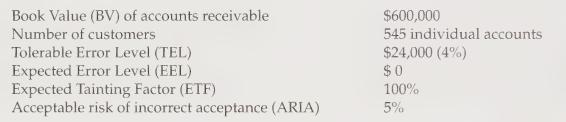
and:
\[ n=\left(B V^{*} \mathrm{R}^{*} \mathrm{ETF}\right) /(\mathrm{TEL}-\mathrm{EEL})=(\$ 600,000 \times 4.75 \times 1.00) /(\$ 24,000-\$ 0)=119 \]
Explain the rationale for why 119 "sample units" should be sufficient for the auditor to draw statistical conclusions about accounts receivable based on the results of the test(s) performed. As part of your discussion, consider the roles of TEL, EEL, ETF, and ARIA.
Book Value (BV) of accounts receivable Number of customers Tolerable Error Level (TEL) Expected Error Level (EEL) Expected Tainting Factor (ETF) Acceptable risk of incorrect acceptance (ARIA) $600,000 545 individual accounts $24,000 (4%) $0 100% 5%
Step by Step Solution
3.40 Rating (153 Votes )
There are 3 Steps involved in it

Get step-by-step solutions from verified subject matter experts
 Study Help