







Question: In Example 7, what is the decibel loss when the sound approaches the microphone 120 from the point directly in front of the microphone? Data
In Example 7, what is the decibel loss when the sound approaches the microphone 120° from the point directly in front of the microphone?
Data from Example 7
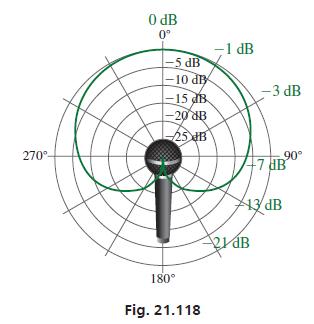
A cardioid microphone, commonly used for vocals or speech, is designed to pick up sound in front of the microphone but reject sound coming from behind the microphone. It gets its name from the fact that its polar sensitivity pattern is heart-shaped as shown in Fig. 21.118. The polar graph shows how sensitive the microphone is in picking up sound coming from different angles. The maximum sensitivity is at 0°, which is directly in front of the microphone. At other angles, the microphone is less sensitive, and therefore there is a decrease in decibels (dB). For example, at 30° to either side, there is about a 1-dB drop, and at 90°, the decrease is about 7 dB.
Polar patterns such as these are found by revolving a sound source in a circle around a microphone placed at the center and measuring the sound picked up by the microphone. Other types of microphones have circular or figure-eight shaped polar patterns. Note that 0° is located straight upward instead of toward the right as is usually done in mathematics. Also notice that the angles increase as you rotate clockwise instead of the usual counterclockwise.
270- 0 dB 0 -5 dB -10 dB -15 dB. -20 dB 25 HB 180 Fig. 21.118 -1 dB -3 dB 21 dB 13 dB 90 +7 dB
Step by Step Solution
3.45 Rating (164 Votes )
There are 3 Steps involved in it
From the given figure we can see that the decibel loss when the sound approaches the micr... View full answer

Get step-by-step solutions from verified subject matter experts
 Study Help