







Question: Solve the given problems. Use a ruler and protractor as in Examples 6 and 7. A rope holds a helium-filled balloon in place with a
Solve the given problems. Use a ruler and protractor as in Examples 6 and 7. A rope holds a helium-filled balloon in place with a tension of 510 N at an angle of 80° with the ground due to a wind. The weight (a vertical force) of the balloon and contents is 400 N, and the upward buoyant force is 900 N. The wind creates a horizontal force of 90 N on the balloon. What is the resultant force on the balloon?
Data from Example 6
Two persons pull horizontally on ropes attached to a car that is stuck in mud. One person pulls with a force of 500 N directly to the right, while the other person pulls with a force of 350 N at an angle of 40° from the first force, as shown in Fig. 9.8(a). Find the resultant force on the car.
We make a scale drawing of the forces as shown in Fig. 9.8(b), measuring the magnitudes of the forces with a ruler and the angles with a protractor. [The scale drawing of the forces is made larger and with a different scale than that in Fig. 9.8(a) in order to get better accuracy.] We then complete the parallelogram and draw in the diagonal that represents the resultant force. Finally, we find that the resultant force is about 800 N and that it acts at an angle of about 16° from the first force.
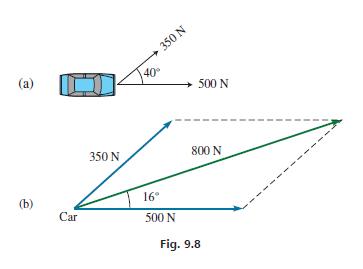
(a) (b) Car 350 N 350 N 40 16 500 N 500 N 800 N Fig. 9.8
Step by Step Solution
3.41 Rating (154 Votes )
There are 3 Steps involved in it
To solve these problems we need to use vector addition Unloading a crate with a crane Let the horizontal force exerted by the rope be F Then the verti... View full answer

Get step-by-step solutions from verified subject matter experts
 Study Help