







Question: Use the data augmentation algorithm to estimate the posterior density of the parameter n in the linkage model in question 3. Question 3. Smith (1969,
Use the data augmentation algorithm to estimate the posterior density of the parameter n in the linkage model in question 3.
Question 3.
Smith (1969, Section 21.10) quotes an example on genetic linkage in which we have observations x = (x1, x2 , x3 , x4) with cell probabilities
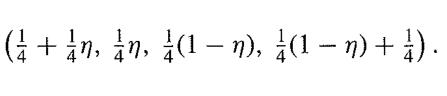 The values quoted are x1 = 461, x2 = 130, x3 = 161 and X4 = 515. Divide x1 into Y0 and Y1 and X4 into y4 and Y5 to produce augmented data y = (y0, Y1, Y2, y3, Y4, Y5) and use the EM algorithm to estimate n.
( +n, n ;( n), (1 n)+k).
Step by Step Solution
3.26 Rating (152 Votes )
There are 3 Steps involved in it
The data augmentation algorithm involves introducing unobserved or latent variables to simplify the ... View full answer

Get step-by-step solutions from verified subject matter experts
 Study Help