







Question: Using the classes from the previous problem, write the output that is produced by the following code fragment. Data from Previous Problem Assume that the
Using the classes from the previous problem, write the output that is produced by the following code fragment.
![public static void main (String [] args) { Moo [] elements {new Blue (), new Moo (), new Shoe (), new Flute () }; for (int i = 0; i < elements.length; itt) { elements [i] . method2 () ; elements [i].methodl () ; System.out.println (elements [i]); System.out..println (); }](https://dsd5zvtm8ll6.cloudfront.net/si.question.images/images/question_images/1606/9/7/8/5045fc88bc84f3731606978505424.jpg)
Data from Previous Problem
Assume that the following classes have been defined:
![public static void main (String [] args) { Moo [] elements {new](https://dsd5zvtm8ll6.cloudfront.net/si.question.images/images/question_images/1606/9/7/8/4225fc88b764c9fa1606978423167.jpg)
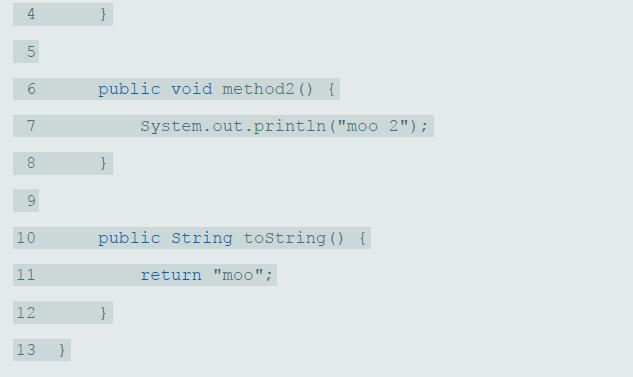
What is the output produced by the following code fragment?
![for (int i = 0; i < elements.length; itt) { elements [i]](https://dsd5zvtm8ll6.cloudfront.net/si.question.images/images/question_images/1606/9/7/8/4465fc88b8e9ae231606978448027.jpg)
public static void main (String [] args) { Moo [] elements {new Blue (), new Moo (), new Shoe (), new Flute () }; for (int i = 0; i < elements.length; itt) { elements [i] . method2 () ; elements [i].methodl () ; System.out.println (elements [i]); System.out..println (); }
Step by Step Solution
3.48 Rating (164 Votes )
There are 3 Steps involved in it
Output from FluteBlueShoeM... View full answer

Get step-by-step solutions from verified subject matter experts
 Study Help