New Semester
Started
Get
50% OFF
Study Help!
--h --m --s
Claim Now
Question Answers
Textbooks
Find textbooks, questions and answers
Oops, something went wrong!
Change your search query and then try again
S
Books
FREE
Study Help
Expert Questions
Accounting
General Management
Mathematics
Finance
Organizational Behaviour
Law
Physics
Operating System
Management Leadership
Sociology
Programming
Marketing
Database
Computer Network
Economics
Textbooks Solutions
Accounting
Managerial Accounting
Management Leadership
Cost Accounting
Statistics
Business Law
Corporate Finance
Finance
Economics
Auditing
Tutors
Online Tutors
Find a Tutor
Hire a Tutor
Become a Tutor
AI Tutor
AI Study Planner
NEW
Sell Books
Search
Search
Sign In
Register
study help
business
capital structure decision
The Capital Structure Decision 1st Edition Harold Bierman - Solutions
(Problems 4 and 5 continued) What is the net present value at time oifthe bond is convertible into 20 shares and the stock is selling at$70 per share when the bond is called at time 5?
The ABC Company has $100,000,000 of.08 convertible bonds outstanding. Each $1,000 bond is convertible into 50 shares of common stock. The common stock is paying $.90 per share per year cash dividend. The stock is selling for $70 per share. There are 500,000,000 shares outstanding.The corporate tax
Assume that:Convertible into 50 shares at any time.Stock price is now $30 a share.Call price ofbond =$1,060.Common stock dividend $1.00 per year.a. The investor (an individual) should initiate the conversion.Yes Q No Q Explain.b. The firm should call the bond. Yes Q No Q Explain.c. With the facts
Assume the call price ofa $1,000 face value convertible bond with a 20-year life is $1,084. The interest rate ofstraight debt is .10 and of the convertible is .06. Ifthe bond were called at time 2, the investor would be indifferent to having bought the convertible compared to having bought the
A $1,000 thirty-year bond paying .08 interest is convertible into 20 shares of cornmon stock. The stock price at time of issue is $40.The bond is callable at $1,050. The corporate tax rate is .35.Investors are not taxed.a. The conversion price is $____________b. The initial conversion premium is
Assume that for a convertible bond:tp=.28, te =.34, B=$1,000, Bond market price =$2,005 k=.10, Cornmon Stock Dividend =$1 per share s =40 shares, Conversion price =$25 Cornmon Stock Market Price =$50, Call Price =$1,050 Maturity: Ten yearsa. Should the investor (an individual) convert
Assume zero taxes. Equipment can be leased at $10,000 per year(first payment 1 year hence) for 10 years or purchased at a cost of$64,177. The company has a weighted average cost ofcapital of 15 percent. A bank has indicated that it would be willing to make the loan of$64,177 at a cost oflO
(Problem 1 continued). Ifthe bank was willing to lend funds at 9 percent, should the company buy or lease?
(Problem 2 continued). Ifthe company pays $64,177 for the equipment, it will save $10,000 a year lease payments for I°years.Comparing "Buy" versus "Lease", what internal rate ofreturn will it earn on its "investment"?
(Problem 1 continued). Now assume a marginal tax rate of .4.Assume that the funds can be obtained for .10 at a bank. The company uses sum-of-the-years' digits depreciation for taxes.Should the firm buy or lease? (Assume that the present value ofthe depreciation deductions is .79997 per dollar of
(Problem 1 continued). Now assume a marginal tax rate of.4 and that a loan can be obtained from the bank at a cost of.09.Should the fIrm buy or lease? Using .054, the present value of depreciation is .811. Use .054 as the discount rate.
(Problem 5 continued). Assume that the lease payments of$10,000 start immediately and that they are paid at the end of each year.There are 10 payments.Compute the present value of leasing: compare the present value with the present value ofleasing obtained for Problem 5.
Assume that there is a .4 marginal tax rate. An asset with a life of three years can be bought for $25,313 or leased for $10,000 per year. Funds can be borrowed at a cost of.09 (payments of SIO,OOO per year).a. What is the present value ofthe debt (the liability) ifthe funds are $10,000 per year.b.
(Problem 5 continued)a. Include the borrowing cash flows in the buy analysis. Assume equal ($10,000) payments of debt. How does this change the net cost if.054 is used as the discount rate?b. Assume that the net cost ofbuying was computed using the cost ofcapital of 15 percent. Now include the
Consider the following investment:There are zero taxes.If debt can be obtained at a cost of 5 percent, determine the net present value ofthe equity cash flows discounted at 15 percent ifa. No debt is used to finance the investment.b. $500 ofdebt is used to finance the investment.c. $900 ofdebt is
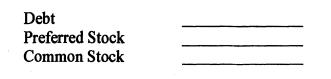
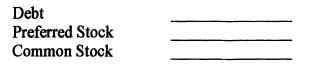
The tax rate for the Tompkins Corporation is .34.The firm has a capital structure of .4 debt, .1 preferred stock, and .5 common stock.a. Complete the above table assuming the "before corporate tax cost"colwnn is correct.b. Compute the after tax weighted average cost of capital ofthe firm, with the
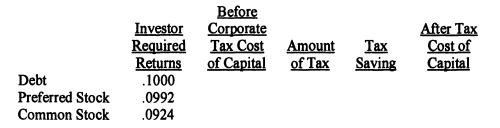
Complete the following table consistent with u.S. tax law and a .34 corporate tax rate. Investor Before Corporate Required Tax Cost Returns of Capital Amount of Tax Tax Saving Debt .1000 Preferred Stock .0992 Common Stock .0924 After Tax Cost of Capital
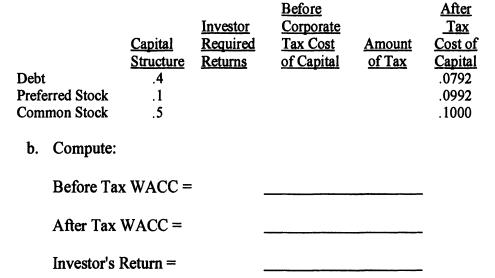
a. Complete the following table consistent with a .34 corporate tax rate. Investor Before Corporate Capital Required Tax Cost Amount After Tax Cost of Structure Returns of Capital of Tax Capital .0792 .0992 .1000 Debt .4 Preferred Stock .1 Common Stock .5 b. Compute: Before Tax WACC = After Tax
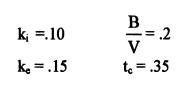
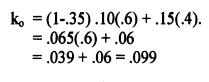
Assume that for a fIrm the following facts and estimates apply and area accepted:The CFO thinks that the capital structure should be B/V = .6, and has made the following calculations for WACC:Briefly evaluate the calculation. k =.10 k.=.15 BI = .2 V te=.35
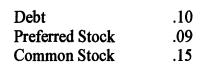
The following table has been prepared for the president ofthe finn.Only bond interest is deductible for income taxes. The finn has a capital structure of.4 debt, .1 preferred stock and .5 common stock.Assume the corporate tax rate is .40.Compute the weighted average cost ofcapital ofthe finn, with
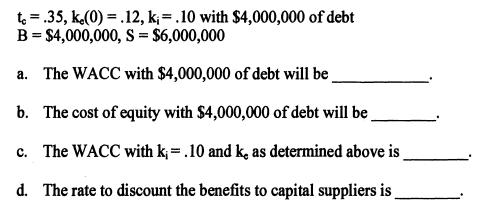
Assume that: t.=.35, k,(0) = .12, k = .10 with $4,000,000 of debt = B $4,000,000, S = $6,000,000 a. The WACC with $4,000,000 of debt will be b. The cost of equity with $4,000,000 of debt will be c. The WACC with k = .10 and ke as determined above is d. The rate to discount the benefits to capital
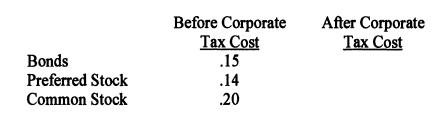
Assume the investors require the following expected returns (before investor tax):The corporate tax rate is .34 and the investor's tax rate is .28.a. The corporation has to earn, before corporate tax the following returns for each type ofcapital:b. The corporation will have after tax (corporate
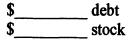
The XYZ company has 20,000 shares of common outstanding selling at$70 per share. It has a .35 tax rate. It has decided to issue $350,000 of debt and use all the proceeds to repurchase shares (at a price of$70).a. The value of Vu is $____________.b. The value of the firm after the debt issuance and
Assume an unlevered firm with a value of $100,000,000 and a cost of equity of.10. The corporate rate is ____________.35. There are zero investor taxes.Assume $80,000,000 of .08 debt is substituted for stock (the debt is given to the shareholders).a. The WACC of the levered firm is %.b. Assume the
The WACC with zero debt is .10. The corporate tax rate is .35. Assume$300 of .09 debt is issued and the new value of the firm (VL) is $755.The new cost of equity is .1043.What is the new WACC?
I. If with a substitution of debt for common stock then with no taxes and no costs offinancial distress the WACC will:increase decrease stay the same increase, decrease, or stay the same II. Ifdebt is substituted for stock with no taxes and no costs offinancial distress one would logically expect
There are no corporate taxes and no costs offinancial distress. ABC corporation has $1,000,000 ofcomrnon stock and $9,000,000 of.08 debt (market value).Assume that .20 ofan unlevered firm (XYZ) with identical operating characteristics can be purchased for $2,800,000.What investment strategy do you
(continue 2)Assume the firm earns $1,100,000.What would the investor have earned with XYZ investment?What did the investor earn with ABC?
(continue 2)Now assume the unlevered firm (XYZ) has common stock selling for$9,000,000. The investor can borrow at .08.The investor likes the leverage ofABC.What investment strategy do you recommend if the investor wants to invest in the stock ofone ofthe two firms?
(continue 2)Assume both ABC and XYZ earn $1,200,000 before interest.What does the investor in .20 ofthe equity ofABC earn?What does the investor in .20 of XYZ earn (with $1,800,000 of investor debt)?
With no debt a firm's cost of capital is .15. The fmn's value is$10,000,000. It can borrow $8,000,000 in substitution for stock at a cost oLIO.What would be the cost ofequity ifthe $8,000,000 is borrowed?What is the new WACC?
Assume that ro = .07 tax exempt return tc =.34 corporate tax rate tp =.30 tax rate on ordinary income t, =.20 tax rate (an average) on stock equity income.a. In equilibrium an investor must earn on taxable debt_________%b. In equilibrium an investor must earn on stock ________%c. In equilibrium a
Assume that a levered firm has:Stock =$48,000(.08) Debt= $80,000,000 The corporate tax rate is .35. There are zero tax investors.a. The frrm with $80,000,000 ofstock substituted for all the debt would have a value of$ _b. The initial stock value is $48,000,000 (see above). How does the transaction
Assume (te= .35):And then $800000,000 of .08 debt is substituted for the stock (give to shareholders).An investor in the company owned.3 ofthe stock before the restructuring. Design an investment strategy for the investor, so that the investor is no worse offwith normal operations than with an all
'The ABC Company has 30,000,000 shares outstanding selling at $70 per share. It is paying taxes at a.35 rate. Its investors have zero taxes.It has $200,000,000 oftaxable income. The company decided to proceed with the following restructuring (which is a surprise to the market):I. Give shareholders
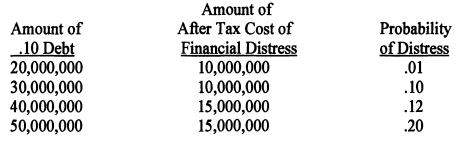
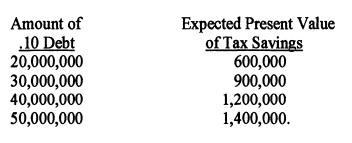
The ABC can use all the tax deductions from interest expense in the year in which the interest is expensed. The following table shows the costs of fmancial distress and the probability of the distress. The corporate tax rate is .35.How much debt should ABC issue? Amount of .10 Debt 20,000,000
(continue 1)Now assume that as debt is substituted for stock the likelihood of using the tax deductions during the period of interest expense is decreased so that the expected value ofthe tax savings are now:How much debt should ABC issue? Amount of .10 Debt 20,000,000 30,000,000 40,000,000
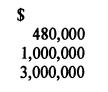
I. Assume that it is decided to manufacture a product using a process where X is the EBIT and E(X) = $700,000. The total investment required is $6,000,000. The tax rate is.4. The life ofthe investment is infinite.a. Assuming all common stock financing, compute the expectation ofearnings after tax
(Problem I continued) Determine the linear relationship of return on equity with respect to EBIT for a given amount ofdebt B for the facts as given in (b).For $3,000,000 ofdebt, compute the return on equity for EBIT equal toIf EBIT were known with certainty, which of two debt levels ($3,000,000 or
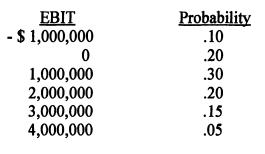
Assume that the following table applies to the RCompanyCompute the probability of a deficit for the following amounts ofdebt if debt costs .10:(a) $0 ofdebt (b) $15,000,000 ofdebt.(c) $35,000,000 ofdebt.(d) $45,000,000 ofdebt. EBIT - $1,000,000 1,000,000 Probability 0 2,000,000 3,000,000 .15
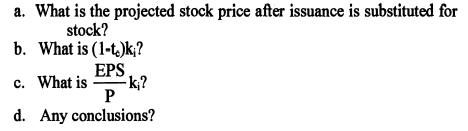
The ABC company has 100,000 shares outstanding and EPS =$4 (total earnings are $400,000). The stock price is $80. The firm can issue$6,000,000 of .08 debt. The corporate tax rate is .35. There are no investor taxes. a. What is the projected stock price after issuance is substituted for stock? b.
(continue 1)What will be the new EPS after debt issuance?
(continue 1)Now assume the stock price is $20 before the debt issuance, and only $1,000,000 of.08 debt can be issueda. What is the projected stock price after debt issuance in substitution for stock 7? Assume 50,000 shares can be purchased (at a price of$20).b. Any conclusions?
(continue 3).What would be the new EPS after debt issuance?
If (1-teki < EPS/P the firm should issue debt and repurchase stock to increase EPS.Assume tc= .35, kj = .10, EPS =$10, P =$80, N = 1,000,000 shares.a. Should the fmn issue debt $20,000,000 of .1O? Base your conclusion on EPS. The $20,000,000 can buy 250,000 shares(at a price of$80).b. What is the
(continue 5) If the stock price for the repurchase were to increase to$153.85 so that 10/153.85 = .065, should the firm issue the debt?
(continue 5) Assume that the EPS =$10 is an expectation and that the finn needs an EPS =$11. The stock can be purchased at $0 per share. How much debt should the finn issue on December 31 ofthe year to achieve the EPS =$11 ?
(continue 5 and 7)How much debt should the finn issue on January 1 of the year to achieve the EPS = $11? The stock can be purchased at $80 per share.
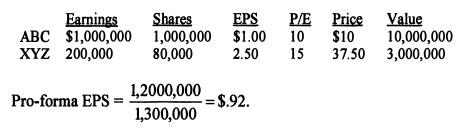
ABC Corporation would like to acquire finn XYZ. It has offered 300,000 of its shares for the 80,000 outstanding shares of XYZ.XYZ finds this offer acceptable.The dilution is not acceptable for ABC.ABC could issue $3,000,000 of .08 debt. The proceeds could buy ABC shares at $10 per share.What should
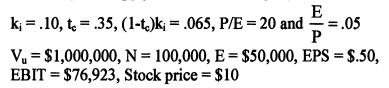
The following facts apply to the ABC CompanyShould the finn issue $500,000 of .10 debt if 50,000 shares can be purchased at a price of $1O? Assume the only criterion for debt issuance is the effect on EPS. E k = .10, t = .35, (1-to)k = .065, P/E = 20 and == .05 P V = $1,000,000, N = 100,000, E =
(continue 10).Now assume kj =.06.Should $500,00 of.06 debt be issued (based on the effect on EPS)?
Showing 500 - 600
of 551
1
2
3
4
5
6
Step by Step Answers

 Get 50% OFF
Claim Now
Get 50% OFF
Claim Now