New Semester Started
Get
50% OFF
Study Help!
--h --m --s
Claim Now
Question Answers
Textbooks
Find textbooks, questions and answers
Oops, something went wrong!
Change your search query and then try again
S
Books
FREE
Study Help
Expert Questions
Accounting
General Management
Mathematics
Finance
Organizational Behaviour
Law
Physics
Operating System
Management Leadership
Sociology
Programming
Marketing
Database
Computer Network
Economics
Textbooks Solutions
Accounting
Managerial Accounting
Management Leadership
Cost Accounting
Statistics
Business Law
Corporate Finance
Finance
Economics
Auditing
Tutors
Online Tutors
Find a Tutor
Hire a Tutor
Become a Tutor
AI Tutor
AI Study Planner
NEW
Sell Books
Search
Search
Sign In
Register
study help
business
dynamic macroeconomics
Macroeconomics A Contemporary Introduction 8th Edition William A. McEachern - Solutions
(Banks Are Financial Intermediaries) In acting as financial intermediaries, what needs and desires of savers and borrowers must banks consider?
(Money Aggregates) Determine whether each of the following is included in the M1 or M2 measures of the money supply:a. Currency held by the nonbanking publicb. Available credit on credit cards held by the nonbanking publicc. Savings depositsd. Large-denomination time depositse. Money market mutual
(CaseStudy: Faking It) Why did the U.S. government consider it important to redesign the $100 note in order to combat the effects of the “supernote”?
(Money Aggregates) What portion of U.S. Federal Reserve notes circulate outside the United States? How does this affect the United States?
(Money Aggregates) What are the two measures of the money supply and how is each measure defined?
(Case Study: The Hassle of Small Change) What are three possible solutions to the problem that the penny now costs more to produce than it’s worth in exchange?
(The Structure of U.S. Banking) Discuss the impact of bank mergers on the structure of American banking.Why do banks merge?
(Bank Deregulation) Some economists argue that deregulating the interest rates that could be paid on deposits combined with deposit insurance led to the insolvency of many depository institutions. On what basis do they make such an argument?
(Federal Reserve System) What are the main powers and responsibilities of the Federal Reserve System?
(Depository Institutions) What is a depository institution, and what types of depository institutions are found in the United States? How do they act as intermediaries between savers and borrowers? Why do they play this role?
(Case Study: When Monetary Systems Break Down)In countries where the monetary system has broken down, what are some alternatives to which people have resorted to carry out exchange?
(The Value of Money) When the value of money was based on its gold content, new discoveries of gold were frequently followed by periods of inflation. Explain.
(Fiat Money) Most economists believe that the better fiat money serves as a store of value, the more acceptable it is. What does this statement mean? How could people lose faith in money?
(Types of Money) Complete each of the following sentences:a. If the face value of a coin exceeds the cost of coinage, the resulting revenue to the issuer of the coin is known as _______.b. A product that serves both as money and as a commodity is _______.c. Coins and paper money circulating in the
(Origins of Banking) Discuss the various ways in which London goldsmiths functioned as early banks.
(Commodity Money) Early in U.S. history, tobacco was used as money. If you were a tobacco farmer and had two loads of tobacco that were of different qualities, which would you supply as money and which would you supply for smoking? Under what conditions would you use both types of tobacco for money?
(Commodity Money) Why do you think rice was chosen to serve as money in medieval Japan? What would happen to the price level if there was a particularly good rice harvest one year?
(Characteristics of Money) Why is universal acceptability such an important characteristic of money?What other characteristics can you think of that might be important to market participants?
(Functions of Money) “If an economy had only two goods (both nondurable), there would be no need for money because exchange would always be between those two goods.” What important function of money does this statement disregard?
(Functions of Money) What are the three important functions of money? Define each of them.
(Money Versus Barter) “Without money, everything would be more expensive.” Explain this statement.Then take a look at a Web page devoted to barter at http://www.ex.ac.uk/~RDavies/arian/barter.html. What are some current developments in barter exchange?
(Barter) Define a double coincidence of wants and explain its role in a barter system.
(The Private Sector) Look at Exhibit 4. How have government outlays as a percent of GDP changed in the industrial countries depicted between 1994 and 2007?What explains the average trend in these economies?
(CaseStudy: An Intergenerational View of Deficits and Debt) Explain why Robert Barro argues that if parents are concerned enough about the future welfare of their children, the effects of deficit spending on the economy will be neutralized.
(Crowding Out and Capital Formation) In earlier chapters, we’ve seen that the government can increase GDP in the short run by running a budget deficit.What are some long-term effects of deficit spending?
(Case Study: Reforming Social Security and Medicare)Why are the Social Security and Medicare programs headed for trouble? When will the trouble begin?What solutions have been proposed?
(The Short-Lived Budget Surplus) Why did the federal budget go from a huge deficit in 1992 to a surplus in 1998? Explain the factors that contributed to the turnaround.
(The Twin Deficits) How is the U.S. budget deficit related to the foreign trade deficit?
(Interest on the Debt) Why did interest payments on the national debt fall from 15.4 percent of the federal budget in 1996 to 8.6 percent in 2007. Why is this percentage expected to increase in the future?10. (Burden of the Debt) Suppose that budget deficits are financed to a considerable extent by
(Crowding Out) How might federal deficits crowd out private domestic investment? How could this crowding out affect future living standards?
(Crowding Out) Is it possible for U.S. federal budget deficits to crowd out investment spending in other countries? How could German or British investment be hurt by large U.S. budget deficits?
(Budget Philosophies) The functional finance approach to budget deficits would set the federal budget to promote an economy operating at potential output.What problems would you expect if the country were to employ this kind of budgetary philosophy?
(Budget Philosophies) One alternative to balancing the budget annually or cyclically is to produce a government budget that would be balanced if the economy were at potential output. Given the cyclical nature of government tax revenues and spending, how would the resulting budget deficit or surplus
(Budget Philosophies) Explain the differences among an annually balanced budget, a cyclically balanced budget, and functional finance. How does each affect economic fluctuations?
(The Budget Process) In terms of the policy lags described in the previous chapter, discuss the following issues associated with the budget process:a. Continuing resolutionsb. Uncontrollable budget itemsc. Overly detailed budget
(The Federal Budget Process) In what sense is the executive branch of the U.S. government always dealing with three budgets?
(The Federal Budget Process) The federal budget passed by Congress and signed by the president shows the relationship between budgeted expenditures and projected revenues. Why does the budget require a forecast of the economy? Under what circumstances would actual government spending and tax
(Multipliers) Suppose investment, in addition to having an autonomous component, also has a component that varies directly with the level of real GDP. How would this affect the size of the government purchase and net tax multipliers?
(Fiscal Policy with an Expansionary Gap) Using the aggregate demand–aggregate supply model, illustrate an economy with an expansionary gap. If the government is to close the gap by changing government purchases, should it increase or decrease those purchases? In the long run, what happens to the
(Changes in Net Taxes) Using the income-expenditure model, graphically illustrate the impact of a $15 billion drop in government transfer payments on aggregate expenditure if the MPC equals 0.75. Explain why it has this impact. What is the impact on the level of real GDP demanded, assuming the
(Fiscal Multipliers) Explain the difference between the government purchases multiplier and the net tax multiplier. If the MPC falls, what happens to the tax multiplier?
(Changes in Government Purchases) Assume that government purchases decrease by $10 billion, with other factors held constant, including the price level. Calculate the change in the level of real GDP demanded for each of the following values of the MPC. Then, calculate the change if the government,
(From Deficits to Surpluses to Deficits) Once the huge federal budget deficits of the 1980s and the first half of the 1990s turned into budget surpluses, why were policy makers more willing to consider discretionary fiscal policy?
(Case Study: Fiscal Policy and Presidential Elections)Suppose that fiscal policy changes output faster than it changes the price level. How might such timing play a role in the theory of political business cycles?
(Case Study: The Supply-Side Experiment) Explain why it is difficult to determine whether the supplyside experiment was a success.
(Fiscal Policy Effectiveness) Determine whether each of the following would make fiscal policy more effective or less effective:a. A decrease in the marginal propensity to consumeb. Shorter lags in the effect of fiscal policyc. Consumers suddenly becoming more concerned about permanent income than
(Automatic Stabilizers) Distinguish between discretionary fiscal policy and automatic stabilizers. Provide examples of automatic stabilizers. What is the impact of automatic stabilizers on disposable income as the economy moves through the business cycle?
(Fiscal Policy) Explain why effective discretionary fiscal policy requires information about each of the following:a. The slope of the short-run aggregate supply curveb. The natural rate of unemploymentc. The size of the multiplierd. The speed with which self-correcting forces operate
(Permanent Income) “If the federal government wants to stimulate consumption by means of a tax cut, it should employ a permanent tax cut. If the government wants to stimulate saving in the short run, it should employ a temporary tax cut.” Evaluate this statement.
(Automatic Stabilizers) Often during recessions, the number of young people who volunteer for military service increases. Could this rise be considered a type of automatic stabilizer? Why or why not?
(Evolution of Fiscal Policy) What did classical economists assume about the flexibility of prices, wages, and interest rates? What did this assumption imply about the selfcorrecting tendencies in an economy in recession? What disagreements did Keynes have with classical economists?
(The Multiplier and the Time Horizon) Explain how the steepness of the short-run aggregate supply curve affects the government’s ability to use fiscal policy to change real GDP.
(Fiscal Policy) Define fiscal policy. Determine whether each of the following, other factors held constant, would lead to an increase, a decrease, or no change in the level of real GDP demanded:a. A decrease in government purchasesb. An increase in net taxesc. A reduction in transfer paymentsd. A
(Case Study: Why Is Unemployment So High in Continental Europe?) European unemployment is a hot topic. Use any Web browser to search for the words“European unemployment.” Just by scanning the headlines, see how many possible explanations you can list. How do they compare to the explanations
(Supply Shocks) Give an example of an adverse supply shock and illustrate graphically. Now do the same for a beneficial supply shock.
(Changes in Aggregate Supply) List three factors that can change the economy’s potential output. What is the impact of shifts of the aggregate demand curve on potential output? Illustrate your answers with a diagram.
(Long-Run Adjustment) The ability of the economy to eliminate any imbalances between actual and potential output is sometimes called self-correction. Using an aggregate supply and aggregate demand diagram, show why this self-correction process involves only temporary periods of inflation or
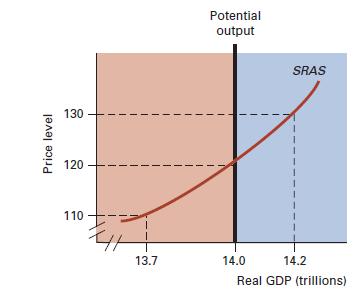
(Expansionary and Contractionary Gaps) Answer the following questions on the basis of the following graph:a. If the actual price level exceeds the expected price level reflected in long-term contracts, real GDP equals _______ and the actual price level equals _______ in the short run.b. The
(Natural Rate of Unemployment) What is the relationship between potential output and the natural rate of unemployment?a. If the economy currently has a frictional unemployment rate of 2 percent, structural unemployment of 2 percent, seasonal unemployment of 0.5 percent, and cyclical unemployment of
(Real Wages) In Exhibit 2 in this chapter, how does the real wage rate at point c compare with the real wage rate at point a? How do nominal wage rates compare at those two points? Explain your answers.
(Changes in Aggregate Supply) What are supply shocks?Distinguish between beneficial and adverse supply shocks. Do such shocks affect the short-run aggregate supply curve, the long-run aggregate supply curve, or both? What is the resulting impact on potential GDP?
(Long-Run Aggregate Supply) Determine whether each of the following, other things held constant, would lead to an increase, a decrease, or no change in long-run aggregate supply:a. An improvement in technologyb. A permanent decrease in the size of the capital stockc. An increase in the actual price
(Long-Run Aggregate Supply) The long-run aggregate supply curve is vertical at the economy’s potential output level. Why is the long-run aggregate supply curve located at this output rather than below or above potential output?
(Long-Run Adjustment) In the long run, why does an actual price level that exceeds the expected price level lead to changes in the nominal wage? Why do these changes cause shifts of the short-run aggregate supply curve?
(Case Study: U.S. Output Gaps and Wage Flexibility)Unemployment is costly to employers, employees, and the economy as a whole. What are some explanations for the coordination failures that prevent workers and employers from reaching agreements?
(Output Gaps and Wage Flexibility) What are some reasons why nominal wages may not fall during a contractionary gap?
(Expansionary Gap) How does an economy that is experiencing an expansionary gap adjust in the long run?
(Contractionary Gap) What does a contractionary gap imply about the actual rate of unemployment relative to the natural rate? What does it imply about the actual price level relative to the expected price level?What must happen to real and nominal wages in order to close a contractionary gap?
(Short-Run Aggregate Supply) In interpreting the short-run aggregate supply curve, what does the adjective short-run mean? Explain the role of labor contracts along the SRAS curve.
(Contractionary Gaps) After reviewing Exhibit 3 in this chapter, explain why contractionary gaps occur only in the short run and only when the actual price level is below what was expected.
(Nominal and Real Wages) Complete each of the following sentences:a. The _______ wage measures the wage rate in dollars of the year in question, while the _______ wage measures it in constant dollars.b. Wage agreements are based on the _______ price level and negotiated in _______ terms. Real wages
(Actual Price Level Higher than Expected) Discuss some instances in your life when your actual production for short periods exceeded what you considered your potential production. Why does this occur only for brief periods?
(Potential Output) Define the economy’s potential output.What factors help determine potential output?
(Short-Run Aggregate Supply) In the short run, prices may rise faster than costs. This chapter discusses why this might happen. Suppose that labor and management agree to adjust wages continuously for any changes in the price level. How would such adjustments affect the slope of the aggregate
(Shifts of Aggregate Demand) Assume the simple spending multiplier equals 10. Determine the size and direction of any changes of the aggregate expenditure line, real GDP demanded, and the aggregate demand curve for each of the following changes in spending:a. Spending rises by $8 billion at each
(Investment and the Multiplier) This chapter assumes that investment is autonomous. What would happen to the size of the multiplier if investment increases as real GDP increases? Explain.
(Simple Spending Multiplier) Suppose that the MPC is 0.8, while investment, government purchases, and net exports sum to $500 billion. Suppose also that the government budget is in balance.a. What is the sum of saving and net taxes when desired spending equals real GDP? Explain.b. What is the value
(Simple Spending Multiplier) Suppose that the MPC is 0.8 and that $14 trillion of real GDP is currently being demanded. The government wants to increase real GDP demanded to $15 trillion at the given price level.By how much would it have to increase government purchases to achieve this goal?
(Simple Spending Multiplier) For each of the following values for the MPC, determine the size of the simple spending multiplier and the total change in real GDP demanded following a $10 billion decrease in spending:a. MPC = 0.9b. MPC = 0.75c. MPC = 0.6
(Case Study: Falling Wealth Triggered Japan’s Recession)What happened to consumption in Japan? Why did this happen? What was the impact on aggregate demand there?
(The Aggregate Demand Curve) What is the effect of a lower price level, other things constant, on the aggregate expenditure line and real GDP demanded? How does the multiplier interact with the price change to determine the new real GDP demanded?
(Case Study: The Ripple Effect of 9/11) How do events, such as the World Trade Center and Pentagon attacks described in the case study “The Ripple Effects of 9/11” affect the aggregate expenditure line and the aggregate demand curve? Explain fully.
(Simple Spending Multiplier) “A rise in investment in an economy leads to a rise in spending.” Use the spending multiplier to verify this statement.
(When Output and Spending Differ) What role do inventories play in determining real GDP demanded?In answering this question, suppose initially that firms are either producing more than people plan to spend, or producing less than people plan to spend.
(Real GDP Demanded) What equalities hold at the level of real GDP demanded? When determining real GDP demanded, what do we assume about the price level? What do we assume about inventories?
(Real GDP Demanded) In your own words, explain the logic of the income-expenditure model. What determines the amount of real GDP demanded?
(Aggregate Expenditure) What are the components of aggregate expenditure? In the model developed in this chapter, which components vary with changes in the level of real GDP? What determines the slope of the aggregate expenditure line?
(Investment Spending) Review Exhibit 6 in this chapter.If the operators of the golf course revised their revenue estimates so that each cart is expected to earn $100 less, how many carts would they buy at an interest rate of 8 percent? How many would they buy if the interest rate is 3 percent?
(Consumption and Saving) Suppose that consumption equals $500 billion when disposable income is $0 and that each increase of $100 billion in disposable income causes consumption to increase by $70 billion. Draw a graph of the saving function using this information.
(MPC and MPS) If consumption increases by $12 billion when disposable income increases by $15 billion, what is the value of the MPC? What is the relationship between the MPC and the MPS? If the MPC increases, what must happen to the MPS? How is the MPC related to the consumption function? How is
(Consumption) Use the following data to answer the questions below:Consumption Real Disposable Expenditures Saving Income (billions) (billions) (billions)$100 $150 $________$200 $200 ________$300 $250 ________$400 $300 ________a. Graph the consumption function, with consumption spending on the
(Net Exports) What factors are assumed constant along the net export function? What would be the impact on net exports of a change in real disposable income?
(Government Spending) How do changes in disposable income affect government purchases and the government purchase function? How do changes in net taxes affect the consumption function?
(Case Study: Investment Varies Much More Than Consumption)Why do economic forecasters pay special attention to investment plans? Take a look at the Conference Board’s index of leading economic indictors at http://www.conference-board.org/. Which of those indicators might affect investment?
(Investment) Why would the following investment expenditures increase as the interest rate declines?a. Purchases of a new plant and equipmentb. Construction of new housingc. Increase inventories 6. (Nonincome Determinants of Investment) What are some factors assumed to be constant along the
(Investment) What are the components of gross private domestic investment? What is the difference between the investment curve shown in Exhibit 6 and the one shown in Exhibit 7?
(Case Study: The Life-Cycle Hypothesis) According to the life-cycle hypothesis, what is the typical pattern of saving for an individual over his or her lifetime?What impact does this behavior have on an individual’s lifetime consumption pattern? What impact does the behavior have on the saving
(Consumption Function) A number of factors can cause the consumption function to shift. What, if anything, happens to the saving function when the consumption function shifts? Explain.
(Consumption Function) How would an increase in each of the following affect the consumption function?How would it affect the saving function?a. Net taxesb. The interest ratec. Consumer optimism, or confidenced. The price levele. Consumers’ net wealthf. Disposable income
(Inflation and Interest Rates) Using a demand-supply diagram for loanable funds (like Exhibit 10), show what happens to the nominal interest rate and the equilibrium quantity of loans when both borrowers and lenders increase their estimates of the expected inflation rate from 5 percent to 10
Showing 1100 - 1200
of 5072
First
5
6
7
8
9
10
11
12
13
14
15
16
17
18
19
Last
Step by Step Answers

 Get 50% OFF
Study Help!
Claim Now
Get 50% OFF
Study Help!
Claim Now