New Semester
Started
Get
50% OFF
Study Help!
--h --m --s
Claim Now
Question Answers
Textbooks
Find textbooks, questions and answers
Oops, something went wrong!
Change your search query and then try again
S
Books
FREE
Study Help
Expert Questions
Accounting
General Management
Mathematics
Finance
Organizational Behaviour
Law
Physics
Operating System
Management Leadership
Sociology
Programming
Marketing
Database
Computer Network
Economics
Textbooks Solutions
Accounting
Managerial Accounting
Management Leadership
Cost Accounting
Statistics
Business Law
Corporate Finance
Finance
Economics
Auditing
Tutors
Online Tutors
Find a Tutor
Hire a Tutor
Become a Tutor
AI Tutor
AI Study Planner
NEW
Sell Books
Search
Search
Sign In
Register
study help
business
economics of public issues
The Economics Of Public Issues 20th Edition Roger LeRoy Miller, Daniel K. Benjamin, Douglass C. North - Solutions
Why don’t drivers of conventional cars with internal-combustion engines care about whatever pollution they generate?
What are the benefits to consumers who purchase electric cars?
What are some of the arguments that you could use to justify the expansion of wind power and solar power?
Why does the federal government have to provide subsidies to entice private companies to build and maintain wind farms?
What do we mean when we say that industrial policy leads to inefficient use of resources?
Can you think of any situation in which the use of taxpayer dollars to subsidize industrial production of one type or another might benefit the nation in the long run?
Under what circumstances would an employer be willing to pay an annual fine for not providing legally required employee health insurance?
In Britain, everyone has the right to healthcare provided by the National Health Service, paid for out of tax revenues. Nevertheless, two-thirds of British citizens earning more than $80,000 per year currently purchase private health insurance. Why would these people opt to “pay twice” for
People over the age of sixty-five are eligible for Medicare, which offers subsidized healthcare—as long as the doctor involved agrees to accept the relatively lower fees paid by Medicare. Some people over sixty-five choose instead to pay out-of-pocket for so-called“concierge” physicians, who
When an employer chooses to reduce the hours worked by many of its employees to fewer than thirty per week, what might be some of the negative consequences to the business? What damages might the affected employees suffer?
Do the increased physician and hospital treatments for serious illnesses among those who are newly insured tell you anything about the price elasticity of demand for medical care? If so, what?
Labor unions are a device for limiting competition, in this instance competition among workers. The union bargains on behalf of all members, presumably resulting in a higher wage for workers and higher costs for employers. Use this fact, combined with the fact that international trade has played an
Although New York City’s mass transit system is the largest in the country, it is not the only one that is heavily subsidized by taxpayers—in fact, as far as we know, all mass transit systems are heavily subsidized by taxpayers. Suggest at least one economic and one political reason why these
Manicurists and pedicurists are required to be licensed in both California and Florida. In California, people practicing these occupations must take 400 hours of classroom training; in Florida, they must take only 240 hours of classroom training. Ceteris paribus (that is, holding other factors
Is there any difference between prohibiting entry by a group of firms and levying a special tax on those firms?
Although governments at all levels sometimes act to prevent some individuals from competing with others, the federal government is probably the most active in this role, state governments are less active, and local governments are the least active. Can you explain this pattern?
Consider two different ways of beating your competition. One way is to offer your customers lower prices and better service. The other is to get a law passed that raises your competitors’ costs—for example, by imposing special operating requirements on them. Can you see any difference between
Suppose a local beverage shop charges $6 for a six-pack of your favorite beverage and charges $15 for a case (containing four sixpacks)of that same beverage? Is this price discrimination?
Suppose a firm starts off with selling a uniform product to two different customers at the same price per unit for each. Now it decides to engage in price discrimination by raising the price to one customer and lowering the price to the other customer. Why doesn’t the profit lost due to lowering
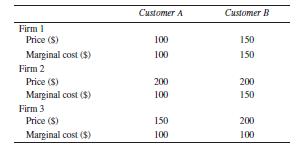
Consider the following data from three different firms (1, 2, and 3)each selling to two different customers (A and B). Shown are the price per unit charged each customer and the marginal cost of producing each unit for the customer. (Thus, for example, Firm 1 has different marginal costs between
Is it price discrimination when a professional football team charges, say, $350 per ticket for fifty-yard-line tickets in the lower deck and$100 per ticket for upper-deck tickets overlooking the end zone?
First-class passengers generally pay higher fares than coach passengers, even when they take advantage of advance-purchase discounts.Is this price discrimination? (Hint: Seats in first class are generally leather rather than fabric and are about 50 percent wider than coach seats. Also, there are
Suppose there is a decline in marginal costs for one member of a cartel. What impact will this have on the incentive of that firm to cheat on the cartel agreement? Explain.
The economy of India (with a population of one billion) has begun to industrialize, and per capita income there is rising. What impact will this growth have on the demand for oil and diamonds—and thus on their prices? Explain.
If the members of your class were to attempt to form a studyreduction cartel in which everyone agreed to study less, which individuals would have the most to gain from the cartel? Which ones would have the greatest incentive to cheat on the cartel?
Which platform firms are used by online businesses to interact with their customers? That is, which firms are the “platforms for the platforms”?How are those platform firms paid? (Hint: Again, a bit of online research will help you answer this.)
Consider the transactions between retailers and customers that involve debit or credit cards. Which firms act as platforms within this two-sided market involving retailers and cardholders? How do those platform firms get paid? (Hint: If you don’t already know, a few minutes of online research
How is YouTube part of a two-sided market? What function does it perform? What are the two audiences that form each side of its two-sided market?
If you were the owner of an online dating service, how would you differentiate your services from those of your competitors? How would such differentiations potentially create a greater demand for your online dating service? What would be your additional costs of providing those differentiations?
In a sense, all transactions in all markets are two-sided. What is the difference between traditional two-sided markets and modern platform-based, two-sided markets? (Hint: How does Amazon differ from your neighborhood Wal-Mart?)
In most cities in the world, it is necessary to purchase an expensive license—often called a medallion—to operate a taxi or a taxi company(see Chapter 18 for details). Would you expect the resale price of those medallions to rise or fall in the future, and why?
How does a country’s tax structure affect who decides to immigrate into the nation or emigrate out of the nation? Contrast, for example, nations A and B. Assume that nation A applies a 20 percent tax on every dollar of income earned by an individual. Nation B applies a 10 percent tax on the first
Suppose federal marginal personal income tax rates will rise significantly over the next ten years. Explain the ways in which individuals at all levels of income can react over time, not just immediately after taxes are raised. How will the size of the response differ, say, a year after the rise in
Explain how the incentive effects of each of the following hypothetical taxes would cause people to change their behavior. Be sure to explain what people are likely to do less of and what they are likely to do more of in response to each tax:(a) A $1,000,000-per-story tax on all office buildings
If you found yourself in the 91 percent federal personal income tax bracket in 1951, how great would have been your incentive to find legal loopholes to reduce your federal tax liabilities? If you found yourself in the lowest federal personal income tax bracket of, say, 15 percent, would your
Consider three scenarios. In each, your neighbor offers to pay $500 if you will clear brush out of his backyard this week.Scenario 1: If you decline the offer, you can collect $200 in unemployment benefits this week. If you accept the offer, you get to keep the entire $500 without having to pay
Suppose the government spends more this year than it collects in taxes, borrowing the difference. Assuming that the government will repay its debts, what does this imply about what must happen to taxes in the future? How might people adjust their behavior to account for this predicted change in
Why is it that teenagers (rather than members of any other age group) are most likely to lose their jobs (or get turned down for employment) when the minimum wage is raised?
Refer back to the last question. Based on the discussion in the chapter, what would you want to know about these women to satisfy yourself that they will be at least as productive as the men? List the key factors and explain briefly.
Suppose you own a company. If you hire ten men, each of them at$70,000 per year, your firm will be able to sell $1,000,000 in output this year, and you will be able to earn $50,000 in profits, an amount that is normal for a firm of your size in your industry. (Your firm’s other costs, such as for
Women who own their own businesses earn net profits that are only half as large as the net profits earned by men who own their own businesses. First, consider why women would be willing to accept lower profits. Could this reflect poorer options for women as employees? Alternatively, could it
A recent British study found that married men earned more than unmarried men, but only if their wives did not have full-time paid employment. Suggest an explanation for this finding. (Hint: In which case is a man more likely to share in the household responsibilities, including child care?)
Suppose an employer offers a base wage of $20 per hour for the first forty hours of work each week and overtime pay of $30 per hour for any hours beyond forty per week; the employer allows workers to choose their own hours of work. Suppose employee A chooses to work thirty-six hours per week and
Some observers have proposed higher income and wealth taxes on the wealthy. Given that one’s wealth generally depends primarily on how much output one produces, how do these taxes affect the incentives of people who are the most productive? Assume that the proceeds from the taxes are given out to
If you play poker with a group of friends, you are playing what is called a zero-sum game. What you win, they lose and vice versa.The sum of the funds that you start with together does not change.All that changes is who owns more or less of that sum at the end of your poker game. Many commentators
Today, usually at little or no cost, you can Skype your friends and family, no matter where they are located. Are you both psychologically and economically richer? Why or why not? Similarly, you can follow the lives of the rich and famous via their Twitter feeds, their blogs, or their Facebook
In 1984, individual balances in private retirement plans were $865 billion. By thirty years later, they had risen to almost $25 trillion. In general, balances in private retirement plans are not included in the statistics that show rising income or wealth inequality. How might such an oversight
When the capital gains tax rate was reduced from 28 to 20 percent in 1997 and especially when it was cut again to 15 percent in 2003, many people believed that these reductions would be temporary.How did this belief affect the incentives to sell assets when the tax rates were cut, compared to a
Does envy of those who are rich depend on the source of that wealth?For example, consider two people who are both equally rich. One of them worked eighty hours a week year after year to accumulate her wealth, while the other won the lottery. Would the envy felt by others toward each of these people
How does the percentage of voters who are renters (as opposed to owners) affect the incentives for politicians to propose rent controls?Does this incentive depend on the likelihood that renters are less likely to vote in local elections than owners of apartments and houses? Why do you suppose
Because rent controls reduce the rental price below the market clearing price, the quantity of rental units on the market must decline.What does this imply must happen to the full cost of renting an apartment including “key money,” harassment by the landlord, and so forth? Explain.
Who, other than the owners of rental units, loses as a result of rent controls? Who gains from rent controls? What effect would the imposition of rent controls have on the market price of an existing single-family house? What effect would rent controls have on the value of vacant land?
What determines the size of the key-money payments that landlords demand (and tenants offer) for the right to lease a rent-controlled apartment?
Referring back to the facts of the previous question: Suppose you knew that in one community water is supplied by a privately owned company, while in the other community water is supplied by the local government. In which community do you predict that water is supplied by the privately owned
Consider two otherwise identical communities; call them P and N.Suppose that in P, all homes, apartments, and businesses have meters that record the usage of water. In addition, the users of the water must pay more when they use more water. Thus, water is priced like most other goods. In community
If allocating water through nonprice measures generally harms society, can you suggest why governments often do this?
During the droughts that periodically plague California, farmers in that state are able to purchase subsidized water to irrigate their crops, while at the same time many California homeowners have to pay large fines if they water their lawns. Can you suggest an explanation for this difference in
Evaluate the following: “Although taxpayers foot the bill for federal water sold to farmers at subsidized prices, they also eat the crops grown with that water. Because the crops are cheaper due to the subsidized water, taxpayers get back exactly what they put in, and so there is no waste from
The United States currently has an “opt-in” system for organ donations from the deceased: People must explicitly choose postmortem donation ahead of time (as when they obtain their driver’s licenses).Many other nations have “opt-out” systems: A desire to donate postmortem is presumed to
The average waiting time on transplant lists is about five years for kidneys (although this is expected to rise sharply due to the rising incidence of diabetes, a major cause of kidney damage). Many of these people waiting must undergo dialysis, at a cost of $90,000 per year for the dialysis, plus
If payment for organs drives up the financial costs of transplants compared to the costs of dialysis, is it possible that private insurance companies, and even Medicare and Medicaid, might respond by changing their standards for transplants? Could the standards change in different directions
Why might the owners of the private insurance companies that pay for most organ transplants (but don’t pay for most dialysis) be in favor of a system that prohibits paying for a donated organ? Should the taxpayers of the United States, who ultimately cover the cost of Medicare and Medicaid
Per capita income varies substantially across the country. If there were a free market in which payment for kidneys was permitted within the United States, would you expect there to be different prices in different parts of the country? In which areas of the country would you expect the most organs
The financial burden of organ transplants tends to be borne more heavily by private insurance companies, while the financial burden of dialysis is borne more heavily by the taxpayer (through funding for Medicare and Medicaid). Instituting payments for kidney donors would likely save each taxpayer
The inflation- and quality-corrected prices of just about every technological device have fallen dramatically. The prices have gone down and the quality has gone up for flat-screen TVs, smartphones, tablets, and gaming computers, among others. Few will argue that we are worse off because of falling
The U.S. Department of Agriculture publishes nutritional guidelines, and the Affordable Care Act mandates calorie counts on menus. Yet the federal government also subsidizes the production of foods that end up causing Americans to violate those guidelines and consume calories that contribute to the
We all undertake risks throughout our lives. When we pass a car on a two-lane highway, we implicitly know that we are increasing the risk of an auto accident, yet we do it anyway. When we drive faster at any time while driving, more often than not, we implicitly increase the risk of suffering
If you compare the actual physical size of a dress in 1950 that was labeled size 6 with a dress labeled size 6 today, you will notice a difference. What do you think that difference is? Why have dress manufacturers changed their size-labeling system?Similarly, if you look at the sizes of men’s
Who benefits the most from menu mandates—caloric labeling of food in restaurants and vending machines—and why? Are there any costs associated with menu mandates? If so, what are they?
Obesity and smoking are both linked to numerous adverse health consequences, including heart disease, cancer, and strokes, among others. The Affordable Care Act permits health insurance companies to charge people higher premiums if they smoke or are obese. But the law forbids the companies from
According to the Surgeon General of the United States, nicotine is the most addictive drug known to humanity, and cigarette smoking kills perhaps 300,000–400,000 people per year in the United States.Why then isn’t tobacco illegal in America?
The markets for prostitution in Nevada and New Jersey have two important differences: (i) prostitutes in New Jersey face higher costs because of government efforts to prosecute them and (ii) customers in New Jersey face higher risks of contracting diseases from prostitutes because the illegal
During Prohibition, some speakeasy operators paid bribes to ensure that the police did not raid them. Would you expect the quality of the liquor served in such speakeasies to be higher or lower than in those that did not pay bribes? Would you expect to find differences(e.g., in income levels)
The federal government currently taxes alcohol on the basis of the 100-proof gallon. (Alcohol that is 100 proof is 50 percent pure ethyl alcohol; most hard liquor sold is 80 proof, or 40 percent ethyl alcohol, whereas wine is usually about 24 proof, and most beer is 6–10 proof.) How would alcohol
In recent years, about twenty states have passed so-called medical marijuana laws. Typically, these laws permit individuals to lawfully purchase marijuana from licensed stores, provided they have a letter from their doctor recommending its use. In a number of these states, the price of medical
From an economic perspective, is it possible for laws restricting dangerous or destructive activity to be too strict? Explain. (Hint: Revisit Chapter 3.)
It is generally acknowledged that more people would like to attend the Super Bowl each year than in fact attend. (Presumably, many people stay away due to the high cost of the tickets, which are priced at many hundreds of dollars apiece.) Suppose a law were passed specifying that people who wished
Some nominally closed resources are effectively open access. For example, to gain entry to Yellowstone National Park by automobile, one must pay a fee of $25. But during the popular summer months, at this price, far more people want to drive into the park than can be readily accommodated by its
Referring back to the last question, raves and education are both goods. That is, people typically prefer more of each to less. Do you think it is proper that people may not hold raves in the room when your class meets? Can you suggest a general principle that could guide university administrators
Explain the sense in which your classroom is an example of a closed access resource. Discuss what would happen to the quality of your education if access to the room were open—in the sense that anyone could come in during class time and, say, have a rave.
Is access to the house or apartment in which you live open or closed?If it is currently a closed access resource, how would it likely be treated differently if it were converted to an open access resource—one that anyone could use at any time in any way she chose? Explain.
If the crucial factor determining a country’s low standard of living is the adverse set of legal and cultural institutions it possesses, can you offer suggestions for how the other nations of the world might help in permanently raising that country’s standard of living?
In light of your answer to question 4, how do you explain that in some countries there is widespread political support for government policies that expropriate resources from some groups for the purpose of handing them out to other groups?
Consider two countries, A and B, that have identical physical endowments of a key natural resource. In country A, any profits made from extracting that resource are subject to confiscation by the government, while in country B, there is no such risk. How does the risk of expropriation affect the
Both Louisiana and Quebec have systems of local law (state and provincial, respectively) that are heavily influenced by their common French heritage, which includes civil law. What do you predict is true about per capita income in Louisiana compared to the other U.S. states, and per capita income
Most international attempts to aid people living in low-income nations have come in one of two forms: (i) gifts of consumer goods(such as food) and (ii) assistance in constructing or obtaining capital goods (such as tractors, dams, or roads). Based on what you have learned in this chapter, how
Go to a source, such as the CIA World Factbook or the World Bank, and collect per capita income and population data for each of the nations listed in Table 4–1. Compare the average per capita income of the common law countries with the average per capita income of the civil law countries. Based
Many economists would argue that private companies are likely to be more efficient than the government at operating airlines. Yet many economists would also argue that there is a valid reason for the government to regulate the safety of those same airlines. Can you explain why the government might
Is safety likely to be a “normal” good (i.e., something people want to consume more of as they get richer)? Use your answer to this question to predict likely safety records of airlines based in North America and Europe, compared to those based in South America and Africa. Then go to
Suppose it is possible to observe (or measure) four attributes of airlines:(i) the size of their planes (measured in passenger-carrying capacity), (ii) the experience levels of their pilots, (iii) the age of their planes, and (iv) the length of the typical route they fly. Which airlines would be
What are the innovations from the last five years that you think are the most important in your life and why? Can you put a rough dollar value on the personal loss you would suffer if these innovations had not occurred, perhaps because they were suppressed or discouraged by government policies?
Suppose you are about to start an innovative, high-tech company in one of two states. You expect before-tax profits to be about $100,000 per year. Both states have similar living conditions, climate, and other amenities, but the tax rate in state A is 17 percent, while the tax rate in state B is 7
Why does it matter to you if the long-run economic growth rate falls from its historical 2.1 percent to, say, only 0.9 percent? How does your answer differ depending on whether you are looking ahead to the end of this year or are looking ahead to the entirety of your working career?
Suppose for simplicity that both Type I and Type II errors resulted in deaths only. Keeping in mind that too little caution produces Type I errors and too much caution produces Type II errors, what would be the best mix of Type I and Type II errors?
What would be the advantages and disadvantages of a regulatory system in which, rather than having the FDA permit or prohibit new drugs, the FDA merely published its opinions about the safety and efficacy of drugs and then allowed physicians to make their own decisions about whether or not to
How could the incentives provided to the FDA be changed to reduce the incidence of Type II errors? (Hint: Is it possible to compare the FDA approval process with the drug-approval process in other nations?)
Does the structure of the drug industry have any bearing on the types of errors that drug firms are likely to make? That is, would a drug industry made up of numerous highly competitive firms be more or less likely to introduce unsafe drugs than an industry consisting of a few large firms?
Why don’t FDA employees accurately balance the marginal benefits to drug consumers against the marginal costs to those consumers?
Showing 1700 - 1800
of 1798
First
4
5
6
7
8
9
10
11
12
13
14
15
16
17
18
Step by Step Answers

 Get 50% OFF
Claim Now
Get 50% OFF
Claim Now