New Semester
Started
Get
50% OFF
Study Help!
--h --m --s
Claim Now
Question Answers
Textbooks
Find textbooks, questions and answers
Oops, something went wrong!
Change your search query and then try again
S
Books
FREE
Study Help
Expert Questions
Accounting
General Management
Mathematics
Finance
Organizational Behaviour
Law
Physics
Operating System
Management Leadership
Sociology
Programming
Marketing
Database
Computer Network
Economics
Textbooks Solutions
Accounting
Managerial Accounting
Management Leadership
Cost Accounting
Statistics
Business Law
Corporate Finance
Finance
Economics
Auditing
Tutors
Online Tutors
Find a Tutor
Hire a Tutor
Become a Tutor
AI Tutor
AI Study Planner
NEW
Sell Books
Search
Search
Sign In
Register
study help
business
engineering economy
Engineering Economy 16th edition William G. Sullivan, Elin M. Wicks, C. Patrick Koelling - Solutions
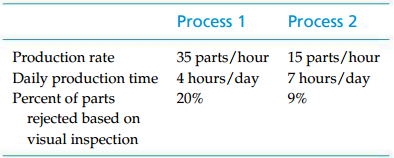
A bicycle component manufacturer produces hubs for bike wheels. Two processes are possible for manufacturing, and the parameters of each process are as follows:Assume that the daily demand for hubs allows all defect-free hubs to be sold. Additionally, tested or rejected hubs cannot be sold.
The speed of your automobile has a huge effect on fuel consumption. Traveling at 65 miles per hour (mph) instead of 55 mph can consume almost 20% more fuel. As a general rule, for every mile per hour over 55, you lose 2% in fuel economy. For example, if your automobile gets 30 miles per gallon at
A company is analyzing a make-versus-purchase situation for a component used in several products, and the engineering department has developed these data:Option A: Purchase 10,000 items per year at a fixed price of $8.50 per item. The cost of placing the order is negligible according to the present
A national car rental agency asks, “Do you want to bring back the economy-class car full of gas or with an empty tank? If we fill up the tank for you,we’ll charge you $3.50 per gallon, which is 50 cents less than the local price for gasoline.” Which choice should you make? State your
Ocean water contains 0.9 ounces of gold per ton. Method A costs $550 per ton of water processed and will recover 90% of the metal. Method B costs $400 per ton of water processed and will recover 60% of the metal. The two methods require the same capital investment and are capable of producing the
Home heating accounts for approximately one-third of energy consumption in a typical U.S. household. Despite soaring prices of oil, coal, and natural gas, one can make his/her winter heating bill noninflationary by installing an ultraconvenient corn burning stove that costs in the neighborhood of
Refer to Example 2-4. If your focus was on reducing expenses, would it be better to reduce the fixed cost (B1) or variable cost (B2) component? What is the effect of a ± 10% change in both of these factors?
Showing 4700 - 4800
of 4707
First
34
35
36
37
38
39
40
41
42
43
44
45
46
47
48
Step by Step Answers

 Get 50% OFF
Claim Now
Get 50% OFF
Claim Now