New Semester
Started
Get
50% OFF
Study Help!
--h --m --s
Claim Now
Question Answers
Textbooks
Find textbooks, questions and answers
Oops, something went wrong!
Change your search query and then try again
S
Books
FREE
Study Help
Expert Questions
Accounting
General Management
Mathematics
Finance
Organizational Behaviour
Law
Physics
Operating System
Management Leadership
Sociology
Programming
Marketing
Database
Computer Network
Economics
Textbooks Solutions
Accounting
Managerial Accounting
Management Leadership
Cost Accounting
Statistics
Business Law
Corporate Finance
Finance
Economics
Auditing
Tutors
Online Tutors
Find a Tutor
Hire a Tutor
Become a Tutor
AI Tutor
AI Study Planner
NEW
Sell Books
Search
Search
Sign In
Register
study help
business
essentials corporate finance
Corporate Finance 12th edition Stephen Ross, Randolph Westerfield, Jeffrey Jaffe, Bradford Jordan - Solutions
For initial public offerings of common stock, 2017 was a relatively slow year, with only about $21.2 billion raised by the process. Relatively few of the 119 firms involved paid cash dividends. Why do you think that most chose not to pay cash dividends?
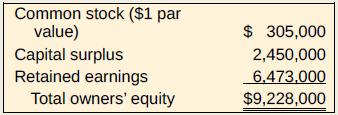
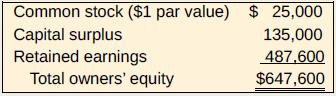
The company with the common equity accounts shown here has declared a stock dividend of 15 percent when the market value of its stock is $74 per share. What effects on the equity accounts will the distribution of the stock dividend have? Common stock ($1 par value) Capital surplus Retained
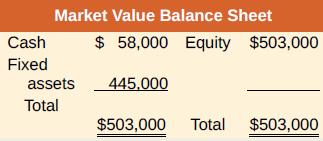
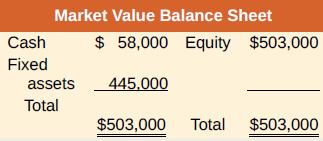
The market value balance sheet for Oracle Manufacturing is shown here. The company has declared a stock dividend of 25 percent. The stock goes ex dividend tomorrow (the chronology for a stock dividend is similar to that for a cash dividend). There are 25,000 shares of stock outstanding. What will
In the previous problem, suppose the company has announced it is going to repurchase $22,800 worth of stock. What effect will this transaction have on the equity of the company? How many shares will be outstanding? What will the price per share be after the repurchase? Ignoring tax effects, show
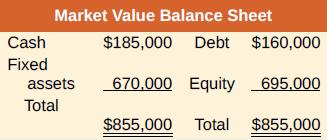
The balance sheet for Fourth Corp. is shown here in market value terms. There are 12,000 shares of stock outstanding.The company has declared a dividend of $1.90 per share. The stock goes ex dividend tomorrow. Ignoring any tax effects, what is the stock selling for today? What will it sell for
Roll Corporation (RC) currently has 385,000 shares of stock outstanding that sell for $108 per share. Assuming no market imperfections or tax effects exist, what will the share price be after: a. RC has a five-for-three stock split? b. RC has a 15 percent stock dividend? c. RC has a
The owners’ equity accounts for Octagon International are shown here: a. If the company’s stock currently sells for $39 per share and a 10 percent stock dividend is declared, how many new shares will be distributed? Show how the equity accounts would change. b. If the company declared
Samuel, Inc., has declared a $7.25 per-share dividend. Suppose capital gains are not taxed, but dividends are taxed at 15 percent. New IRS regulations require that taxes be withheld when the dividend is paid. The company’s stock sells for $67 per share and is about to go ex-dividend. What do you
Blue Angel, Inc., a private firm in the holiday gift industry, is considering a new project. The company currently has a target debt-equity ratio of .40, but the industry target debt-equity ratio is .35. The industry average beta is 1.2. The market risk premium is 7 percent and the risk-free rate
Bruin Industries just issued $325,000 of perpetual 7 percent debt and used the proceeds to repurchase stock. The company expects to generate $146,000 of earnings before interest and taxes in perpetuity. The company distributes all its earnings as dividends at the end of each year. The firm’s
Bluegrass Mint Company has a debt-equity ratio of .35. The required return on the company’s unlevered equity is 12.1 percent and the pretax cost of the firm’s debt is 6.3 percent. Sales revenue for the company is expected to remain stable indefinitely at last year’s level of $18.6 million.
Summers, Inc., is an unlevered firm with expected annual earnings before taxes of $23.5 million in perpetuity. The current required return on the firm’s equity is 11 percent and the firm distributes all of its earnings as dividends at the end of each year. The company has 1.9 million shares of
Fitzgerald Industries has a new project available that requires an initial investment of $4.6 million. The project will provide unlevered cash flows of $835,000 per year for the next 20 years. The company will finance the project with a debtvalue ratio of .35. The company’s bonds have a YTM of
First and Ten Corporation’s stock returns have a covariance with the market portfolio of .0415. The standard deviation of the returns on the market portfolio is 20 percent and the expected market risk premium is 6.7 percent. The company has bonds outstanding with a total market value of $55
Triad Corporation has established a joint venture with Tobacco Road Construction, Inc., to build a toll road in North Carolina. The initial investment in paving equipment is $125 million. The equipment will be fully depreciated using the straight-line method over its economic life of 5 years.
National Electric Company (NEC) is considering a $53 million project in its power systems division. Tom Edison, the company’s chief financial officer, has evaluated the project and determined that the project’s unlevered cash flows will be $4.1 million per year in perpetuity. Mr. Edison has
Walker, Inc., is an all-equity firm. The cost of the company’s equity is currently 11.9 percent and the risk-free rate is 3.5 percent. The company is currently considering a project that will cost $11.4 million and last 6 years. The company uses straight-line depreciation. The project will
Daniel Kaffe, CFO of Kendrick Enterprises, is evaluating a 10-year, 6.3 percent loan with gross proceeds of $4.6 million. The interest payments on the loan will be made annually. Flotation costs are estimated to be 2.5 percent of gross proceeds and will be amortized using a straight-line schedule
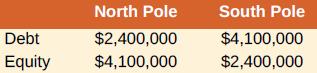
North Pole Fishing Equipment Corporation and South Pole Fishing Equipment Corporation would have identical equity betas of 1.05 if both were all equity financed. The market value information for each company is shown here: The expected return on the market portfolio is 10.9 percent and the
If Wild Widgets, Inc., were an all-equity company, it would have a beta of .95. The company has a target debt-equity ratio of .40. The expected return on the market portfolio is 11 percent and Treasury bills currently yield 3.5 percent. The company has one bond issue outstanding that matures in 15
Pompeii Pizza Club owns three identical restaurants popular for their specialty pizzas. Each restaurant has a debt-equity ratio of 40 percent and makes interest payments of $42,000 at the end of each year. The cost of the firm’s levered equity is 19 percent. Each store estimates that annual sales
What is the main difference between the FTE approach and the other two approaches?
Knotts, Inc., an all-equity firm, is considering an investment of $1.2 million that will be depreciated according to the straight-line method over its 4-year life. The project is expected to generate earnings before taxes and depreciation of $426,000 per year for four years. The investment will not
Benton is a rental car company that is trying to determine whether to add 25 cars to its fleet. The company fully depreciates all its rental cars over five years using the straight-line method. The new cars are expected to generate $245,000 per year in earnings before taxes and depreciation for
What is the main difference between the WACC and APV methods?
How is the APV of a project calculated?
Cede & Co. expects its EBIT to be $163,000 every year forever. The company can borrow at 8 percent. The company currently has no debt and its cost of equity is 15 percent. If the tax rate is 23 percent, what is the value of the company? What will the value be if the company borrows $185,000
Morrow Corp. has EBIT of $775,000 per year that is expected to continue in perpetuity. The unlevered cost of equity for the company is 12 percent and the corporate tax rate is 24 percent. The company also has a perpetual bond issue outstanding with a market value of $1.8 million. a. What is
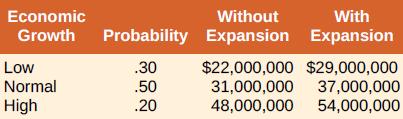
Sam McKenzie is the founder and CEO of McKenzie Restaurants, Inc., a regional company. Sam is considering opening several new restaurants. Sally Thornton, the company’s CFO, has been put in charge of the capital budgeting analysis. She has examined the potential for the company’s expansion and
Tom Scott is the owner, president, and primary salesperson for Scott Manufacturing. Because of this, the company’s profits are driven by the amount of work Tom does. If he works 40 hours each week, the company’s EBIT will be $435,000 per year; if he works a 50-hour week, the company’s EBIT
Charisma, Inc., has debt outstanding with a face value of $4.5 million. The value of the firm if it were entirely financed by equity would be $18.3 million. The company also has 340,000 shares of stock outstanding that sell at a price of $41 per share. The corporate tax rate is 21 percent. What is
Edwards Construction currently has debt outstanding with a market value of $95,000 and a cost of 9 percent. The company has EBIT of $8,550 that is expected to continue in perpetuity. Assume there are no taxes. a. What is the value of the company’s equity? What is the debt-tovalue
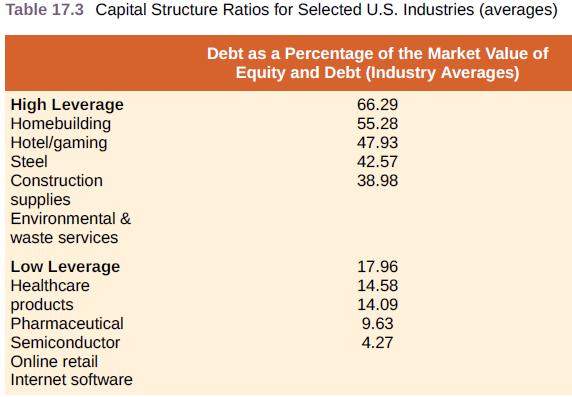
Refer to the observed capital structures given in Table 17.3 of the text. What do you notice about the types of industries with respect to their average debt-equity ratios? Are certain types of industries more likely to be highly leveraged than others? What are some possible reasons for this
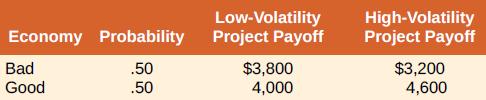
Fountain Corporation’s economists estimate that a good business environment and a bad business environment are equally likely for the coming year. The managers of the company must choose between two mutually exclusive projects. Assume that the project the company chooses will be the firm’s only
Good Time Company is a regional chain department store. It will remain in business for one more year. The probability of a boom year is 60 percent and the probability of a recession is 40 percent. It is projected that the company will generate a total cash flow of $126 million in a boom year and
Stephenson Real Estate Company was founded 25 years ago by the current CEO, Robert Stephenson. The company purchases real estate, including land and buildings, and rents the property to tenants. The company has shown a profit every year for the past 18 years and the shareholders are satisfied with
Byrd Corporation is comparing two different capital structures, an all-equity plan (Plan I) and a levered plan (Plan II). Under Plan I, the company would have 365,000 shares of stock outstanding. Under Plan II, there would be 245,000 shares of stock outstanding and $4.56 million in debt
Kolby Corp. is comparing two different capital structures. Plan I would result in 3,500 shares of stock and $37,440 in debt. Plan II would result in 2,800 shares of stock and $66,560 in debt. The interest rate on the debt is 10 percent. a. Ignoring taxes, compare both of these plans to an
FCOJ, Inc., a prominent consumer products firm, is debating whether or not to convert its all-equity capital structure to one that is 35 percent debt. Currently there are 5,000 shares outstanding and the price per share is $49. EBIT is expected to remain at $43,600 per year forever. The interest
ABC Co. and XYZ Co. are identical firms in all respects except for their capital structure. ABC is all equity financed with $540,000 in stock. XYZ uses both stock and perpetual debt; its stock is worth $270,000 and the interest rate on its debt is 8 percent. Both firms expect EBIT to be $61,000.
Gunnar Corp. uses no debt. The weighted average cost of capital is 8.6 percent. If the current market value of the equity is $37 million and there are no taxes, what is EBIT?
In the previous question, suppose the corporate tax rate is 23 percent. What is EBIT in this case? What is the WACC? Explain. Data From Previous Question.Gunnar Corp. uses no debt. The weighted average cost of capital is 8.6 percent. If the current market value of the equity is $37 million
Shadow Corp. has no debt but can borrow at 5.8 percent. The firm’s WACC is currently 9.1 percent and the tax rate is 22 percent. a. What is the company’s cost of equity? b. If the company converts to 25 percent debt, what will its cost of equity be? c. If the company converts
In Problem 14, what is the cost of equity after recapitalization? What is the WACC? What are the implications for the firm’s capital structure decision? Data From Problem 14Cede & Co. expects its EBIT to be $163,000 every year forever. The company can borrow at 8 percent. The company
Levered, Inc., and Unlevered, Inc., are identical in every way except their capital structures. Each company expects to earn $18 million before interest per year in perpetuity, with each company distributing all its earnings as dividends. Levered’s perpetual debt has a market value of $65 million
Tool Manufacturing has an expected EBIT of $63,000 in perpetuity and a tax rate of 21 percent. The firm has $115,000 in outstanding debt at an interest rate of 7 percent and its unlevered cost of capital is 12 percent. What is the value of the company according to MM Proposition I with taxes?
Hunter Corporation expects an EBIT of $31,480 every year forever. The company currently has no debt and its cost of equity is 14 percent. The tax rate is 21 percent. a. What is the current value of the company? b. Suppose the company can borrow at 8 percent. What will the value of the
The Bellwood Company is financed entirely with equity. The company is considering a loan of $3.1 million. The loan will be repaid in equal installments over the next two years and has an interest rate of 8 percent. The company’s tax rate is 24 percent. According to MM Proposition I with taxes,
Harris, Inc., has equity with a market value of $18.5 million and debt with a market value of $7.3 million. Treasury bills that mature in one year yield 4 percent per year and the expected return on the market portfolio is 11 percent. The beta of the company’s equity is 1.15. The firm pays no
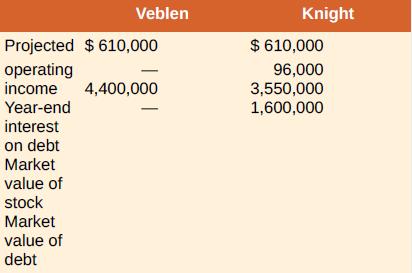
The Veblen Company and the Knight Company are identical in every respect except that Veblen is unlevered. The market value of Knight Company’s 6 percent bonds is $1.6 million. Financial information for the two firms appears here. All earnings streams are perpetuities. Neither firm pays taxes.
Refi Corporation is planning to repurchase part of its common stock by issuing corporate debt. As a result, the firm’s debt-equity ratio is expected to rise from 35 percent to 50 percent. The firm currently has $2.7 million worth of debt outstanding. The cost of this debt is 6.4 percent per
Taco Salad Manufacturing, Inc., plans to announce that it will issue $1.6 million of perpetual debt and use the proceeds to repurchase common stock. The bonds will sell at par with a coupon rate of 6 percent. The company is currently all-equity and worth $6.1 million with 280,000 shares of common
Dickson, Inc., has a debt-equity ratio of 2.3. The firm’s weighted average cost of capital is 10 percent and its pretax cost of debt is 6 percent. The tax rate is 24 percent. a. What is the company’s cost of equity capital? b. What is the company’s unlevered cost of equity
In a world of corporate taxes only, show that the WACC can be written as WACC = R0 × [1 − TC(B/V)].
Sunrise, Inc., has no debt outstanding and a total market value of $245,000. Earnings before interest and taxes, EBIT, are projected to be $19,000 if economic conditions are normal. If there is strong expansion in the economy, then EBIT will be 25 percent higher. If there is a recession, then EBIT
Bandon Manufacturing intends to issue callable, perpetual bonds with annual coupon payments and a par value of $1,000. The bonds are callable at $1,175. One-year interest rates are 9 percent. There is a 60 percent probability that long-term interest rates one year from today will be 10 percent and
New Business Ventures, Inc., has an outstanding perpetual bond with a 9 percent coupon rate that can be called in one year. The bond makes annual coupon payments and has a par value of $1,000. The call premium is set at $150 over par value. There is a 60 percent chance that the interest rate in
Assets, Inc., plans to issue $5 million of bonds with a coupon rate of 7 percent, a par value of $1,000, semiannual coupons, and 30 years to maturity. The current market interest rate on these bonds is 6 percent. In one year, the interest rate on the bonds will be either 9 percent or 5 percent
Edgehill, Inc., has 325,000 bonds outstanding. The bonds have a par value of $1,000, a coupon rate of 6 percent paid semiannually, and 13 years to maturity. The current YTM on the bonds is 5.6 percent. The company also has 10 million shares of stock outstanding, with a market price of $71 per
Away Corp. has interest-bearing debt with a market value of $55 million. The company also has 1.6 million shares that sell for $43 per share.What is the debt-equity ratio for this company based on market values?
Highway 65, Inc., is going to elect 12 board members next month. Betty Brown owns 11.6 percent of the total shares outstanding. How confident can she be of having one of her candidate friends elected under the cumulative voting rule? Will her friend be elected for certain if the voting procedure
The shareholders of Solar Power Corp. need to elect four new directors to the board. There are 14.3 million shares of common stock outstanding and the current share price is $15.25. If the company uses cumulative voting procedures, how much will it cost to guarantee yourself one seat on the board
An election is being held to fill three seats on the board of directors of a firm in which you hold stock. The company has 19,600 shares outstanding. If the election is conducted under cumulative voting and you own 500 shares, how many more shares must you buy to be assured of earning a seat on
The shareholders of the Mango Company need to elect seven new directors. There are 850,000 shares outstanding currently trading at $61 per share. You would like to serve on the board of directors; unfortunately, no one else will be voting for you. How much will it cost you to be certain that you
Happy Times, Inc., wants to expand its party stores into the Southeast. In order to establish an immediate presence in the area, the company is considering the purchase of the privately held Joe’s Party Supply. Happy Times currently has debt outstanding with a market value of $115 million and a
Photochronograph Corporation (PC) manufactures time series photographic equipment. It is currently at its target debt-equity ratio of .40. It’s considering building a new $60 million manufacturing facility. This new plant is expected to generate aftertax cash flows of $9.6 million a year in
Breckenridge Corp. has a debt-equity ratio of .65. The company is considering a new plant that will cost $137 million to build. When the company issues new equity, it incurs a flotation cost of 8 percent. The flotation cost on new debt is 3.5 percent. What is the initial cost of the plant if the
This is a comprehensive project evaluation problem bringing together much of what you have learned in this and previous chapters. Suppose you have been hired as a financial consultant to Defense Electronics, Inc. (DEI), a large, publicly traded firm that is the market share leader in radar
Floyd Industries stock has a beta of 1.15. The company just paid a dividend of $.75 and the dividends are expected to grow at 4.5 percent per year. The expected return on the market is 11 percent and Treasury bills are yielding 3.7 percent. The most recent stock price for the company is
Macfarlane, Inc., recently issued new securities to finance a new TV show. The project cost $30 million and the company paid $1.9 million in flotation costs. In addition, the equity issued had a flotation cost of 7 percent of the amount raised, whereas the debt issued had a flotation cost of 3
The Saunders Investment Bank has the following financing outstanding. What is the WACC for the company? Debt: 40,000 bonds with a coupon rate of 4.9 percent and a current price quote of 106.5; the bonds have 15 years to maturity and a par value of $1,000. 40,000 zero coupon bonds with a price
Och, Inc., is considering a project that will result in initial aftertax cash savings of $1.85 million at the end of the first year, and these savings will grow at a rate of 3 percent per year indefinitely. The company has a target debt-equity ratio of .65, a cost of equity of 11 percent, and an
Southern Alliance Company needs to raise $75 million to start a new project and will raise the money by selling new bonds. The company will generate no internal equity for the foreseeable future. The company has a target capital structure of 70 percent common stock, 5 percent preferred stock, and
Suppose your company needs $43 million to build a new assembly line. Your target debt-equity ratio is .65. The flotation cost for new equity is 6 percent and the flotation cost for debt is 2 percent. Your boss has decided to fund the project by borrowing money because the flotation costs are lower
Titan Mining Corporation has 6.4 million shares of common stock outstanding and 175,000 6.2 percent semiannual bonds outstanding, par value $1,000 each. The common stock currently sells for $53 per share and has a beta of 1.15; the bonds have 25 years to maturity and sell for 106 percent of par.
Given the following information for Huntington Power Co., find the WACC. Assume the company’s tax rate is 21 percent. Debt: 17,000 4.9 percent coupon bonds outstanding, $2,000 par value, 20 years to maturity, selling for 105 percent of par; the bonds make semiannual payments. Common
Kose, Inc., has a target debt-equity ratio of .38. Its WACC is 10.1 percent and the tax rate is 25 percent. a. If the company’s cost of equity is 12 percent, what is its pretax cost of debt? b. If instead you know that the aftertax cost of debt is 6.4 percent, what is the cost of
In the previous problem, suppose the company’s stock has a beta of 1.10. The risk-free rate is 2.9 percent and the market risk premium is 7 percent. Assume that the overall cost of debt is the weighted average implied by the two outstanding debt issues. Both bonds make semiannual payments. The
Hero Manufacturing has 7.6 million shares of common stock outstanding. The current share price is $67 and the book value per share is $4. The company also has two bond issues outstanding, both with semiannual coupons. The first bond issue has a face value of $80 million and a coupon rate of 6.8
Fama’s Llamas has a weighted average cost of capital of 9.1 percent. The company’s cost of equity is 11 percent and its cost of debt is 6.4 percent. The tax rate is 21 percent. What is the company’s debt-equity ratio?
Miller Manufacturing has a target debt-equity ratio of .40. Its cost of equity is 11.8 percent and its cost of debt is 6.5 percent. If the tax rate is 21 percent, what is the company’s WACC?
Mullineaux Corporation has a target capital structure of 70 percent common stock and 30 percent debt. Its cost of equity is 10.9 percent and the cost of debt is 5.7 percent. The relevant tax rate is 23 percent. What is the company’s WACC?
For the firm in the previous problem, suppose the book value of the debt issue is $25 million. In addition, the company has a second debt issue on the market, a zero coupon bond with nine years left to maturity; the book value of this issue is $60 million and the bonds sell for 68 percent of par.
Shanken Corp. issued a 30-year, 5.9 percent semiannual bond three years ago. The bond currently sells for 106 percent of its face value. The company’s tax rate is 22 percent. a. What is the pretax cost of debt? b. What is the aftertax cost of debt? c. Which is more relevant, the
One Step, Inc., is trying to determine its cost of debt. The firm has a debt issue outstanding with 17 years to maturity that is quoted at 95 percent of face value. The issue makes semiannual payments and has a coupon rate of 6 percent. What is the company’s pretax cost of debt? If the tax rate
What is wrong with measuring the performance of a U.S. growth stock manager against a benchmark composed of British stocks?
How can the return on a portfolio be expressed in terms of a factor model?
What is the relationship between the one factor model and the CAPM?
The Nixon Corporation’s common stock has a beta of .95. If the risk-free rate is 2.7 percent and the expected return on the market is 10 percent, what is the company’s cost of equity capital?
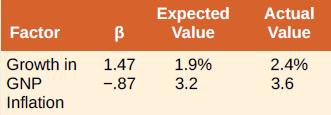
Suppose a factor model is appropriate to describe the returns on a stock. The current expected return on the stock is 10.5 percent. Information about those factors is presented in the following chart: a. What is the systematic risk of the stock return? b. The firm announced that its
A researcher has determined that a two-factor model is appropriate to determine the return on a stock. The factors are the percentage change in GNP and an interest rate. GNP is expected to grow by 3.5 percent and the interest rate is expected to be 2.9 percent. A stock has a beta of 1.3 on the
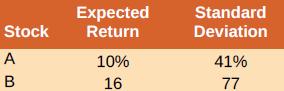
Assume Stocks A and B have the following characteristics: The covariance between the returns on the two stocks is .001. a. Suppose an investor holds a portfolio consisting of only Stock A and Stock B. Find the portfolio weights, XA and XB, such that the variance of her portfolio is
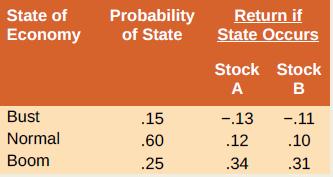
Suppose you observe the following situation: a. Calculate the expected return on each stock. b. Assuming the capital asset pricing model holds and Stock A’s beta is greater than Stock B’s beta by .25, what is the expected market risk premium? Return if State Occurs State of
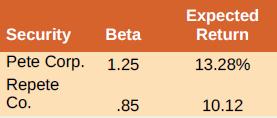
Suppose you observe the following situation: Assume these securities are correctly priced. Based on the CAPM, what is the expected return on the market? What is the risk-free rate? Expected Return Security Beta Pete Corp. 1.25 13.28% Repete Co. .85 10.12
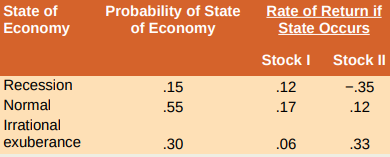
Consider the following information about Stocks I and II:? The market risk premium is 7.5 percent and the risk-free rate is 4 percent. Which stock has more systematic risk? Which one has more unsystematic risk? Which stock is ?riskier?? Explain. Rate of Return if State Occurs State of Probability
Suppose the risk-free rate is 4.4 percent and the market portfolio has an expected return of 10.9 percent. The market portfolio has a variance of .0391. Portfolio Z has a correlation coefficient with the market of .31 and a variance of .3407. According to the capital asset pricing model, what is
A portfolio that combines the risk-free asset and the market portfolio has an expected return of 9 percent and a standard deviation of 16 percent. The risk-free rate is 4.1 percent and the expected return on the market portfolio is 11 percent. Assume the capital asset pricing model holds. What
The market portfolio has an expected return of 11.5 percent and a standard deviation of 19 percent. The risk-free rate is 4.1 percent.a. What is the expected return on a well-diversified portfolio with a standard deviation of 9 percent? b. What is the standard deviation of a well-diversified
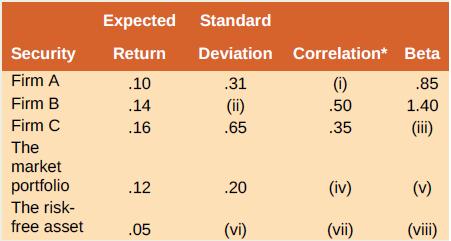
You have been provided the following data about the securities of three firms, the market portfolio, and the riskfree asset: a. Fill in the missing values in the table. b. Is the stock of Firm A correctly priced according to the capital asset pricing model (CAPM)? What about the stock of
Suppose the expected returns and standard deviations of Stocks A and B are E(RA) = .11, E(RB) = .13, σA = .47, and σB = .81. a. Calculate the expected return and standard deviation of a portfolio that is composed of 40 percent A and 60 percent B when the correlation between the returns on A
Showing 2900 - 3000
of 4098
First
23
24
25
26
27
28
29
30
31
32
33
34
35
36
37
Last
Step by Step Answers

 Get 50% OFF
Claim Now
Get 50% OFF
Claim Now