New Semester
Started
Get
50% OFF
Study Help!
--h --m --s
Claim Now
Question Answers
Textbooks
Find textbooks, questions and answers
Oops, something went wrong!
Change your search query and then try again
S
Books
FREE
Study Help
Expert Questions
Accounting
General Management
Mathematics
Finance
Organizational Behaviour
Law
Physics
Operating System
Management Leadership
Sociology
Programming
Marketing
Database
Computer Network
Economics
Textbooks Solutions
Accounting
Managerial Accounting
Management Leadership
Cost Accounting
Statistics
Business Law
Corporate Finance
Finance
Economics
Auditing
Tutors
Online Tutors
Find a Tutor
Hire a Tutor
Become a Tutor
AI Tutor
AI Study Planner
NEW
Sell Books
Search
Search
Sign In
Register
study help
business
financial accounting for managers
Loose Leaf For Financial Accounting For Managers 1st Edition Wayne Thomas ,Michael Drake ,Jake Thornock ,David Spiceland - Solutions
Transactions of a company that include the purchase and sale of resources that are expected to benefit the company for several years are referred to as:A) Investing activities.B) Financing activities.C) Expenditure activities.D) Operating activities.
Accountants are responsible for measuring various operating, investing, and financing activities. Which of the following correctly matches the activity with its type?A) Investing––paying for utilities used during the month B) Investing––purchasing land for cash C) Operating––paying cash
Draco Company engages in the following cash payments:Purchase equipment $ 2,000 Pay rent 500 Repay loan to the bank 5,000 Pay workers' salaries 1,000 What is the total amount of cash paid for operating activities?A) $6,000 B) $2,000 C) $7,000 D) $1,500
Draco Company engages in the following cash payments:Purchase equipment $ 3,650 Pay rent 525 Repay loan to the bank 4,500 Pay workers’ salaries 800 What is the total amount of cash paid for operating activities?A) $8,150 B) $1,325 C) $3,650 D) $5,300
Transactions related to the primary business activities of the company, such as selling goods and services to customers and the associated costs of doing so, are referred to as:A) Investing activities.B) Operating activities.C) Management activities.D) Financing activities.
How many of the following cash transactions are operating activities?Borrow $50,000 from the bank.Purchase $12,000 in supplies.Provide services to customers for $27,000.Pay the utility bill of $750.Purchase a delivery truck for $12,000.Receive $25,000 from issuing common stock.A) One B) Two C)
Which of the following is an operating activity?A) Issuing common stock B) Paying dividends C) Borrowing cash from a bank to acquire a building D) Paying electricity bills for the month
One disadvantage of the corporate form of business is:A) Limited liability.B) Access to more capital.C) Smaller in size.D) Double taxation.
Limited liability means:A) Stockholders of a corporation are not obligated to pay the corporation's debts out of their own pocket.B) Liabilities of a company cannot exceed its assets.C) Companies are not allowed to borrow unless they are profitable.D) Companies are less likely to be sued if they
Which business form has the advantage of limited liability?A) Corporation B) Sole proprietorship C) Partnership D) All business forms share equal limited liability
The form of business organization that is legally separate from its owners is a:A) Partnership.B) Sole proprietorship.C) Corporation.D) Separation entity.
Which of the following groups is not among the external users for whom financial statements are prepared?A) Customers B) Suppliers C) Regulators D) Customers, suppliers, and regulators are all external users of financial statements
Which of the following groups is not among the external users for whom financial statements are prepared?A) Creditors B) Regulators C) Investors D) Managers
The primary focus for financial accounting information is to provide information useful for:A) Investing decisions and credit decisions.B) Investing decisions but not credit decisions.C) Credit decisions but not investing decisions.D) Neither investing decisions nor credit decisions.
Financial accounting:A) Provides information primarily for external decision makers.B) Provides information primarily for a company's employees.C) Provides information primarily for the use of managers of the company.D) Is primarily used to compute a company's tax obligation.
Financial accounting does not deal with which of the following?A) Measuring a company's economic activity B) Providing information to internal users C) Preparing financial reports D) Communicating financial results to investors
Which definition below best describes financial accounting?A) Process of measuring income taxes owed to the government B) System of maintaining communication with a company's customers and suppliers C) Procedures designed to enhance the company's image to potential investors D) Measuring business
The primary purpose(s) of financial accounting is (are) to:A) Measure and record business transactions.B) Prepare federal and state tax returns.C) Communicate financial results to investors and creditors.D) Both measure and communicate financial information to external parties.
What is the primary purpose of financial accounting?A) Determine the amount of tax liability owed to the government B) Communicate business activities to internal management C) Measure business activities and communicate those measures to external users to make decisions D) Measure the
The economic entity assumption states that in the absence of information to the contrary, the business entity will continue to operate indefinitely.⊚ true⊚ false
The periodicity assumption indicates that the economic life of an enterprise can be divided into artificial time periods for financial reporting purposes.⊚ true⊚ false
To be a faithful representation of business activities, accounting information should be complete, neutral, and free from error.⊚ true⊚ false
Relevance refers to accounting information having confirmatory value and/or predictive value.⊚ true⊚ false
The two fundamental decision-specific qualitative characteristics that make accounting information useful are comparability and understandability.⊚ true⊚ false
The Financial Accounting Standards Board's conceptual framework does not prescribe Generally Accepted Accounting Principles. It provides an underlying foundation for the development of accounting standards and interpretation of accounting information.⊚ true⊚ false
Certain major events – such as mergers, acquisitions, and restatements – are to be reported on a more timely basis to the SEC using a current report.⊚ true⊚ false
Quarterly financial statements filed with the SEC are not audited.⊚ true⊚ false
Public companies are required to file quarterly financial statements on Form 10-Q.⊚ true⊚ false
The compensation of top executives is disclosed in the proxy statement.⊚ true ⊚ false
All companies are required to provide a summary of significant accounting policies in the disclosure notes to the annual report.⊚ true⊚ false
The primary objective of financial accounting is to provide useful information to managers in making decisions.⊚ true⊚ false
Auditors are trained individuals hired by a company as an independent party to express a professional opinion of the fairness of that company's financial statements.⊚ true⊚ false
The role of independent auditors is to help ensure that management has in fact appropriately applied Generally Accepted Accounting Principles (GAAP) in preparing the company's financial statements.⊚ true⊚ false
The 1934 Securities Exchange Act gives the Securities and Exchange Commission (SEC)the power to require companies that publicly trade their stock to prepare periodic financial statements for distribution to investors and creditors.⊚ true⊚ false
The 1933 Securities Act and the 1934 Securities Exchange Act were designed to restore investor confidence in financial accounting following the stock market crash in 1929.⊚ true⊚ false
Financial accounting and reporting standards in the United States are established primarily by the Financial Accounting Standards Board (FASB).⊚ true⊚ false
The rules of financial accounting are called Generally Accepted Accounting Principles(GAAP).⊚ true⊚ false
In general, if a company's net income is increasing, so will its stock price.⊚ true⊚ false
Investors and creditors rely heavily on financial accounting information in making investment and lending decisions.⊚ true⊚ false
Financial accounting has an impact on everyday business decisions as well as wideranging economic consequences.⊚ true⊚ false
The statement of comprehensive income is a financial statement that summarizes the changes in equity that arise from nonowner sources.⊚ true⊚ false
Any transaction that affects the income statement ultimately affects the balance sheet through the balance of retained earnings.⊚ true ⊚ false
Financing activities provide information to investors and creditors about the mix of external financing of the company.⊚ true⊚ false
Operating cash flows generally include cash transactions for the purchase and sale of resources that are expected to benefit the company for more than one year.⊚ true⊚ false
Investing cash flows generally include cash receipts and cash payments for transactions involving revenue and expense activities during the period.⊚ true⊚ false
All cash transactions reported on the statement of cash flows are classified as (1)operating activities, (2) investing activities, or (3) financing activities.⊚ true⊚ false
Dividends are considered an expense in running the business and reported on the income statement.⊚ true⊚ false
Retained earnings represent all net income minus all dividends over the life of the company.⊚ true⊚ false
Common stock represents an external source of stockholders' equity, whereas retained earnings represents an internal source.⊚ true⊚ false
Stockholders' equity arises from two primary sources–common stock and revenue.⊚ true⊚ false
The statement of stockholders' equity is a financial statement that summarizes the changes in stockholders' equity over an interval of time.⊚ true⊚ false
The balance sheet is a financial statement that reports the company's revenues and expenses over an interval of time.⊚ true⊚ false
Financial statements are periodic reports published by the company for the purpose of providing information to managers.⊚ true⊚ false
Double taxation refers to a corporation's income being taxed twice—first when the company pays corporate income taxes on income it earns, and then again when stockholders pay personal income taxes when the company distributes that income as dividends to them.⊚ true⊚ false
A company's total resources include assets and stockholders' equity.⊚ true⊚ false
Limited liability means the stockholders are not held personally responsible for the financial obligations of the corporation.⊚ true⊚ false
One of the differences between a partnership and a corporation is that owners of a partnership have limited liability.⊚ true⊚ false
Dividends represent a return of the company's profits to its owners, the stockholders.⊚ true⊚ false
Expenses include a company’s costs of providing products and services to customers, as well as cash payments to its stockholders.⊚ true⊚ false
If a company reports revenues of $17,000 and expenses of $12,000, then net income equals $5,000.⊚ true⊚ false
The difference between revenues and expenses is referred to as net income or net loss.⊚ true⊚ false
The costs related to rent, utilities, and salaries in the current reporting period are examples of liabilities.⊚ true⊚ false
The accounting equation shows that a company's total resources equal creditors' and owners' claims to those resources.⊚ true⊚ false
If total liabilities of a company equal $16,000 and total stockholders' equity equals$9,000, then total assets equal $7,000.⊚ true⊚ false
If total assets of a company equal $12,000 and total stockholders' equity equals $4,000, then total liabilities equal $8,000.⊚ true⊚ false
Amounts owed to suppliers, employees, the government in the form of taxes, and utility companies are examples of liabilities.⊚ true⊚ false
Cash, inventory for sale to customers, supplies, and buildings are examples of liabilities.⊚ true⊚ false
A corporation is an entity that is legally separate from its owners.⊚ true⊚ false
Operating activities include transactions that relate to the primary operations of the company, such as providing products and services to customers and the associated costs.⊚ true⊚ false
Investing activities include transactions involving the purchase and sale of resources that are expected to benefit the company for several years.⊚ true⊚ false
Financing activities include transactions the company has with investors and creditors.⊚ true⊚ false
The primary functions of financial accounting are to measure business activities of a company and to communicate those measurements to internal parties for decision-making purposes.⊚ true⊚ false
Accounting information is used by creditors to decide whether to invest in a company's stock.⊚ true⊚ false
Accounting information is used by investors to decide whether to invest in a company's stock.⊚ true⊚ false
Accounting is a system of maintaining records of a company's operations and communicating that information to decision makers.⊚ true⊚ false
Define the four basic assumptions underlying Generally Accepted Accounting Principles:(a) economic entity, (b) going concern, (c) periodicity, (d) monetary unit.
How does the value of an audit affect financial statements?
List and describe the four financial statements most frequently provided to external users.
Describe the three fundamental business activities that accountants measure using the statement of cash flows.
Define accounting. Describe the two primary functions of financial accounting and its role in our society.
Use the following information available as of December 31 to prepare an income statement for the year and a balance sheet at December 31st for Bronzer Company.Fees received for services performed during the year, $120,000 Accounts payable, $18,500 Accounts receivable, $17,300 Miscellaneous expenses
Use the following information available as of December 31 to prepare an income statement for the year and a balance sheet at December 31st for Glacier Company.Fees received for services performed during the year, $120,000 Accounts payable, $18,100 Accounts receivable, $17,300 Miscellaneous expenses
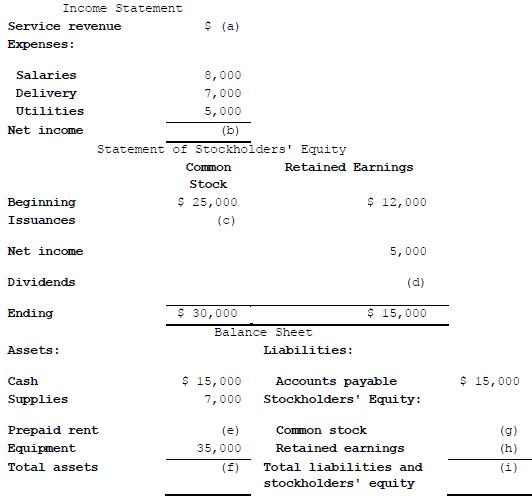
Below are incomplete financial statements for Barrington, Incorporated. Calculate the missing amounts. Income Statement Service revenue Expenses: $ (a) Salaries Delivery Utilities Net income 8,000 7,000 5,000 (b) Statement of Stockholders' Equity Beginning Issuances Net income Dividends Ending
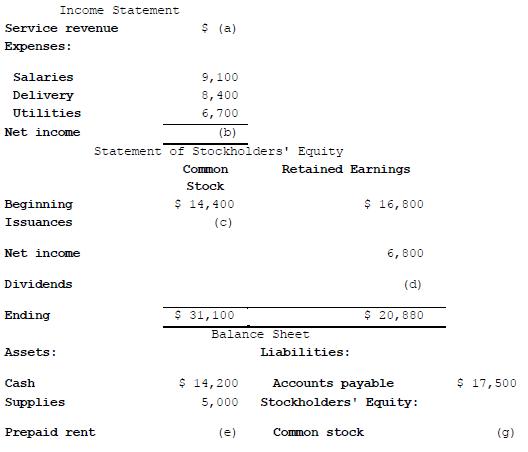
Below are incomplete financial statements for Glacier, Incorporated. Calculate the missing amounts Income Statement Service revenue Expenses: $ (a) Salaries Delivery Utilities Net income 9,100 8,400 6,700 (b) Statement of Stockholders' Equity Beginning Issuances Net income Dividends Ending Assets:
Northeast, Incorporated reports the following amounts at the end of the year:In addition, the company had common stock of $65,000 at the beginning of the year and issued an additional $5,000 of common stock during the year. The company also had retained earnings of $20,700 at the beginning of the
Northeast, Incorporated reports the following amounts at the end of the yearIn addition, the company had common stock of $79,000 at the beginning of the year and issued an additional $6,100 during the year. The company also had retained earnings of $28,400 at the beginning of the year and paid
Below is cash flow information for five independent situations. Calculate the answer to each.1.A company reports operating cash flows of $3,200, investing cash flows of $700, and financing cash flows of −$400. What is the amount of the change in total cash?2.A company reports operating cash flows
Below is cash flow information for five independent situations. Calculate the answer to each.1.A company reports operating cash flows of $2,710, investing cash flows of $410, and financing cash flows of −$200. What is the amount of the change in total cash?2.A company reports operating cash flows
Below is balance sheet information for five independent situations. Calculate the answer to each.1.A company reports total assets of $2,000 and total liabilities of $900. What is the amount of stockholders' equity?2.A company reports total liabilities of $2,400 and stockholders' equity of $1,100.
Below is balance sheet information for five independent situations. Calculate the answer to each.1.A company reports total assets of $2,340 and total liabilities of $790. What is the amount of stockholders' equity?2.A company reports total liabilities of $3,600 and stockholders' equity of $700.
Below is information related to retained earnings for five independent situations.Calculate the answer to each.1.A company reports an increase in retained earnings of $3,200 and net income of $4,800. What is the amount of dividends?2.A company reports beginning retained earnings of $1,800, net
Below is information related to retained earnings for five independent situations.Calculate the answer to each.1.A company reports an increase in retained earnings of $2,870 and net income of $4,420. What is the amount of dividends?2.A company reports beginning retained earnings of $2,600, net
During its first five years of operations, Waterhouse Manufacturing reports net income and pays dividends as follows. Calculate the balance of retained earnings at the end of each year.Note that retained earnings will always equal $0 at the beginning of year 1.Year Net Income Dividends 1 $ 1,700 $
During its first five years of operations, Waterhouse Manufacturing reports net income and pays dividends as follows. Calculate the balance of retained earnings at the end of each year.Note that retained earnings will always equal $0 at the beginning of year 1.Year Net Income Dividends 1 $ 2,000 $
Each of the following independent situations represents amounts shown on the four basic financial statements. Fill in the missing blanks using your knowledge of amounts that appear on the financial statements.1.Revenues = $27,000; Expenses = $18,000; Net income = ________.2.Increase in
Each of the following independent situations represents amounts shown on the four basic financial statements. Fill in the missing blanks using your knowledge of amounts that appear on the financial statements.1.Revenues = $27,700; Expenses = $19,200; Net income = ________.2.Increase in
Glenview Financial has the following cash transactions for the year. Assume cash at the beginning of the period is $6,000. Prepare a statement of cash flows.Accounts Amounts Cash received for sale of services to customers $ 42,000 Cash received from issuance of common stock 33,000 Cash paid to
Glenview Financial has the following cash transactions for the year. Assume cash at the beginning of the period is $8,100. Prepare a statement of cash flows.Accounts Amounts Cash received for sale of services to customers $ 50,000 Cash received from issuance of common stock 28,000 Cash paid to
Shalett Interiors has the following account balances at the end of the year. Use only the appropriate accounts to prepare a balance sheet.Accounts Balances Equipment $78,000 Accounts payable 12,000 Common stock 20,000 Service revenue 62,000 Cash 8,000 Retained earnings ?Salaries expense 38,000
Shalett Interiors has the following account balances at the end of the year. Use only the appropriate accounts to prepare a balance sheet.Accounts Balances Equipment $ 86,700 Accounts Payable 13,600 Common Stock 14,600 Service Revenue 58,100 Cash 10,000 Retained Earnings ?Salaries Expense 36,600
Showing 1100 - 1200
of 1520
First
2
3
4
5
6
7
8
9
10
11
12
13
14
15
16
Step by Step Answers

 Get 50% OFF
Claim Now
Get 50% OFF
Claim Now