New Semester
Started
Get
50% OFF
Study Help!
--h --m --s
Claim Now
Question Answers
Textbooks
Find textbooks, questions and answers
Oops, something went wrong!
Change your search query and then try again
S
Books
FREE
Study Help
Expert Questions
Accounting
General Management
Mathematics
Finance
Organizational Behaviour
Law
Physics
Operating System
Management Leadership
Sociology
Programming
Marketing
Database
Computer Network
Economics
Textbooks Solutions
Accounting
Managerial Accounting
Management Leadership
Cost Accounting
Statistics
Business Law
Corporate Finance
Finance
Economics
Auditing
Tutors
Online Tutors
Find a Tutor
Hire a Tutor
Become a Tutor
AI Tutor
AI Study Planner
NEW
Sell Books
Search
Search
Sign In
Register
study help
business
foundations macroeconomics
Macroeconomics For Today 11th Edition Irvin B. Tucker - Solutions
Predict the direction of change for either supply or demand in the following situations:a. Several new companies enter the cell phone industry.b. Consumers suddenly decide SUVs are unfashionable.c. Frost threatens to damage the coffee crop, and consumers expect the price to rise sharply in the
Suppose war in the Middle East threatened oil supplies, and gasoline prices began rising.Consumers feared future oil shortages, so they rushed to fill up their gas tanks. In this case, as the price of gas increased, consumers bought more, not less. Is this an exception to the law of demand?
Draw graphs to illustrate the difference between a decrease in quantity supplied and a decrease in supply for condominiums. Give a possible reason for change in each graph.
Suppose oil prices rise sharply for years as a result of war in the Persian Gulf region. What happens and why to the demand for each of the following?a. Carsb. Home insulationc. Coald. Tires
Draw graphs to illustrate the difference between a decrease in the quantity demanded and a decrease in demand for Mickey Mantle baseball cards. Give a possible reason for change in each graph.
Some people will pay a higher price for brandname goods. For example, some people buy Rolls Royce cars and Rolex watches to impress others. Does knowingly paying higher prices for certain items just to be a “snob” violate the law of demand?
Explain why an allocatively efficient point on the PPC is also productively efficient, but a productively efficient point on the PPC may or may not be allocatively efficient.
With the disappearance of the former Soviet Union and the end of the Cold War, the United States became the world’s only superpower and no longer engaged in an intense competition to build up its military. As a result, in the 1990s, Congress and the White House had the opportunity to reduce the
The present choice between investing in capital goods and producing consumer goods now affects the ability of an economy to produce in the future. Explain.
Draw a production possibilities curve for a hypothetical economy producing capital goods and consumer goods. Suppose a major technological breakthrough occurs in the capital goods industry and the new technology is widely adopted only in this industry. Draw the new production possibilities curve.
Suppose, unfortunately, your mathematics and economics professors have decided to give tests two days from now and you can spend a total of only twelve hours studying for both exams. After some thought, you conclude that dividing your study time equally between each subject will give you an
Interpret the phrases “There is no such thing as a free lunch” and “A free lunch is possible” in terms of the production possibilities curve.
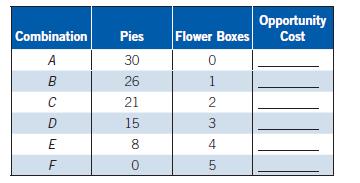
The following table shows the production possibilities for pies and flower boxes. Fill in the opportunity cost (pies forgone) of producing the first through the fifth flower box. Combination Pies Flower Boxes Opportunity Cost A 30 0 B 26 1 21 2 D 15 3 E 8 F 0 5
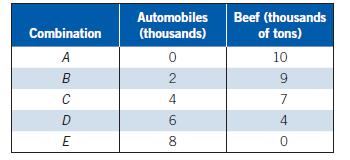
The following is a set of hypothetical production possibilities for a nation.a. Plot these production possibilities data. What is the opportunity cost of the first 2,000 automobiles produced? Between which points is the opportunity cost per thousand automobiles highest? Between which points is the
Which of the following decisions has the greater opportunity cost? Why?a. A decision to use an undeveloped lot in Tokyo’s financial district for an apartment building.b. A decision to use a square mile in the desert for a gas station.
Explain verbally the statement “There is no such thing as a free lunch” in relation to scarce resources.
Suppose a retailer promotes its store by advertising a drawing for a “free car.” Is this car free because the winner pays zero for it?
Assume a research firm collects survey sales data that reveal the relationship between the possible selling prices of hamburgers and the quantity of hamburgers consumers would purchase per year at alternative prices. The report states that if the price of a hamburger is $4, then 20,000 will be
Draw a graph without specific data for the expected relationship between the following variables:a. The probability of living and ageb. Annual income and years of educationc. Inches of snow and sales of bathing suitsd. Number of football games won and the athletic budget In each case, state whether
In order for Ethiopia to increase its future economic growth, it must choose a point that isa. below its production possibilities curve.b. further along on its production possibilities curve toward the capital goods axis.c. further along on its production possibilities curve toward the consumption
If a country’s population grows at the same rate as its real GDP, then real per capita GDPa. grows at an increasing rate.b. grows at a constant rate.c. doesn’t change.d. decreases at a decreasing rate.
Which of the following best defines the vicious circle of poverty?a. Countries are poor because they cannot afford to save and invest.b. Countries are poor because of high population growth.c. Countries are poor because of lack of education and training for workers.d. Countries are poor because of
Which of the following is not an example of a country’s infrastructure?a. Transportation systemb. Communications systemc. Political systemd. Educational system
Which of the following makes short-term conditional low-interest loans to LDCs?a. World Bankb. Agency for International Development (AID)c. Agency for International Finance (AIF)d. International Monetary Fund (IMF)
Which of the following makes long-term lowinterest loans to LDCs?a. Agency for International Development (AID)b. World Bankc. International Monetary Fund (IMF)d. New International Economic Order (NIEO)
Which of the following is in charge of U.S. aid to foreign countries?a. Agency for International Development (AID)b. World Bankc. International Monetary Fund (IMF)d. New International Economic Order (NIEO)
Exhibit 8 shows the production possibilities curve of the nation of Padia. Based only on this information, the point which would produce the lowest rate of growth would bea. I.b. II.c. III.d. IV.e. V.
Exhibit 8 shows the production possibilities curve of the nation of Padia. Based only on this information, which point would produce the highest rate of growth?a. Ib. IIc. IIId. IVe. V
Which of the following is a true statement?a. The LDC classification is of questionable accuracy.b. GDP per capita ignores the degree of income distribution.c. GDP per capita is affected by exchange rate changes.d. GDP per capita does not account for the difference in the cost of living among
Economic growth and development in LDCs are low because many of them lacka. savings.b. infrastructure.c. a political environment favorable to growth.d. All of the answers are correct.
Which of the following is a characteristic of an LDC?a. Capital flightb. Vicious circle of povertyc. Lack of entrepreneursd. All of the answers are correct.
Economic development encompasses which of the following measures?a. Economic growthb. The political environmentc. Educationd. All of the answers are correct.
Real GDP per capita and other alternative measures of the quality of life area. independent.b. directly correlated.c. poorly correlated.d. inversely related.
Compared to IACs, LDCs are often characterized bya. lower life expectancy.b. lower adult literacy.c. lower per capita energy consumption.d. All of the answers are correct.
Which of the following is not a characteristic of most less-developed countries?a. Inadequate human capitalb. Inadequate capital goodsc. High population growth rated. Inadequate water suppliese. High productivity
Which of the following statements explains the vicious circle of poverty?a. By investing in education and infrastructure at the same time, the country can overcome the problems of poverty.b. Poverty arises out of the lack of investment, but countries cannot invest because they are poor.c. A nation
Which of the following is infrastructure?a. Policeb. Training and educationc. Highwaysd. All of the answers are correct.
GDP per capita is a relatively good measurement ofa. the distribution of income.b. purchasing power.c. household production.d. the standard of living.
Which of the following is a problem when comparing GDP per capita between nations?a. GDP per capita fails to measure income distribution.b. Fluctuations in exchange rates affect differences in GDP per capita.c. GDP per capita is subject to greater measurement errors for LDCs compared to IACs.d. All
Which of the following statements is true?a. The United States today comes closer to the socialist form of economic organization than it does to capitalism.b. When central planners set prices above equilibrium for goods and services, they create shortages.c. According to Karl Marx, under
Which of the following is a correct characterization of socialism?a. Tradition answers the basic economic questions.b. Markets are used exclusively to answer the basic economic questions.c. Resources are privately owned but central planning is used to answer the basic economic questions.d.
Property rights allowing individuals to own goods, services, and factors of production are most important ina. socialistic economies.b. planned economies.c. capitalist economies.d. command economies.
Which of the following economies is an example of a mixed system?a. United Statesb. United Kingdomc. Swedend. All of these answers are correct.
Adam Smith’s book Wealth of Nations was published at the time of thea. War of 1812.b. U.S. Declaration of Independence.c. U.S. Civil War.d. Great Depression.
Which nation achieved the ideal communist society as described by Marx?a. Castro’s Cubab. Mao’s Chinac. Stalin’s Soviet Uniond. No nation has achieved Marx’s vision of a communist society.
A principal feature of a command economy is that .a. production decisions are made by profitmaximizing firms.b. there is a central planning board at the top that transmits economic decisions down to the various producing and consuming units below.c. consumers are allowed to determine what is
According to Adam Smith, the “invisible hand”refers to which of the following?a. The “best interests of society” (public interest)will occur as an outcome of the market process coordinating the self- interested interactions of buyers and sellers (private interest).b. Government interference
In Marx’s ideal communist society, the statea. actively promotes income incentives.b. follows the doctrine of laissez-faire.c. owns resources and conducts planning.d. does not exist.
Karl Marx publisheda. Das Kapital.b. General Theory of Communism.c. The Wealth of Nations.d. The Capitalist Manifesto.
The term socialism refers to which of the following?a. A religion centered on community interactionb. An economic system characterized by private ownership of resources and decentralized market-price allocationc. An economic system characterized by government ownership of resources and centralized
Which of the following is a strength of a command-based economic system?a. Goods can be allocated based on need rather than willingness and ability to pay.b. Producers have strong incentives to innovate because successful innovators are rewarded with higher profit.c. Consumers can transmit their
Which of the following statements is true?a. The doctrine of laissez-faire advocates an economic system with extensive government intervention and little individual decision making.b. In capitalism, income is distributed on the basis of need.c. Adam Smith was the father of socialism.d. Most
Which of the following is a criticism of capitalism?a. Unequal distribution of incomeb. Failure to protect the environmentc. Exploitation of workersd. All of these answers are correct.
Adam Smith wrote that thea. economic problems of eighteenth-century England were caused by free markets.b. government should control the economy.c. pursuit of private self-interest promotes the public interest in a market economy.d. public or collective interest is not promoted by people pursuing
In Adam Smith’s competitive market economy, the question of what goods to produce is determined by thea. “invisible hand” of the price system.b. “invisible hand” of government.c. “invisible hand” of public interest.d. “visible hand” of laws and regulations.
Adam Smith was an advocate ofa. mercantilism.b. a nation maximizing its stock of gold.c. unrestricted or free trade.d. the “visible hand” of public interest.
In a command economy, the basic economic questions are answered bya. central authority.b. individual buyers and sellers.c. traditional methods.d. None of these answers are correct.
An economic system is the organizations and methods used to determinea. what goods and services are produced.b. how goods and services are produced.c. for whom goods and services are produced.d. All of these answers are correct.
A shift of the U.S. demand curve for Mexican pesos to the left and a decrease in the peso price per dollar would result froma. an increase in the U.S. inflation rate relative to the rate in Mexico.b. a change in U.S. consumers’ tastes away from Mexican products and toward products made in South
Which of the following is not included in the current account?a. exports of goodsb. imports of goodsc. U.S. capital inflow and outflowd. unilateral transfers
One big difference between tariffs and quotas is that tariffsa. raise the price of a good while quotas lower it.b. generate tax revenues while quotas do not.c. stimulate international trade while quotas inhibit it.d. hurt domestic producers while quotas help them.
If one country can produce a good with fewer resources than another country, this is calleda. specialization.b. geographic advantage.c. comparative advantage.d. absolute advantage.
A country that has a lower opportunity cost of producing a gooda. has a comparative advantage.b. can produce the good using fewer resources than another country.c. requires fewer labor hours to produce the good.d. All of the above answers are correct.
Which of the following could cause the dollarpound exchange rate to change as shown in Exhibit 15?a. American goods become more popular in Great Britain.b. British incomes rise, while U.S. incomes remain unchanged.c. The U.S. price level rises, while the British price level remains unchanged.d. The
Exhibit 15 shows a situation in whicha. both the dollar and the pound have depreciated.b. both the dollar and the pound have appreciated.c. the dollar has depreciated, and the pound has appreciated.d. the dollar has appreciated, and the pound has depreciated.
Suppose a German bank purchases a U.S.Treasury bond. This transaction would be recorded in thea. capital account.b. current account.c. goods trade balance.d. unilateral transfers.
Expenditures for services such as tourism, income for foreign investment, and foreign gifts are tabulated in thea. current account.b. capital account.c. official reserve account.d. goods account.
The account that records a nation’s foreign economic transactions is called thea. trade account.b. T account.c. exchange market.d. balance of payments.
The main explanation for why the cheap foreign labor argument is a poor reason for restricting international trade is thata. workers who get paid less tend to have lower productivity than those who get paid more.b. all firms and workers gain when there are no restrictions on international trade.c.
Which of the following is not an argument used in favor of protectionism?a. to protect an “infant” industryb. to protect domestic jobsc. to preserve national securityd. to protect against “unfair” competition because of cheap foreign labore. to reduce prices paid by domestic consumers
The principal objective of the WTO is toa. reduce the level of all tariffs.b. establish fair prices for all goods traded internationally.c. prevent the trading of services across nations’borders.d. encourage countries to establish quotas.
A tariff is aa. tax on an exported product.b. limit on the number of goods that can be exported.c. limit on the number of goods that can be imported.d. tax on an imported product.e. subsidy on an imported product.
If each nation in Exhibit 14 specializes in producing the good for which it has a comparative advantage, thena. Ireland would produce neither potatoes nor wheat.b. the United States would produce both potatoes and wheat.c. the United States would produce potatoes.d. Ireland would produce potatoes.
In Exhibit 14, the United States has a comparative advantage in producinga. potatoes.b. wheat.c. both potatoes and wheat.d. neither potatoes nor wheat.
In Exhibit 14, Ireland’s opportunity cost of producing one unit of wheat isa. 1/3 ton of potatoes.b. 3 tons of potatoes.c. either a or b.d. neither a nor b.
In Exhibit 14, the United States has an absolute advantage in producinga. potatoes.b. wheat.c. both potatoes and wheat.d. neither potatoes nor wheat.
Assume the United States can use a given amount of its resources to produce either 20 airplanes or 8 automobiles and Japan can employ the same amount of its resources to produce either 20 airplanes or 10 automobiles. The United States should specialize ina. airplanes.b. automobiles.c. both goods.d.
The theory of comparative advantage suggests that a (an)a. industrialized country should not import.b. country that is not competitive should import everything.c. country specialize in producing goods or services for which it has a lower opportunity cost.d. None of the above answers are correct.
As shown in Exhibit 11, if people behave according to rational expectations theory, an increase in the aggregate demand curve from AD1 to AD2 will cause the economy to movea. directly from E1 to E3 and then remain at E3.b. directly from E1 to E2 and then remain at E2.c. from E1 to E2 initially and
As shown in Exhibit 11, if people behave according to rational expectations theory, an increase in the aggregate demand curve from AD1 to AD2 will cause the price level to movea. directly from 100 to 105 and then remain at 105.b. directly from 100 to 110 and then remain at 110.c. from 100 to 105
As shown in Exhibit 11, if people behave according to adaptive expectations theory, an increase in the aggregate demand curve from AD1 to AD2 will causea. labor to adjust nominal wages sluggishly.b. the aggregate supply curve to shift from SRAS1 to SRAS2.c. the price level to eventually rise from
As shown in Exhibit 11, if people behave according to adaptive expectations theory, an increase in the aggregate demand curve from AD1 to AD2 will cause the price level to movea. directly from 100 to 110 and then remain at 110.b. directly from 100 to 105 and then remain at 105.c. from 100 to 105
As shown in Exhibit 11, if people behave according to adaptive expectations theory, an increase in the aggregate demand curve from AD1 to AD2 will cause the economy to movea. directly from E1 to E3 and then remain at E3.b. directly from E1 to E2 and then remain at E2.c. from E1 to E2 initially and
Which of the following is an example of an incomes policy?a. Presidential jawboningb. Wage and price guidelinesc. Wage and price controlsd. All of the above answers are correct.
Suppose the economy in Exhibit 10 is at point E1, and the Fed increases the money supply. If people have rational expectations, then the economy will movea. to point A in the short run and point B in the long run.b. directly to point B.c. to point C in the short run and point D in the long run.d.
Suppose the economy in Exhibit 10 is at point E1, and the Fed increases the money supply. If people have adaptive expectations, then the economy will movea. to point A in the short run and point B in the long run.b. directly to point B.c. to point C in the short run and point D in the long run.d.
“Preannounced, stable policies to achieve a low and constant money supply growth and a balanced federal budget are therefore the best way to lower the inflation rate.” This statement best illustratesa. Keynesian theory.b. rational expectations theory.c. incomes policy.d. supply-side theory.
According to adaptive expectations theory, expansionary monetary and fiscal policies to reduce the unemployment rate area. useless in the long run.b. useless in the short run.c. ineffective in impacting the price level.d. None of the answers are correct.
Under adaptive expectations theory, people expect the rate of inflation this year to bea. zero, regardless of the rate last year.b. the same as last year.c. the rate based on predictable fiscal policies.d. All of the answers are correct.
The hypothesis that people believe that the best indicator of the future is the recent past isa. rational expectations.b. adaptive expectations.c. lagged expectations.d. trend expectations.
Under the natural rate hypothesis, expansionary monetary and fiscal policies can at best produce aa. permanent change in the long-run Phillips curve.b. short-run change in the unemployment rate.c. long-run change in the unemployment rate.d. permanent change in the unemployment rate.
The long-run Phillips curve is a(an)line at the natural rate of unemployment.a. horizontalb. verticalc. upward-slopingd. downward-sloping
The natural rate hypothesis argues that the economy willa. self-correct to the natural rate of inflation.b. require expansionary fiscal policy to reach the natural rate of unemployment.c. self-correct to the natural rate of unemployment.d. require expansionary monetary policy to reach the natural
If the long-run Phillips curve is vertical, then any government policy designed to lowera. unemployment will not change the unemployment rate and only increase the inflation rate.b. unemployment will work, leaving the inflation rate unchanged.c. inflation will cause employment to rise.d.
The Phillips curvea. was relatively well-defined during the 1960s.b. demonstrates how to achieve stable economic growth.c. shows the trade-off between deficits and inflation.d. helps to stimulate entrepreneurial profits.
Economists began to lose confidence in the Phillips curve during thea. 1930s.b. 1960s.c. 1970s.d. 1980s.
On a Phillips curve diagram, an increase in the rate of inflation and a decrease in the rate of unemployment, is represented by a(an)a. upward movement along the Phillips curve.b. downward movement along the Phillips curve.c. upward shift of the Phillips curve.d. downward shift of the Phillips
The Phillips curve relates the inflation rate toa. the unemployment rate.b. GDP.c. disposable personal income.d. the interest rate.
Assume that the economy depicted in part (b) of Exhibit A-3 is in short-run equilibrium with AD1 and SRAS. Keynesian theory arguesa. nominal wages will fall as long as employment remains above the natural level of unemployment.b. lower wages will result in a shift from SRAS1 to SRAS2 as shown in
In part (b) of Exhibit A-3, the economy is initially in short-run equilibrium at real GDP level Y1 and price level P2. If the government decides to intervene, it woulda. increase taxes.b. decrease the money supply.c. increase the level of government spending for goods and services.d. decrease the
Showing 100 - 200
of 5010
1
2
3
4
5
6
7
8
9
10
11
12
13
14
15
Last
Step by Step Answers

 Get 50% OFF
Claim Now
Get 50% OFF
Claim Now