New Semester
Started
Get
50% OFF
Study Help!
--h --m --s
Claim Now
Question Answers
Textbooks
Find textbooks, questions and answers
Oops, something went wrong!
Change your search query and then try again
S
Books
FREE
Study Help
Expert Questions
Accounting
General Management
Mathematics
Finance
Organizational Behaviour
Law
Physics
Operating System
Management Leadership
Sociology
Programming
Marketing
Database
Computer Network
Economics
Textbooks Solutions
Accounting
Managerial Accounting
Management Leadership
Cost Accounting
Statistics
Business Law
Corporate Finance
Finance
Economics
Auditing
Tutors
Online Tutors
Find a Tutor
Hire a Tutor
Become a Tutor
AI Tutor
AI Study Planner
NEW
Sell Books
Search
Search
Sign In
Register
study help
business
fundamental accounting
Fundamental Accounting Principles Volume 2 21st Edition John Wild, Ken Shaw, Barbara Chiappetta - Solutions
Refer to the information in Problem 6-3A and assume the periodic inventory system is used. Problem 6-4A*Periodic: Alternative cost flows Required p.|1. Compute cost of goods available for sale and the number of units available for sale.2. Compute the number of units in ending inventory.3. Compute
Information: Seminole Company began year 2013 with 23,000 units of product in its .lanuary 1 inventory costing $15 each. It made successive purchases of its product in year 2013 as follows. The company uses a periodic inventory system. On December 31, 2013, a physical count reveals that 40,000
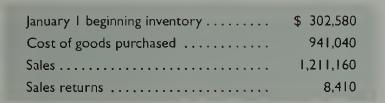
Wayward Company wants to prepare interim financial statements for the first quarter. The company wishes to avoid making a physical count of inventory. Waywiird’s gross profit rate averages 34%. The following information for the first quarter is available from its records.Required Use the gross
Information: TDS Company uses a perpetual inventory system. It entered into the following purchases and sales transactions for April. (For specific identification, the April 9 sale consisted of 8 units from beginning inventory and 27 units from the April 6 purchase; the April 30 sale consisted of
Refer to the information in Problem 6-1B and assume the periodic inventory system is used.Required 1. Compute cost of goods available for sale and the number of units available for sale.2. Compute the number of units in ending inventory.3. Compute the cost assigned to ending inventory using (a)
Information: Seneca Co. began year 2013 with 6,500 units of product in its January 1 inventory costing $35 each. It made successive purchases of its product in year 2013 as follows. The company uses a peri¬ odic inventory system. On December 31, 2013, a physical count reveals that 8,500 units of
Success Systems P2 A3: PartA Adria Lopez of Success Systems is evaluating her inventory to determine whether it must be adjusted based on lower of cost or market rules. Her company has three different types of software in its inventory and the following information is available for each.Required 1.
Access the September 24, 2011, 10-K report for Apple, Inc. (Ticker AAPL), filed on October 26, 2011, from the EDGAR filings at www.SEC.gov.Required 1. What products are manufactured by Apple?2. What inventory method does Apple use? {Hint: See the Note 1 to its financial statements.)3. Compute its
Where do we get the amounts to enter in the Unadjusted Thai Balance columns of a work sheet?
Why are revenue and expense accounts called temporary? Identify and list the types of temporary accounts.
What accounts are listed on the post-closing trial balance?
Classify the following assets as (1) current assets, (2) plant assets, or (3) intangible assets:(a) land used in operations, (b) office supplies, (c) receivables from customers due in 10 months, id) insurance protection for the next 9 months, (e) trucks used to provide services to customers, (f)
Cite at least two examples of assets classified as investments on the balance sheet.
Explain why temporary accounts are closed each period.
Explain and prepare a classified balance sheet
Compute the current ratio and describe what it reveals about a company’s financial condition.
Describe and prepare closing entries
Prepare reversing entries and explain their purpose.
Explain and prepare a post-closing trial balance.
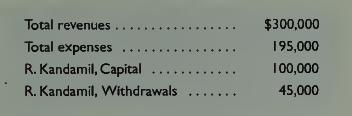
The following information is available for the R. Kandamil Company before closing the accounts. After all of the closing entries are made, what will be the balance in the R. Kandamil, Capital account?a. $360,000d. $150,000b. $250,000e. $60,000c. $160,000 Total revenues $300,000 Total expenses
Which of the following errors would cause the balance sheet and statement of owner’s equity columns of a work sheet to be out of balance?a.Entering a revenue amount in the balance sheet and state¬ ment of owner’s equity debit column.b. Entering a liability amount in the balance sheet and
Based on the following information from Repicor Company’s balance sheet, what is Repicor Company’s current ratio?Currentassets. $ 75,000 Investments. 30,000 Plant assets. 300,000 Current liabilities. 50,000 Long-term liabilities. 60,000 D. Repicor, Capital. 295,000 a.2.10 d.0.95 b.1.50 e.0.67
How do reversing entries simplify recordkeeping?
Complete the following descriptions related to temporary and permanent accounts.1. Permanent accounts report on activities related to_future accounting periods, and they carry their ending balances into the next period.2. _accounts include all income statement accounts, the withdrawals account, and
Classifying balance sheet items: The following are common categories on a classified balance sheet.A. Current assets D. Intangible assets B. Long-term investments E. Current liabilities F. Long-term liabilities C. Plant assets For each of the following items, select the letter that identifies the
List the following steps in preparing a work sheet in their proper order by writing numbers 1-5 in the blank spaces provideda. _Total the statement columns, compute net income (loss), and complete work sheet. PIb. -Extend adjusted balances to appropriate financial statement columns.c. _Prepare an
In preparing a work sheet, indicate the financial statement Debit column to which a normal balance in the following accounts should be extended. Use IS for the Income Statement Debit column and BS for the Balance Sheet and Statement of Owner’s Equity Debit column. a. Equipment b. Owner,
Prepare closing entries from the ledger : The ledger of Mai Company includes the following accounts with normal balances: D. Mai, Capital$9,000; D. Mai, Withdrawals $800; Services Revenue $13,000; Wages Expense $8,400; and Rent Expense$1,600. Prepare the necessary closing entries from the available
Identify post-closing accounts: Identify the accounts listed in QS 4-9 that would be included in a post-closing trial balance
Use the information in the adjusted trial balance reported in Exercise 4-4 to compute the current ratio as of the balance sheet date (round the ratio to two decimals). Interpret the current ratio for the Wilson Trucking Company. (Assume that the industry average for the current ratio is 1.5.)
The following data are taken from the unadjusted trial balance of the Westcott Company at December 31, 2013. Each account carries a normal balance and the accounts are shown here in alphabetical order.1. Use the data above to prepare a worksheet. Enter the accounts in proper order and enter their
In the blank space beside each numbered balance sheet item, enter the letter of its balance sheet classifica¬ tion. If the item should not appear on the balance sheet, enter a Z in the blank.A. Current assets D. Intangible assets F. Long-term liabilities B. Long-term investments E. Current
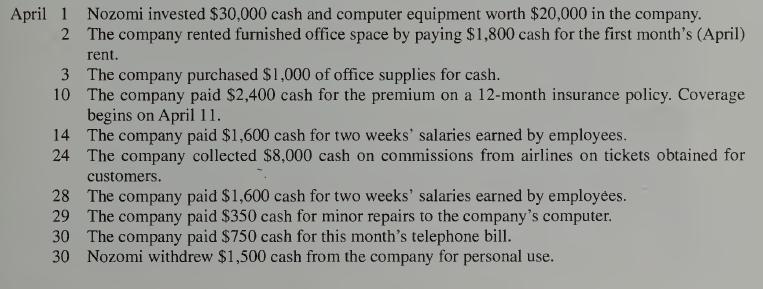
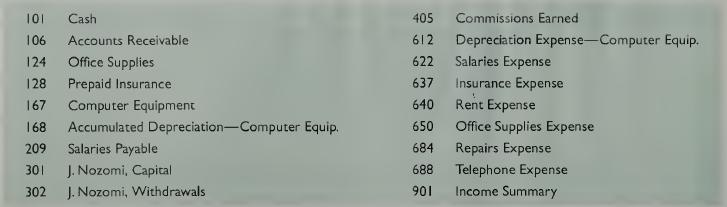
On April 1, 2013, Jiro Nozomi created a new travel agency. Adventure Travel. The following transactions occurred during the company’s first month.The company’s chart of accounts followsRequired 1. Use the balance column format to set up each ledger account listed in its chart of accounts.2.
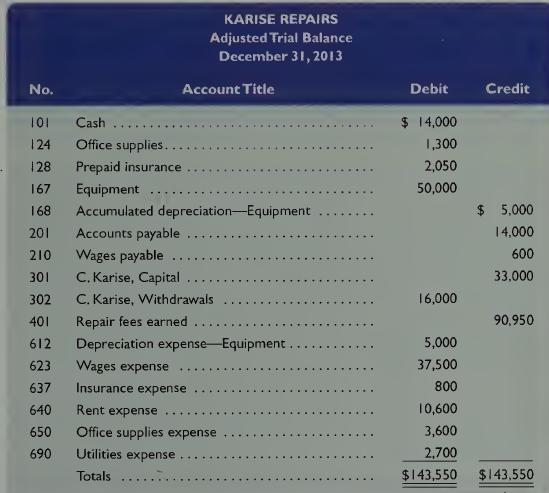
The adjusted trial balance of Karise Repairs on December 31, 2013, follows.Required 1. Prepare an income statement and a statement of owner’s equity for the year 2013, and a classified balance sheet at December 31,2013. There are no owner investments in 2013.2. Enter the adjusted trial balance in
In the blank space beside each numbered balance sheet item, enter the letter of its balance sheet classifica¬ tion. If the item should not appear on the balance sheet, enter a Z in the blank.A. Current assets E. Cunent liabilities B. Long-term investments F. Long-term liabilities C. Plant assets
On July 1, 2013, Lula Plume created a new self-storage business. Safe Storage Co. The following transac¬ tions occurred during the company’s first monthThe company’s chart of accounts follows:Required 1. Use the balance column format to set up each ledger account listed in its chart of
Refer to Polaris’s financial statements in Appendix A to answer the following Required 1. For the year ended December 31, 2011, what amount is credited to Income Summary to summarize its revenues earned?2. For the year ended December 31, 2011, what amount is debited to Income Summary to summarize
Assume that one of your classmates states that a company’s books should be ongoing and therefore not closed until that business is terminated. Write a half-page memo to this classmate explaining the concept of the closing process by drawing analogies between (1) a scoreboard for an athletic event
Access Motley Fool’s discussion of the current ratio at Fooi.com/SchoolA^aluation/ CurrentAndOuickRatio.htm. (If the page changed, search that site for the current ratio.)Required 1. What level for the current ratio is generally regarded as sufficient to meet near-term operating needs?2. Once you
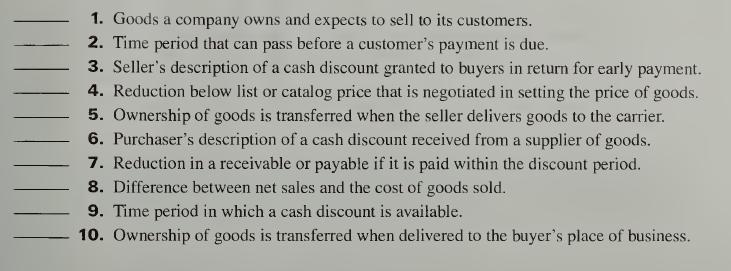
Enter the letter for each term in the blank space beside the definition that it most closely matches.A. Sales discount B. Credit period C. Discount period D. FOB destination E. FOB shipping point F. Gross profit G. Merchandise inventory H. Purchase discount I. Cash discount J. Trade discount 1.
Prepare journal entries to record each of the following purchases transactions of a merchandising^ QS 5-3 company. Show supporting calculations and assume a perpetual inventory system. Nov. 5 Purchased 600 units of product at a cost of $10 per unit. Terms of the sale are 2/10, n/60; the invoice is
Income statement information for adidas Group, a German footwear, apparel, and accessories manufacturer, for the year ended December 31, 2011, follows. The company applies IFRS, as adopted by the European Union, and reports its results in millions of Euros. Prepare its calendar year 2011 (1)
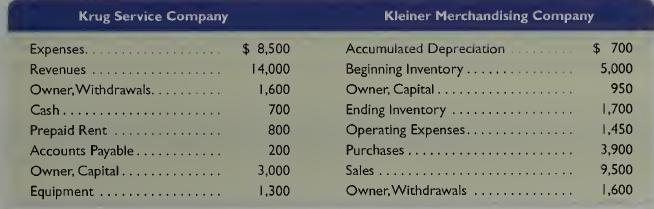
Use the following information (in alphabetical order) from a service company and from a merchandiser to compute net income. For the merchandiser, also compute gross profit, the goods available for sale, and the cost of goods sold. Hint: Not all information may be necessary. Krug Service Company
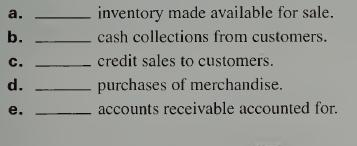
The operating cycle of a merchandiser with credit sales includes the following five activities. Starting with merchandise acquisition, identify the chronological order of these five activities a. b. C. d. e. inventory made available for sale. cash collections from customers. credit sales to
The following supplementary records summarize Tosca Company’s merchandising activities for year 2013. Set up T-accounts for Merchandise Inventory and Cost of Goods Sold. Then record the summarized activi¬ ties in those T-accounts and compute account balances. Cost of merchandise sold to
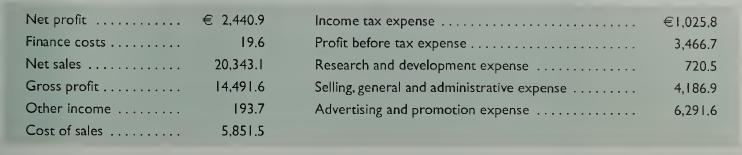
L’Oreal reports the following income statement accounts for the year ended December 31,2011 (euros in millions). Prepare the income statement for this company for the year ended December 31, 2011, following usual IFRS practices. Net profit Finance costs Net sales Gross profit. 2.440.9 Income tax
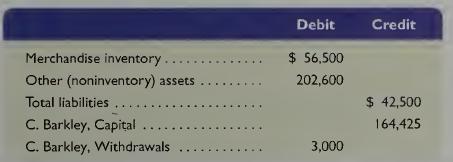
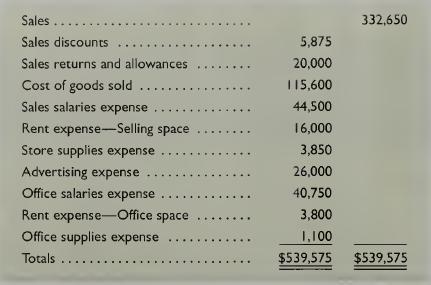
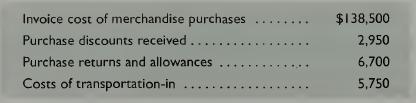
Barkley Company’s adjusted trial balance on March 31, 2013, its fiscal year-end, followsOn March 31, 2012, merchandise inventory was $37,500. Supplementary records of merchandising activities for the year ended March 31, 2013, reveal the following itemized costs.Required 1. Calculate the
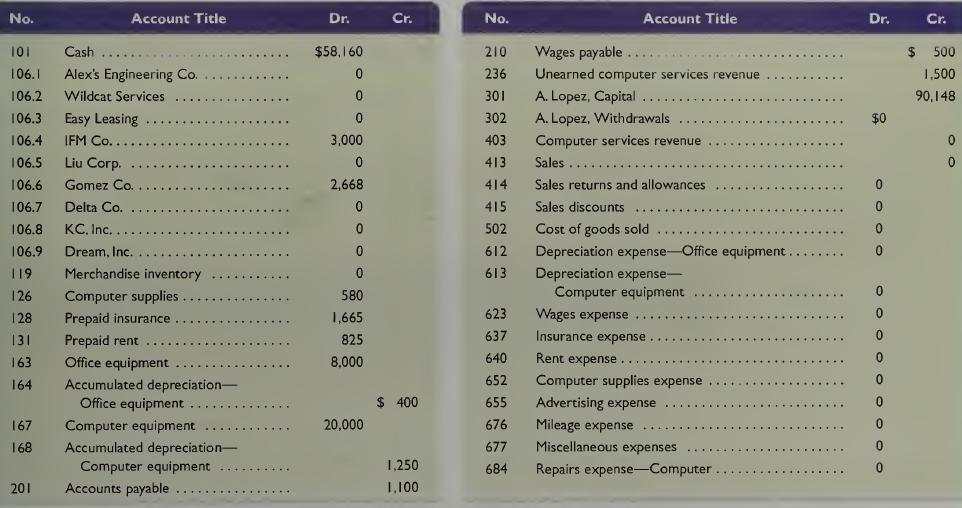
Success Systems PI P2 P3 P4: Adria Lopez created Success Systems on October 1, 2013. The company has been successful, and its list of customers has grown. To accommodate the growth, the accounting system is modified to set up separate accounts for each customer. The following chart of accounts
Phoenix Company can invest in each of three cheese-making projects: Cl, C2, and C3. Each project requires an initial investment of $228,000 and would yield the following annual cash flows.(1) Assuming that the company requires a 12% return from its investments, use net present value to determine
Fill in each of the blanks below with the correct term.1. A-arises from a past decision and cannot be avoided or changed; it is irrelevant to future decisions.2. -refer to the incremental revenue generated from taking one particular action over another.3. Relevant costs are also knownas_ 4.
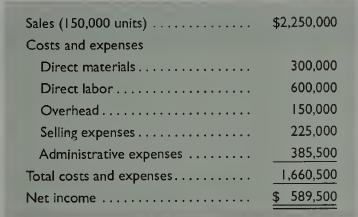
Farrow Co. expects to sell 150,000 units of its product in the next period with the following results.The company has an opportunity to sell 15,000 additional units at $12 per unit. The additional sales would not affect its current expected sales. Direct materials and labor costs per unit would be
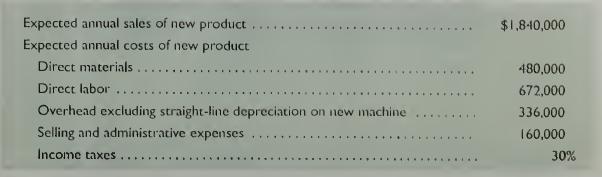
Factor Company is Planning to add a new Product to its line. To manufacture this product, the company needs to buy a new machine at a $480,000 cost with an expected four year life and a $20,000 salvage value. All sales are for cash, and all costs are out of pocket except for depreciation on the new
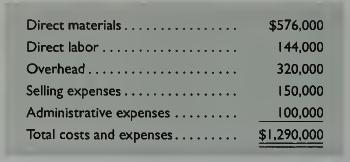
Jones Products manufactures and sells to wholesalers approximately 400,000 packages per year of under¬ water markers at $6 per package. Annual costs for the production and sale of this quantity are shown in the table.A new wholesaler has offered to buy 50,000 packages for $5.20 each. These markers
Adria Lopez is considering the purchase of equipment for Success Systems that would allow the company to add a new product to its computer furniture line. The equipment is expected to cost $300,000 and to have a six-year life and no salvage value. It will be depreciated on a straight-line basis.
Assume Polaris invested $2.12 million to expand its manufacturing capacity. Assume that these assets have a ten-year life, and that Polaris requires a 10% internal rate of return on these assets.Required 1. What is the amount of annual cash flows that Polaris must earn from these projects to have a
A company is considering an investment expected to yield $70,000 after six years. If this company demands an 8% return, how much is it willing to pay for this investment
Assume that you win a $150,000 cash sweepstakes. You decide to deposit this cash in an account earning 8% annual interest, and you plan to quit your job when the account equals $555,000. How many years will it be before you can quit working?
A company is considering an investment paying $10,000 every six months for three years. The first payment would be received in six months. If this company requires an 8% annual return, what is the maximum amount it is willing to pay for this investment?
Describe the earning of interest and the concepts of present and future values
Assume that you must make future value estimates using the future value of 1 table (Table B.2). Which interest rate column do you use when working with the following rates?1. 8% annual rate, compounded quarterly 2. 12% annual rate, compounded annually 3. 6% annual rate, compounded semiannually 4.
a. How much would you have to deposit today if you wanted to have $60,000 in 4 years? Annual interest rate is 9%.b. Assume that you are saving up for a trip around the world when you graduate in 2 years. If you can earn 8% on your investments, how much would you have to deposit today to have
When activity-based costing is used rather than traditional allocation methods [select one],(a) managers must identify cost drivers for various items of overhead cost, {b) individual cost items in service departments are allocated directly to products or services, (c) managers can direct their
Explain cost flows for activity-based costing
Identify and assess advantages and disadvantages of activity-based costing
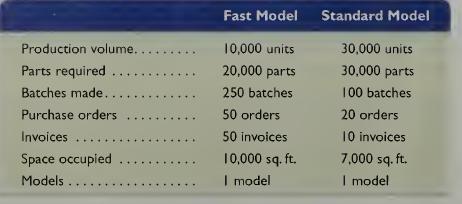
Refer to the data in QS C-2. Assume that the following information is available for the company’s two products.Required Assign overhead costs to each product model using activity-based costing (ABC). What is the overhead cost per unit of each model? Production volume... Parts required.... Batches
1. Which costing method tends to overstate the cost of high-volume products?a. Traditional volume-based costingc. Job order costingb. Activity-based costingd. Differential costing 2. If management wants the most accurate product cost, which of the following costing methods should be used?a.
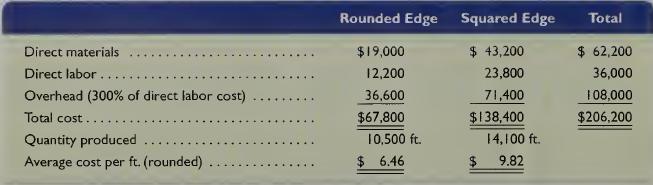
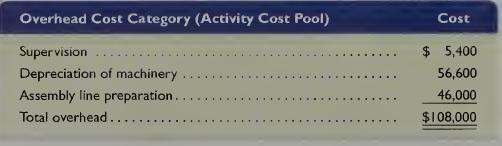
Northwest Company produces two types of glass shelving, rounded edge and squared edge, on the same production line. For the current period, the company reports the following data.Northwest’s controller wishes to apply activity-based costing (ABC) to allocate the $108,000 of overhead costs
Healthy Day Company produces two beverages, PowerPunch and SlimLife. Data about these products followAdditional data from its two production departments follow.Required 1. Determine the cost of each product line using ABC.2. What is the cost per bottle for PowerPunch? What is the cost per bottle of
Craftmore Machining produces machine tools for the construction industry. The following details about overhead costs were taken from its company records.Additional information on the drivers for its production activities followsRequired 1. Compute the activity overhead rates using ABC. Form cost
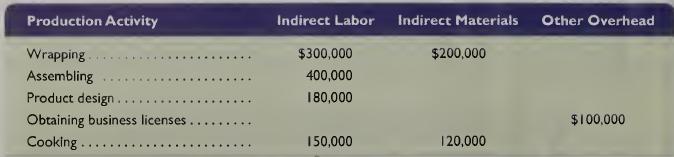
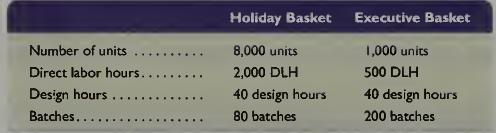
Fancy Foods produces gourmet gift baskets that it distributes online as well as from its small retail store. The following details about overhead costs are taken from its recordsAdditional information on the drivers for its production activities follows.Wrapping. 100,000 units Assembling. 20,000
Information from Raff Co. at Dec. 31, 2012, follows: cash, $820,000; accounts receivable, $240,000; inventories, $470,000; plant assets, $910,000; accounts pavable, $350,000; and income taxes payable, $180,000. Compute its (a) current ratio and {b) acid-test ratio.
On Dec. 31, 2013, Raff Company (see question 8) had accounts receivable of $290,000 and inventories of $530,000. During 2013, net sales amounted to $2,500,000 and cost of goods sold was $750,000. Compute (a) accounts receivable turnover, (b) days' sales uncollected, (c) inventory turnover, and (d)
Identify the four major sections of an income statement that are potentially reportable.
A company using FIFO for the past 15 years decides to switch to LIFO. The effect of this event on prior years' net income is (a) reported as if the new method had always been used;(b) ignored because it is a change in an accounting estimate; or (c) reported on the current year income statement
Explain the purpose and identify the building blocks of analysis
Describe standards for comparisons in analysis
Explain the form and assess the content of a complete income statement
Describe and apply methods of vertical analysis
A company's sales in 2012 were $300,000 and in 2013 were $351,000. Using 2012 as the base year, the sales trend percent for 2013 is:a. 17%b. 85%c. 100%d. 117%e. 48%
Refer to Piaggio’s financial statements in Appendix A. Compute its debt ratio as of December 31,201 I, and December 31,2010.
Which of the following items (a) through (i) are part of fmancial reporting but are nof included as part of general-purpose financial statements? (a) balance sheet, (b) financial statement notes, (c) statement of shareholders’ equity, (d) prospectus, (e) stock price information and analysis, (f)
Refer to the information in QvS 17-2. Use that information for Tide Corporation to determine the 2012 and 2013 common-size percents for cost of goods sold using net sales as the base.
Answer each of the following related to international accounting and analysis.a. Identify a limitation to using ratio analysis when examining companies reporting under different ac¬ counting systems such as IFRS versus U.S. GAARb. Identify an advantage to using horizontal and vertical analyses
Identifying financial ratios C2: 1. Which two ratios are key components in measuring a company’s operating efficiency? Which ratio summarizes these two components?2. What measure reflects the difference between current assets and current liabilities?3. Which two short-term liquidity ratios
Refer to Simon Company's balance sheets in Exercise 17-7. Analyze its year-end short-term liquidity position at the end of 2014, 2013, and 2012 by computing (1) the current ratio and (2) the acid-test ratio. Comment on the ratio results. (Round ratio amounts to two decimals.)
Refer to the Simon Company information in Exercises 17-7 and 17-9. Compare the company’s long-term risk and capital structure positions at the end of 2014 and 2013 by computing these ratios: (1) debt and equity ratios—percent rounded to one decimal, (2) debt-to-equity ratio—rounded to two
A company issues $10,000 of 9%, 5-year bonds dated January 1, 2013, that mature on December 31, 2017, and pay interest semiannually on each June 30 and December 31. Prepare the entry to record this bond issuance and the first semiannual interest payment.
How do you compute the amount of interest a bond issuer pays in cash each year?
Are these bonds issued at a discount or a premium? Explain your answer.Five-year, 6% bonds with a $100,000 par value are issued at a price of $91,893. Interest is paid semiannually, and the bonds' market rate is 8% on the issue date.
What is the issuer's journal entry to record the issuance of these bonds?Five-year, 6% bonds with a $100,000 par value are issued at a price of $91,893. Interest is paid semiannually, and the bonds' market rate is 8% on the issue date.
What is the amount of bond interest expense recorded at the first semiannual period using the straight-line method?Five-year, 6% bonds with a $100,000 par value are issued at a price of $91,893. Interest is paid semiannually, and the bonds' market rate is 8% on the issue date.
Using the straight-line method to allocate bond interest expense, the issuer records the second interest payment (on December 31, 2013) with a debit to Premium on Bonds Payable in the amount of (a) $7,470, (b) $530, (c) $8,000, or (d) $400.On December 31,2012, a company issues 16%, 10-year bonds
How are these bonds reported in the long-term liability section of the issuer's balance sheet as of December 31, 2013? On December 31,2012, a company issues 16%, 10-year bonds with a par value of $100,000. Inter¬ est is paid on June 30 and December 31. The bonds are sold to yield a 14% annual
Six years ago, a company issued $500,000 of 6%, eight-year bonds at a price of 95. The current carrying value is $493,750. The company decides to retire 50% of these bonds by buying them on the open market at a price of 10272. What is the amount of gain or loss on the retirement of these bonds?
When a borrower records an interest payment on an installment note, how are the balance sheet and income statement affected?
Water Sports Company (WSC) patented and successfully test-marketed a new product. To expand its abil¬ ity to produce and market the new product, WSC needs to raise $800,000 of financing. On January 1, 2013, the company obtained the money in two ways:a. WSC signed a $400,000, 10% installment note
A company enters into an agreement to make four annual year-end payments of $1,000 each, starting one year from now. The annual interest rate is 8%. The present value of these four payments is (a) $2,923, (b) $2,940, or (c) $3,312.
Suppose a company has an option to pay either (a) $10,000 after one year or (b) $5,000 after six months and another $5,000 after one year. Which choice has the lower present value?
On May 1, a company sells 9% bonds with a $500,000 par value that pay semiannual interest on each January 1 and July I.The bonds are sold at par plus interest accrued since January 1. The issuer records the first semiannual interest payment on July 1 with (a) a debit to Interest Payable for
company issued 5-year, 5% bonds with a par value of $100,000. The company received $95,735 for the bonds. Using the straight-line method, the company’s interest expense for the first semiannual interest period isa. $2,926.50.b. $5,853.00.c. $2,500.00.d. $5,000.00.e. $9,573.50.
Showing 200 - 300
of 2510
1
2
3
4
5
6
7
8
9
10
11
12
13
14
15
Last
Step by Step Answers

 Get 50% OFF
Claim Now
Get 50% OFF
Claim Now