New Semester
Started
Get
50% OFF
Study Help!
--h --m --s
Claim Now
Question Answers
Textbooks
Find textbooks, questions and answers
Oops, something went wrong!
Change your search query and then try again
S
Books
FREE
Study Help
Expert Questions
Accounting
General Management
Mathematics
Finance
Organizational Behaviour
Law
Physics
Operating System
Management Leadership
Sociology
Programming
Marketing
Database
Computer Network
Economics
Textbooks Solutions
Accounting
Managerial Accounting
Management Leadership
Cost Accounting
Statistics
Business Law
Corporate Finance
Finance
Economics
Auditing
Tutors
Online Tutors
Find a Tutor
Hire a Tutor
Become a Tutor
AI Tutor
AI Study Planner
NEW
Sell Books
Search
Search
Sign In
Register
study help
business
introduction to accounting
Healthcare Finance An Introduction To Accounting And Financial Management 3rd Edition Louis Gapenski PhD - Solutions
The interest rate required by investors on a debt security can be expressed by the following equation:Define each term of the equation, and explain how it affects the interest rate. Interest rate = RRF+IP + DRP + LP + PRP + CRP.
Pacific Homecare has three bond issues outstanding. All three bonds pay $100 in annual interest plus $1,000 at maturity. Bond Shas a maturity of five years, Bond M has a 15-year maturity, and Bond L matures in 30 years.a. What is the value of each of these bonds when the required interest rate is 5
What is meant by the term classified stock?
What is a dividend reinvestment plan?
What is meant when a stock is listed?
What are the differences between HCA selling shares in the primary market versus its shares being sold in the secondary market?
What is the purpose of securities markets regulation?
What types of decisions must the issuer and its investment banker make?
What are the sources of equity (i.e., fund capital) to not-for-profit firms?
Are not-for-profit firms at a disadvantage when it comes to raising equity capital? Explain your answer.
What are three approaches to valuing common stocks?
Show the constant growth model in its expected rate of return form.
Explain the meaning of the term risk/return trade-off.
Assume the risk-free rate is 6 percent and the market risk premium is 6 percent. The stock of Physicians Care Network (PCN) has a beta of 1.5. The last dividend paid by PCN (D0) was $2 per share.a. What would PCN’s stock value be if the dividend was expected to grow at a constant:• −5
California Clinics, an investor-owned chain of ambulatory care clinics, just paid a dividend of $2 per share. The firm’s dividend is expected to grow at a constant rate of 5 percent per year, and investors require a 15 percent rate of return on the stock.a. What is the stock’s value?b. Suppose
What is meant by the term capital structure decision?
What is the difference between business and financial risk?
Should the component costs be estimated on a before- or an after-tax basis?
What are the three primary methods for estimating a for-profit firm’s cost of equity?
What is the best proxy for the risk-free rate in the CAPM method? Why?
Why is there a cost associated with fund capital?
What is the cost of fund capital?
a. Why is there a cost to retained earnings in investor-owned businesses?b. What are the three methods commonly used to estimate the cost of equity?c. Is the risk premium in the CAPM the same as the risk premium in the debt cost plus risk premium model?d. How would you estimate the cost of equity
What are some forms of regulation used in the health services industry?
Briefly, what is the organization of this book?
a. What are some of the industries in the healthcare sector?b. What is meant by the term healthcare finance as used in this book?c. What are the two broad areas of healthcare finance?d. Why is it necessary to have a book on healthcare finance as opposed to a generic finance book?
a. Briefly discuss the role of finance in the health services industry.b. Has this role increased or decreased in importance in recent years?
What role does regulation play in the health services industry?
Describe the organization of the book and the learning tools embedded in each chapter.
What pressures recently have been placed on not-for-profit hospitals to ensure that they meet their charitable mission?
Why does a finance book have to consider taxes?
What are some different types of private insurers?
What are some different types of managed care plans?
Briefly explain the following payment methods:• Cost-based• Charge-based and discounted charges• Per procedure• Per diagnosis• Per diem• Global• Capitation
Which of these payment methods carries the least risk for providers?The most risk? Explain your answer.
a. What is the primary goal of investor-owned corporations?b. What is the primary goal of most not-for-profit healthcare corporations?c. Are there substantial differences between the finance goals of investor-owned and not-for-profit corporations? Explain.d. What is the agency problem?
Describe provider incentives and risks under each of the following reimbursement methods:a. Cost-basedb. Charge-based (including discounted charges)c. Per procedured. Per diagnosise. Per diemf. Global pricing g. Capitation
Assume that Provident Health System, a for-profit hospital, has \($1\) million in taxable income for 2004, and its tax rate is 30 percent.a. Given this information, what is the firm’s net income? (Hint: net income is what remains after taxes have been paid.)b. Suppose the hospital pays out
A firm that owns the stock of another corporation does not have to pay taxes on the entire amount of dividends received. In general, only 30 percent of the dividends received by one corporation from another are taxable. The reason for this tax law feature is to mitigate the effect of triple
John Doe is in the 40 percent personal tax bracket. He is considering investing in HCA bonds that carry a 12 percent interest rate.a. What is his after-tax yield (interest rate) on the bonds?b. Suppose Twin Cities Memorial Hospital has issued tax-exempt bonds that have an interest rate of 6
George and Margaret Wealthy are in the 48 percent tax bracket, considering both federal and state personal taxes. Norman Briggs, the CEO of Community General Hospital, has been aggressively pursuing the couple to contribute \($500\) thousand to the hospital’s soon-to-be-built Cancer Care Center.
Are investors passive users of this information?
Briefly explain the following basic concepts as they apply to the preparation of financial statements:• Accounting entity• Going concern• Accounting period• Objectivity and reliability• Monetary unit• Relevance• Full disclosure• Materiality• Conservatism• Consistency and
Briefly explain the differences between cash and accrual accounting.
Why do GAAP favor accrual over cash accounting?
Explain two problems that can occur when the matching principle is implemented.
Briefly explain the following terms used in the recording and compiling of accounting data:• Transaction• Account• Posting• Chart of accounts• General ledger• T account• Double entry system
What are the three primary financial statements?
Why are the footnotes to the financial statements important?
Describe how the following types of revenue are reported on the income statement:• Discounts from charges• Charity care• Bad debt losses
What is the logic behind the provision for bad losses?
How is net income calculated?
What is the payout ratio?
What is the retention ratio?
What are the payout and retention ratios of a not-for-profit organization?
a. What are generally acceptable accounting principles (GAAP)?b. What is the purpose of GAAP?c. What organizations are involved in establishing GAAP?
Explain the difference between cash and accrual accounting. Be sure to include a discussion of the matching principle.
a. What is the difference between gross revenues and net revenues?b. What is the difference between patient service revenue and other revenue?c. What is the difference between charity care and bad debt losses? How is each handled on the income statement?
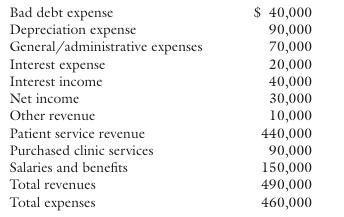
Entries for the Warren Clinic 2004 income statement are listed below in alphabetical order. Reorder the data in proper format. Bad debt expense Depreciation expense General/administrative expenses Interest expense $ 40,000 90,000 70,000 20,000 Interest income 40,000 Net income 30,000 Other revenue
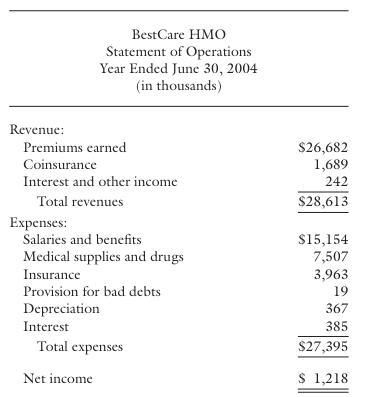
Consider the following income statement:a. How does this income statement differ from the one presented in Table 3.1?b. Did BestCare spend $367,000 on new fixed assets during fiscal year 2004? If not, what is the economic rationale behind its reported depreciation expense?c. Explain the provision
Consider this income statement:a. How does this income statement differ from the ones presented in Table 3.1 and Problem 3.2?b. Why does Green Valley show a provision for income taxes while the other two income statements did not?c. What is Green Valley’s total profit margin? How does this value
Great Forks Hospital reported net income for 2004 of $2.4 million on total revenues of $30 million. Depreciation expense totaled $1 million.a. What were total expenses for 2004?b. What were total cash expenses for 2004? c. What was the hospital’s 2004 cash flow?
Assume that Mainline Homecare, a for-profit corporation, had exactly the same situation as reported in Problem 3.5. However, Mainline must pay taxes at a rate of 40 percent of pretax income. Assuming that the same revenues and expenses reported for financial accounting purposes would be reported
What is the purpose of the balance sheet?
What are the four major categories of asset accounts?
What is the primary difference between current assets and the remainder of the asset side of the balance sheet?
What are liabilities?
Use an example to explain the logic behind accruals.
Is there a significant difference in the economic content of balance sheets created by investor-owned and not-for-profit health services organizations?
Briefly explain the three major categories shown on the statement.
In your view, what is the most important piece of information reported on the statement?
What is the effect on a business’s equity account of a payment on a bill that has already been booked (recorded as an account payable)?
a. What is the difference between the income statement and balance sheet in regards to timing?b. What is wrong with this statement: “The clinic’s cash balance for 2004 was $150,000, while its net income on December 31, 2004, was $50,000.”
Middleton Clinic had total assets of $500,000 and an equity balance of$350,000 at the end of 2003. One year later, at the end of 2004, the clinic had $575,000 in assets and $380,000 in equity. What was the clinic’s dollar growth in assets during 2004, and how was this growth financed?
The following are selected entries for Warren Clinic for December 31, 2004, in alphabetical order. Create Warren Clinic’s balance sheet. Accounts payable Accounts receivable, net Cash $ 20,000 60,000 30,000 Other long-term liabilities 10,000 Long-term debt 120,000 Long-term investments 100,000
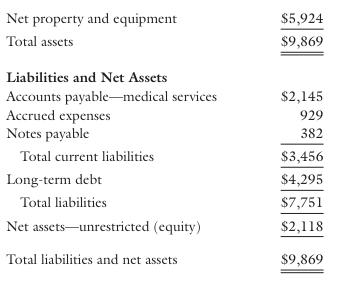
Consider the following balance sheet:a. How does this balance sheet differ from the one presented in Table 4.1 for Sunnyvale ?b. What is BestCare’s net working capital for 2004?c. What is BestCare’s debt ratio? How does it compare with Sunnyvale’s debt ratio? BestCare HMO Balance Sheet June
Consider this balance sheet:a. How does this balance sheet differ from the ones presented in Table 4.1 and Problem 4.5?b. What is Green Valley’s net working capital for 2004?c. What is Green Valley’s debt ratio? How does it compare with the debt ratios for Sunnyvale and BestCare? Assets Green
What is meant by the term cost?
How does time period affect the definition of fixed costs?
Construct a simple table like the one in Table 5.1, and discuss its elements.
Sketch and explain a simple diagram similar to Figure 5.1 to match your table.
What is a semi-fixed cost?
How does the addition of semi-fixed costs change a cost behavior graph?
Construct a simple P&L statement like the one in Table 5.4, and discuss its elements.
Sketch and explain a simple diagram to match your table.
Define and explain the contribution margin.
Can breakeven concepts be applied to a profit value other than zero?
What is meant by the following statement: “Marginal analysis is made more complicated by long-run considerations.”
Under capitation, what is the difference between a CVP graph with the number of visits on the X axis versus one with the number of members on the X axis?
How do provider incentives differ when it moves from a fee-for-service to a capitated environment?
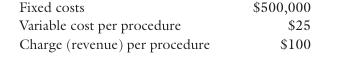
Assume that a radiologist group practice has the following cost structure:Furthermore, assume that the group expects to perform 7,500 procedures in the coming year.a. Construct the group’s base case projected profit and loss statement.b. What is the group’s contribution margin? What is its
General Hospital, a not-for-profit acute care facility, has the following cost structure for its inpatient services:The hospital expects to have a patient load of 15,000 inpatient days next year.a. Construct the hospital’s base case projected P&L statement.b. What is the hospital’s
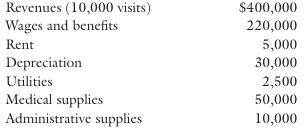
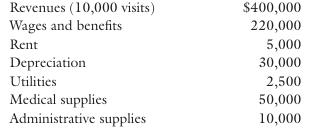
You are considering starting a walk-in clinic. Your financial projections for the first year of operations are as follows:Assume that all costs are fixed except supply costs, which are variable.Furthermore, assume that the clinic must pay taxes at a 30 percent rate.a. Construct the clinic’s
Review the walk-in clinic data presented in Problem 5.5. Construct projected profit and loss statements at volume levels of 8,000, 9,000, 10,000, 11,000, and 12,000 visits.Problem 5.5.You are considering starting a walk-in clinic. Your financial projections for the first year of operations are as
Give some examples of each type of cost for an emergency services department.
On what basis are cost drivers chosen?
What two characteristics make a good cost driver?
What are the three primary methods of cost allocation?
Briefly outline the allocation procedures used by Kensington Hospital.
What is the most important organizational benefit derived from the selection of a good cost driver?
Showing 200 - 300
of 1352
1
2
3
4
5
6
7
8
9
10
11
12
13
14
Step by Step Answers

 Get 50% OFF
Claim Now
Get 50% OFF
Claim Now