New Semester
Started
Get
50% OFF
Study Help!
--h --m --s
Claim Now
Question Answers
Textbooks
Find textbooks, questions and answers
Oops, something went wrong!
Change your search query and then try again
S
Books
FREE
Study Help
Expert Questions
Accounting
General Management
Mathematics
Finance
Organizational Behaviour
Law
Physics
Operating System
Management Leadership
Sociology
Programming
Marketing
Database
Computer Network
Economics
Textbooks Solutions
Accounting
Managerial Accounting
Management Leadership
Cost Accounting
Statistics
Business Law
Corporate Finance
Finance
Economics
Auditing
Tutors
Online Tutors
Find a Tutor
Hire a Tutor
Become a Tutor
AI Tutor
AI Study Planner
NEW
Sell Books
Search
Search
Sign In
Register
study help
business
microeconomics
Microeconomics And Behavior 8th Edition Robert Frank, David Colander - Solutions
5. Why are bond prices and interest rates inversely related?
3. Why do higher interest rates make future events economically less important?
2. Explain why depreciation is an economic cost just like any other.
*17. How would your answer to the preceding problem be different if the employer in question sold his product according to the demand schedule P 20 Q?
4. Why does economic theory lead us to place more emphasis on discrimination by persons and institutions other than employers as a cause of wage differences that exceed productivity differences?
3. Why might local employers pay workers the value of what they produce even if workers are unable or unwilling to move to another area to accept a better job?
2. If a monopolist bought all the firms in a formerly competitive industry and acquired the legal right to exclude entry, how would the quantity of labor employed be affected?
1. What is the difference between the perfect competitor’s VMPL curve and the imperfect competitor’s MRPL curve?
3. Solve the preceding problem for Bertrand duopolists.
6. How is the optimal degree of product variety related to population density? To transportation cost? To the fixed costs of offering new products?
5. Describe the trade-off between cost and variety.
4. Does the equilibrium in the Cournot model satisfy the definition of a Nash equilibrium?
3. What is the difficulty with the tit-for-tat strategy as a possible solution to the oligopoly collusion problem?
2. How is the problem of oligopoly collusion similar in structure to the prisoner’s dilemma?
12. Suppose the government imposed a price ceiling on a monopolist (an upper bound on the price the monopolist can charge). Let denote the price ceiling, and suppose the monopolist incurs no costs in producing output. True or false: If the demand curve faced by the monopolist is inelastic at the
11. A monopolist’s price is $10. At this price the absolute value of the elasticity of demand is 2. What is the monopolist’s marginal cost?
10. If you have ever gone grocery shopping on a weekday afternoon, you have probably noticed some elderly shoppers going slowly down the aisles checking their coupon book for a coupon that matches each of their purchases. How is this behavior explained by the hurdle model of price discrimination?
8. The demand by senior citizens for showings at a local movie house has a constant price elasticity equal to 4. The demand curve for all other patrons has a constant price elasticity equal to 2. If the marginal cost per patron is $1 per showing, how much should the theater charge members of each
2. A monopolist has a demand curve given by P ⫽ 100 ⫺ Q and a total cost curve given by TC ⫽ 16 ⫹ Q2. The associated marginal cost curve is MC ⫽ 2Q. Find the monopolist’s profit-maximizing quantity and price. How much economic profit will the monopolist earn?
11. How does the hurdle method of price discrimination mitigate both the efficiency and fairness problems associated with monopoly?
10. What forces work against X-inefficiency in privately owned monopolies?
9. True or false: If a monopolist faces a perfectly horizontal demand curve, then the dead-weight loss to the economy is zero.
8. True or false: A lump-sum tax on a monopolist will always increase the price charged by the monopolist and lower the quantity of output sold.
7. Suppose the elasticity of demand is ⑀ ⫽ ⫺3. By how much will a profit-maximizing monopolist’s price exceed marginal cost? How does this markup of price over marginal cost compare with perfect competition?
6. What effect will the imposition of a 50 percent tax on economic profit have on a monopolist’s price and output decisions?(Hint: Recall that the assumed objective is to choose the level of output that maximizes economic profit.)
5. Why is an output level at which MR intersects MC from below never the profit-maximizing level of output?
3. When is marginal revenue less than price for a monopolist?Explain.
2. If the United States has thousands of cement producers but a small town has only one, is this cement producer a monopolist? Explain.
1. What five factors give rise to monopoly? In the long run, why is economies of scale the most important factor?
11. You are the owner/manager of a small competitive firm that manufactures house paints.You and all your 1000 competitors have total cost curves given bya. What is the most you would be willing to pay for the exclusive right to use this invention?b. Would the inventor be willing to sell at that
10. Merlin is like all other managers in a perfectly competitive industry except in one respect:Because of his great sense of humor, people are willing to work for him for half the going wage rate. All other firms in the industry have short-run total cost curves given bywhere M is the salary paid
7. Same as Problem 6, except nowCould any firm actually have this particular LTC curve? Why or why not? LTCQ = Q+4Q.
6. All firms in a competitive industry have long-run total cost curves given bywhere Q is the firm’s level of output. What will be the industry’s long-run equilibrium price? (Hint: Use either calculus or a graph to find the minimum value of the associated long-run average cost curve.) What will
4. Assuming the aflatoxin outbreak in Problem 3 persists, will the long-run loss in producer and consumer surplus be larger than, smaller than, or the same as the short-run loss?
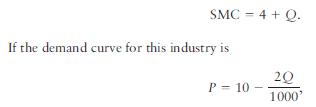
3. Each of 1000 identical firms in the competitive peanut butter industry has a short-run marginal cost curve given bywhat will be the short-run loss in producer and consumer surplus if an outbreak of aflatoxin suddenly makes it impossible to produce any peanut butter? SMC-4+Q. If the demand curve
12. Would you expect a firm that adopts cost-saving innovations faster than 80 percent of all firms in its industry to earn economic profits? If so, will there be any tendency for these profits to be bid away?
11. Why are pecuniary economies and diseconomies said to be the exception rather than the rule?
7. What do economists mean when they say that the shortrun competitive equilibrium is efficient?
5. Does the fact that a business manager may not know the definition of marginal cost contradict the theory of perfect competition?
4. A firm’s total revenue curve is given by TR aQ 2Q2. Is this a perfectly competitive firm? Explain why or why not.
2. Under what conditions will we expect firms to behave as price takers even though there are only a small number of other firms in the industry?
1. What is the difference between economic profit and accounting profit, and how does this difference matter for actual business decisions?
13. For the long-run total cost function LTC1Q2 ⫽ Q2 ⫹ 10, sketch ATC, AVC, AFC, and MC.
12. A firm has a long-run total cost function:Derive expressions for long-run average cost and marginal cost, and sketch these curves. LTC(Q) Q3-200 + 2200.
2. Sketch the short-run TC, VC, FC, ATC, AVC, AFC, and MC curves for the production function where K is fixed at 2 units in the short run, with r ⫽ 3 and w ⫽ 2.
5. If the LAC curve is rising beyond some point, what can we say about the degree of returns to scale in production?
3. In which production process is fixed cost likely to be a larger percentage of short-run total costs, book publishing or landscape gardening?
2. What is the relationship between the law of diminishing returns and the slope of the short-run marginal cost curve?
1. What is the relationship between the law of diminishing returns and the curvature of the variable cost curve?
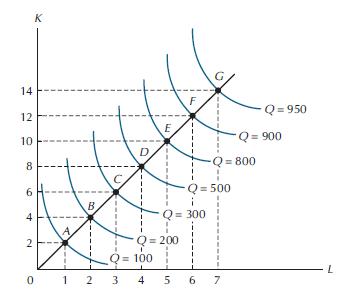
10. Identify the regions of increasing, constant, and decreasing returns to scale on the isoquant map shown. K 14 F 12 E 10 D 8 C 6 Q=950 Q=900 =800 Q=500 B 4 Q=300 2 Q=200 Q= 100 L 0 1 2 2 3 4 3 4 5 6 567
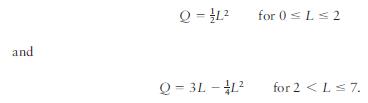
7. A firm’s short-run production function is given bya. Sketch the production function.b. Find the maximum attainable production. How much labor is used at that level?c. Identify the ranges of L utilization over which the marginal product of labor is increasing and decreasing.d. Identify the
6. Suppose a crime wave hits West Philadelphia, so that the marginal product and average product of police officers are now 60 arrests per hour for any number of police officers. What is the optimal allocation of 500 police officers between the two areas now?
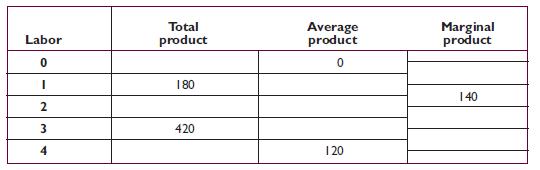
4. The following table provides partial information on total product, average product, and marginal product for a production function. Using the relationships between these properties, fill in the missing cells. Labor Total product Average product Marginal product 0 0 180 140 2 3 420 4 120
9. Currently, 2 units of labor and 1 unit of capital produce 1 unit of output. If you double both the inputs (4 units of labor and 2 units of capital), what can you conclude about the output produced under constant returns to scale? Decreasing returns to scale? Increasing returns to scale?
8. A factory adds a worker and subsequently discovers that the average product of its workers has risen. True or false:The marginal product of the new worker is less than the average product of the plant’s workers before the new employee’s arrival.
6. Distinguish between diminishing returns to a variable input and decreasing returns to scale.
5. How is an isoquant map like an indifference map? In what important respect do the two constructs differ?
4. A wag once remarked that when a certain government official moved from New York to California, the average IQ level in both states went up. Interpret this remark in the context of the average-marginal relationships discussed in the chapter.
3. Why should a person in charge of hiring productive inputs care more about marginal products than about average products?
2. Give an example of production in which the short run lasts at least 1 year.
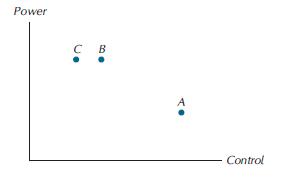
11. Hal is having difficulty choosing between two tennis rackets, A and B. As shown in the diagram, B has more power than A, but less control. According to the rational choice model, how will the availability of a third alternative—racket C—influence Hal’s final decision? If Hal behaves like
5. Claiborne is a gourmet. He makes it a point never to visit a restaurant a second time unless he has been served a superb meal on his first visit. He is puzzled at how seldom the quality of his second meal is as high as the first. Should he be?
2. Sears Roebuck has hired you as a consultant to give it marketing advice about how to sell its new all-terrain vehicle. On the basis of the material covered in this chapter, suggest two specific marketing strategies for Sears to consider.
5. The policy of one school was to punish students for being late, while the corresponding policy in an otherwise identical school was to reward students for being on time. If effectiveness is measured by behavior on the day following punishment or reward, which policy would seem to be more
4. Is there anything irrational about weighing gains less heavily than losses?
3. Distinguish between (1) the best decision and (2) the decision that leads to the best possible outcome.
2. Why is it rational to make decisions with less than complete information?
1. Suppose you were the owner of a small business and were asked the maximum you would be willing to pay in order to attend a course in the traditional theory of rational choice. In which case would your answer be larger: (1) if it were known that people always behave in strict accordance with the
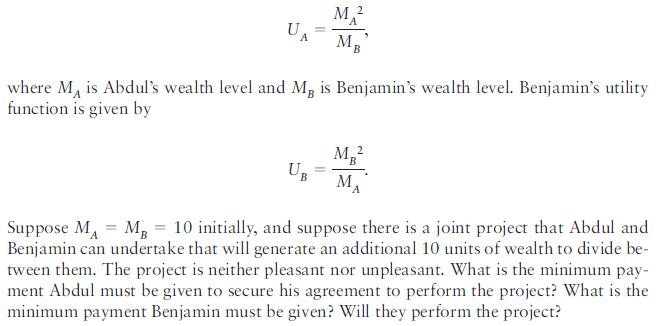
4. Abdul’s utility function is given by U = A M2 A MB where MA is Abdul's wealth level and MR is Benjamin's wealth level. Benjamin's utility function is given by MB 2 UB MA A Suppose M = M = 10 initially, and suppose there is a joint project that Abdul and Benjamin can undertake that will
3. Alphonse’s utility function is given byG are the wealth levels of Alphonse and Gaston, respectively. If Alphonse’s initial wealth level is 100 while Gaston’s is only 20, how much of his wealth will Alphonse give to Gaston? A M.M. A G'
5. Explain how the military arms race between the United States and the former Soviet Union had the same formal structure as a prisoner’s dilemma.
4. In the commitment model, what role is played by the observability of preferences?
3. Try to think of at least two commitment problems you personally encountered during the last year.
2. Explain the role of rational analysis in the psychologist’s model of human motivation.
1. Summarize in your own words the major difficulties of the present-aim and self-interest standards of rationality.
*20. There are two groups, each with a utility function given by where M 144 is the initial wealth level for every individual. Each member of group 1 faces a loss of 44 with probability 0.5. Each member of group 2 faces the same loss with probability 0.1.a. What is the most a member of each group
*19. There are two groups of equal size, each with a utility function given by where M 100 is the initial wealth level for every individual. Each member of group 1 faces a loss of 36 with probability 0.5. Each member of group 2 faces the same loss with probability 0.1.a. What is the most a member
15. Your current wealth level is M 49 and you are forced to make the following wager: if a fair coin comes up heads, you get 15; you lose 13 if it comes up tails. Your utility function isa. What is the expected value of this gamble?b. What is its expected utility?c. How would your answers change if
10. Suppose your utility function is given u = M, by where M is your total wealth. If M has an initial value of 16, will you accept the gamble in the preceding problem?
8. What is the expected value of a random toss of a die? (Fair and six-sided.)
9. Give some examples in which people do not self-insure against minor losses.
8. Explain, in your own words, why it makes sense to selfinsure against minor losses.
7. Give some examples of behavior that seem inconsistent with the assumption of risk aversion.
6. Why is it intuitively plausible to assume that most people are risk averse?
4. How does statistical discrimination affect the distribution of insurance premiums within a group?
2. Explain why, despite the potential adversarial relationship between sellers and buyers, commercial advertising nonetheless transmits information about product quality.
1. Why must a signal between potential adversaries be costly to fake?
19. Cornell is committed to its current policy of allowing the children of its faculty to attend the university without paying tuition. Suppose the demand curve of Cornell faculty children(CFCs) for slots in other universities is given by P 30 5Q0, where P is the tuition price charged by other
10. Karen earns $75,000 in the current period and will earn $75,000 in the futurea. Assuming that these are the only two periods, and that banks in her country borrow and lend at an interest rate r 0, draw her intertemporal budget constraint.b. Now suppose banks offer 10 percent interest on funds
4. Explain in your own words why even long-term heavy drinkers might be highly responsive to increases in the price of alcohol.
3. Do you think a college education has a high- or low-price(tuition) elasticity of demand?
*19. Repeat the preceding problem on the assumption that rice and wheat are perfect, onefor-one complements.
16. Is the cross-price elasticity of demand positive or negative for the following pairs of items?a. Tennis rackets and tennis ballsb. Peanut butter and jellyc. Hot dogs and hamburgers
15. Draw the Engel curves for the following goods: food, Hawaiian vacations, cashews, Kmart brand sneakers ($4.99/pr).
12. What price maximizes total expenditure along the demand curve P 27 Q2?
9. Professors Adams and Brown make up the entire demand side of the market for summer research assistants in the economics department. If Adams’s demand curve is P = 50 - 20, and Brown's is P = 50-Q, where Q and Q are the hours de- manded by Adams and Brown, respectively, what is the market
15. True or false: If each individual in a market has a straight-line demand curve for a good, then the market demand curve for that good must also be a straight line.Explain.
12. If you expected a long period of declining GNP, what kinds of companies would you invest in?
11. How can changes in the distribution of income across consumers affect the market demand for a product?
10. Do you think a college education at a specific school has a high or low price (tuition) elasticity of demand?
Showing 5600 - 5700
of 7548
First
50
51
52
53
54
55
56
57
58
59
60
61
62
63
64
Last
Step by Step Answers

 Get 50% OFF
Claim Now
Get 50% OFF
Claim Now