New Semester
Started
Get
50% OFF
Study Help!
--h --m --s
Claim Now
Question Answers
Textbooks
Find textbooks, questions and answers
Oops, something went wrong!
Change your search query and then try again
S
Books
FREE
Study Help
Expert Questions
Accounting
General Management
Mathematics
Finance
Organizational Behaviour
Law
Physics
Operating System
Management Leadership
Sociology
Programming
Marketing
Database
Computer Network
Economics
Textbooks Solutions
Accounting
Managerial Accounting
Management Leadership
Cost Accounting
Statistics
Business Law
Corporate Finance
Finance
Economics
Auditing
Tutors
Online Tutors
Find a Tutor
Hire a Tutor
Become a Tutor
AI Tutor
AI Study Planner
NEW
Sell Books
Search
Search
Sign In
Register
study help
business
modeling monetary economies
Modeling Monetary Economies 4th Edition Bruce Champ, Scott Freeman, Joseph Haslag - Solutions
Consider an overlapping generations mode with the following characteristics: Each generation is composed of 1,000 individuals. The fiat money supply changes according to Mt = 2Mt-1. The initial old own a total of 10,000 units of fiat money (Mo = $10,000). Each period, the newly printed
Consider an economy with a shrinking stock of fiat money. Let Nt = N, a constant, and Mt = zMt-1 for every period t, where z is positive and less than 1. The government taxes each old person τ goods in each period, payable in fiat money. It destroys the money it collects.a. Find and
Let Nt = nNt-1 and Mt = zMt-1 for every period t, where z and n are both greater than 1. The money created each period is used to finance a lump-sum subsidy a*t of goods to each young person.a. Find the equation for the budget set of an individual in the monetary equilibrium. Graph
Consider again the model economy described in Exercise 3.2, but suppose there is a second storable good, silver. Silver is as easy to exchange and store as gold. The initial old own a total of 50 units of silver. There can be no additions to the stock of silver. People are indifferent between
Suppose the consumption of gold offers people a marginal utility that diminishes as that person consumes more gold. Assume also that gold can be mined in unlimited amounts at the constant marginal costs, χ , units of the non gold consumption good.a. Can the trading value of gold exceed χ in
Consider a fiat money/barter system like that portrayed in this chapter. Suppose the number of goods J is 4. Each search for a trading partner costs a person 3 units of utility. In addition, suppose the exchange cost of goods is 2 units of utility. What is the maximum value of the exchange cost for
Consider a commodity money model economy like the one described in this chapter but with the following features: There are 100 identical people in every generation. Each person is endowed with 10 units of the consumption good when young and nothing when old. To keep things simple, let us assume
Consider a fiat money/barter system like that portrayed in this chapter. Suppose the number of goods J is 100. Each search for a trading partner costs a person 2 units of utility.a. What is the probability that a given random encounter between people of separate islands will result in a successful
Suppose that population increases at a fixed rate n. For this model economy, verify that the horizontal intercept of the feasible set line is equal to y and that the vertical intercept of the feasible set line is equal to ny.
In this chapter, we modeled growth in an economy by a growing population. We could also achieve a growing economy by having an endowment that increases over time. To see this, consider the following economy: Let the number of young people born in each period be constant at N. There is a constant
Suppose utility equals In (c1,t) + β In (c2, t+1)where In (c)represents the natural logarithm of c, whose derivative equals 1/c. The parameter β is a positive number.a. Prove that real money balances are q* = βy/1 + β.b. Derive expressions for the lifetime consumption pattern c*1,t and
In each of the four cases, please tell me the unit of measure, or in the case of a price, the rate at which two goods are traded for one another (in other words, describe both the numerator and the denominator).a. vtmtb. Mtc. vtd. pt
Consider an economy with a growing population in which each person is endowed with y1when young and y2 when old. Assume that y2 is sufficiently small that everyone wants to consume more than y2 in the second period of life. Bear in mind that under the new assumptions, the
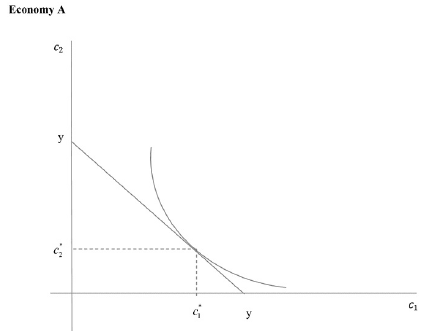
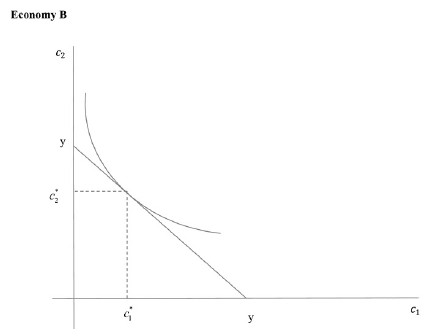
Consider two economies, A and B. Both economies have the same population, supply of fiat money, and endowments. In each economy, the number of young people born in each period is constant at N, and the supply of fiat money is constant at M . Furthermore, each person is endowed with y units of the
Suppose capital is risky and pays gross real rates of return of 1.2, 1.1, and 0.9 with probabilities .1, .7, and .2, respectively. A risk-free asset pays a safe gross real rate of return of 1.04. What is the expected rate of return on capital? What is the risk premium of capital?
Consider an overlapping generations model with 200 lenders and 100 borrowers born in every period. Everyone lives for only two periods. Each lender is endowed with 20 goods when young and nothing when old. Each borrower is endowed with nothing when young and 40 goods when old. The lenders want to
Consider an economy of three-period-lived people in overlapping generations. Each person is endowed with y goods when young and old and nothing when middle-aged. The population of each generation born in period t is Nt, where Nt = nNt-1. There are no assets other than loans. Explain how
Consider an economy with a constant population in which each person is endowed with y1 when young and y2 when old. Assume that y2 is sufficiently small so that everyone wants to consume more that y2 in the second period of life. Bear in mind that under the new assumptions, the
Consider an economy in which the population follows the rule Nt = 1.1 Nt-1. In addition, suppose that endowments per young person grow each period according to yt = 1.05yt-1. Assume old people do not receive any endowments. Assume that a young person’s preferences are such that they
Consider two economies, labelled A and B. In each one, let every two period-lived person be endowed with 20 units of the consumption when young and nothing when old. In Economy A, each young person chooses to consume 10 units of the consumption good. In Economy B, each young person chooses to
Suppose a person has constant marginal utility over both goods instead of diminishing marginal utility for consumption when young and consumption when old. a. Draw an indifference curve for constant-marginal-utility preferences. b. If the marginal utility of consumption when young were
Consider an economy with a constant population of N = 100. Each person is endowed with y = 20 units of the consumption good when young and nothing when old.a. What is the equation for the feasible set of this economy? Portray the feasible set on a graph. With arbitrarily drawn indifference curves,
Consider an economy in which there are 100 workers. One-half of the workers are endowed with 200 units of the consumption good when young and nothing when old. The remaining workers are endowed with 20 units of the consumption good when young and nothing when old. Each worker saves 30 percent of
Consider an economy in which people wish to hold bank checking deposits worth a total of 5 million goods and currency worth 2 million goods in every period. In addition, there is a stock of unintermediated capital worth 10 million goods. Fiat money is the only asset used as currency. Deposits ata.
Consider an economy in which there are 1,000 workers. One-half of the workers are endowed with 50 units of the consumption good when young and nothing when old. The remaining workers are endowed with 10 units of the consumption good when young and nothing when old. Each worker saves 30 percent of
Consider an economy in which there are 200 workers. Three-fourths of the workers are endowed with 100 units of the consumption good when young and nothing when old. The remaining workers are endowed with 20 units of the consumption good when young and nothing when old. Each worker saves 50 percent
Consider an economy in which people wish to hold money balances worth a total of 5,000,000 goods. They are indifferent between money issued by the central bank and money issued by private banks (so long as both offer the same rate of return). In the initial period, the central bank issues
Consider an economy in which people wish to hold money balances worth a total of 4,000 goods. They are indifferent between money issued by the central bank and money issued by private banks (so long as both offer the same rate of return). The central bank owns a constant stock of capital equal to
People in an economy want to hold money balances worth 500 goods. If both central bank, or fiat, money and deposits at a bank pay the same return, people are indifferent between it and bank deposits. The central bank owns a stock of capital equal to the stock of fiat money. Assume the gross real
Suppose Canada backs Canadian dollars with U.S. dollars. Canada issues million Canadian dollars to purchase $5 million worth U.S. Treasury bonds. Use Equation 10.28 to compute the implied exchange rate between the Canadian dollar and the U.S. dollar.
Suppose the old bankers on the central island own $5,000,000 of fiat money and creditors are owed $7,500,000.a. Compute the price at which creditors be able to sell the debt they own.b. How much interest will a banker be willing to pay after the debtors have arrived in order to have one more dollar
Consider a version of the model economy presented in this chapter with fiat and private money. Assume that population is constant with 400 people born each period. Each young person is endowed with 10 units of consumption good when young and nothing when old. Let the central bank issue $10,000. A
Consider an economy in which there is a morning period and an afternoon period. There are 100 debtors and 100 creditors born each period. When old, one of the debtors arrives in the morning. Before the afternoon starts, 75 percent of the creditors must leave. Each creditor loans 100 units of the
Suppose there are 200 young people born each period. Each young person receives 200 goods, but nothing when middle-aged or when old. There is a storage technology. For each good put into storage in the current period, a person will receive one unit of consumption good next period. In addition,
Suppose there are 100 young people born each period. Each young person receives 250 goods, but nothing when middle-aged or when old. People can access a storage technology that yields one good next period for every good put in storage in the current period. Alternatively, there is a capital good.
Use the same data as put forward in problem 13.3.Problem 13.3Suppose there are 100 young people born each period. Each young person receives 250 goods, but nothing when middle-aged or when old. People can access a storage technology that yields one good next period for every good put in storage in
Suppose you are the sole shareholder of a bank with deposits of $1,200,000 and assets of $1,000,000. There is no reserve requirement. Your liability in the bank is limited by law to your investment (if it fails, you needn't make up losses to depositors). You are risk neutral.a. What is the net
Consider an economy with a large number of potential online game providers. The provider lacks the funds to start their projects. There is an equal number of investors who have the funds but no desire to create online games. Each investor has 50 goods to invest. Each online game requires 200 goods
Consider an economy in which people live two-period lives in overlapping generations but are endowed only in the first period of life. Capital has a minimum size, k*, which is greater than the endowment of any single individual but less than the total endowment of a single generation. Capital pays
Consider an economy with a large number of potential online game providers. The provider lacks the funds to start their projects. There is an equal number of investors who have the funds but no desire to create online games. Each investor has 10 goods to invest. Each online game requires 20 goods
Suppose a person faces the following two bundles: Bundle A, which consists of 6 units of the consumption good when a person is young and 12 units of the consumption good when a person is old (c1 = 6 and c2 = 12); and Bundle B, which consists of 4 units of the consumption good when a person is young
Showing 100 - 200
of 141
1
2
Step by Step Answers

 Get 50% OFF
Claim Now
Get 50% OFF
Claim Now