New Semester Started
Get
50% OFF
Study Help!
--h --m --s
Claim Now
Question Answers
Textbooks
Find textbooks, questions and answers
Oops, something went wrong!
Change your search query and then try again
S
Books
FREE
Study Help
Expert Questions
Accounting
General Management
Mathematics
Finance
Organizational Behaviour
Law
Physics
Operating System
Management Leadership
Sociology
Programming
Marketing
Database
Computer Network
Economics
Textbooks Solutions
Accounting
Managerial Accounting
Management Leadership
Cost Accounting
Statistics
Business Law
Corporate Finance
Finance
Economics
Auditing
Tutors
Online Tutors
Find a Tutor
Hire a Tutor
Become a Tutor
AI Tutor
AI Study Planner
NEW
Sell Books
Search
Search
Sign In
Register
study help
business
numerical mathematical economics
Monetary Economics Policy And Its Theoretical Basis 2nd Edition Keith Bain, Peter Howells - Solutions
Solve each of the following equations. (a) (29-3)(9-4)=6 (b)(1 + 2) (21-6)= +1
14. (a) Solve 4/9 - (d ^ 2)/25 = 0(b) Explain why 4/9 + (d ^ 2)/25 = 0 has no real solutions.
13. (i) Solve the equation 6x ^ 2 - x - 15 = 0(ii) Hence, solve the equation 6 * (y - 3) ^ 2 - (y - 3) - 15 = 0
Solve each of the following equations. (a) 7f+f=60 (c) 1/2x - 1/1/x+ (b) 15-8h2-2h 5 =0 (d) 2-3.5y-9.75y=0 4
Solve each of the following equations. (a) || (29-3)(q-4)=6 (b) (+2)(21-6)=+1
Solve the equation 7x3 + 21x2 = 0.
8. Two consecutive positive numbers are such that the sum of their squares is 113. Find the two numbers.
7. If four times a whole number is subtracted from three times the square of the number, the result 15 is obtained. Find the number.
9. The difference between two positive numbers is 7 and the square of their sum is 289. Find the two numbers.
The difference between two positive numbers is 7 and the square of their sum is 289. Find the two numbere
6. The sum of a whole number and twice the square of the number is 10. Find the number.
Solve each of the following equations. (a) a-16-0 (b) 462-100=0 (c) 121--0 (d) 25d2- 0 (e) 9x2-64-0 (f) 1/8/2 =0
Solve each of the following equations. (a) k(2k+5)=3 (b) 2m(m-5)=5m-18 (c) (n-2)(n+4)=27 (d) (p-1)(p-6)=126 (e) 32-5(r+1)=7r+58 (f) (3s+1)(s-4)=-5(s-1)
Solve each of the following equations. (a) +10s+21=0 (b) -16t+63=0 3u2+49u+60-0 (d) 6w2-29w+20=0 (c) (e) x+2x-9=0 (f) 9y+21y-18=0 (g) m-16m+64-0 (h) (i) 25p+70p+49=0 (1) +12k+36=0 4 99+1-0
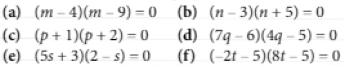
Solve each of the following equations. (a) (m-4)(m-9)-0 (b) (n-3)(n+5)=0 (c) (p+1)(p+2)=0 (d) (79-6)(4q-5)=0 (e) (5s+3)(2-s)-0 (f) (-21-5)(81-5)=0
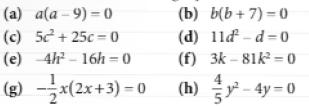
Solve each of the following equations. (a) a(a-9)=0 (c) 5c+25c=0 (e) 4h-16h=0 (g) -x(2x+3)=0 (b) b(b+7)=0 (d) 11d-d-0 (f) 3k-81k2-0 (h)-4y=0
Solving quadratic equations of the form ax + bx + c =d. Solve each of the following equations.(a) x(x+1)=6(b) (2y-1)(y-4)=9
Explain why 16x2 + 490 has no real solutions.
1. Solve each of the following equations. (a) 9x-4-0 (c) 36m-1 (b) 100y-25-0 (d) n-4=0
Solve each of the following equations (a) x(x+6)=-5 (c) (3t+5)(t-2)=-6 (b) 9y(1-y)-2 (d) (2v+1)= (v+2)
Given that y = 3x+3sqr a + b2,(i) find(a) the value of y when a 13, b-15 and x = 3.8,(b) the value of a when b = 13, x=8.5 and y = 35,(c) the values of b when a -23, x-15.6 and y = 56.(ii) explain if it is possible to have a value of y if a + b
Given that A = 1/3 πr2 h + 4/3 πr3, find (a) the value of A when = 3.142, h = 15 and r=7, (b) the value of h when = 3.142, A = 15 400 and r=14.
Given that m(nx-y2)/p =3n, where p +k, find (a) the value of p when m=5, n=7,x=4 and y=-2, (b) the value of n when m=14, p=9,x=2 and y=3, (c) the values of y when m=5, n=4, p = 15 and x=42, (d) the value of k.
12. The amount of energy, E joules (J), stored in an object with a mass of m kg is given by the formula E = mgh + 1/2 mv where h m is the height of the object above the ground, v m s¹ is the velocity of the object and g is taken to be 10 ms.(i) Given that v >= 0 rearrange the formula E = mgh + 1/2
. The time taken, T' seconds, for a pendulum to complete one oscillation is given by the formula T-2 where I m is the length of the pendulum and g is taken to be 10 m s. (i) Express I in terms of T and g. (ii) Hence, find the length of the pendulum if it takes 12 seconds to complete 20 oscillations.
Given that a = sqrt((3b + c)/(b - c)), and 3b + c > 0,(i) express b in terms of a and c,(ii) find the value of b when a = 2 and c = 5.(iii) For b to be defined, a2 = t. State the value of t.
Rearrange each of the following formulae to make the letter in the brackets the subject. 4 (a) V = r (b) v=u+2as (c) y=(x-p)+9 (d) t= 4z [r] [n] [x] [z] m-3
Given that V = pi * r ^ 2 * h + 2/3 * pi * r ^ 3(i) make h the subject of the formula,(ii) find the value of h when V = 1000 and r = 7
Rearrange each of the following formulae to make the letter in the brackets the subject. +2=k 1+4 (e) (b) z= (c) px b y(z-y) x -p+q (a) = a'b [h] [z] [p] =1 [b]
Rearrange each of the following formulae to make the letter in the brackets the subject. (a) F=C+32 [C] (b) A 2r+l [4] (c) s = ut+at [u] (d) S= [2a+(n-1)d] [d]
Given that a2(b + c) = 2b - c, find(a) the values of a when b = 7 and c = 2,(b) the value of c when a = 4 and b = - 1.
Given that sqrt(ax2 - b) = c, find the values of x when a = 2 b = 7 and c = 5.
3. In each of the following cases, make the letter in the brackets the subject of the formula. (a) h-k = m (b) b=D+4ac [h] [D] V2 (c) P- [V] R e (d) A= Xr [0] 360
2. In each of the following cases, make the letter in the brackets the subject of the formula. (a) m =b+c - (b) 5q-r- k+a 2p 3 [a] S \pl (c) 3k [k] 5
1. In each of the following cases, make the letter in the brackets the subject of the formula. (a) ax + by-k [y] (b) PV=RT [n] (c) 5b-2d-3c [d] (d) R=m(a+g) [a]
Given that x+y y(a) find the value of x when y = 4 and z = 2(b) explain if it is possible to have a value of z if x = y.
2. Given that a = sqrt((5b + 16)/(2b - 23)) find the value of b when a = 3
Given that y = sqrt((x + 7)/(x - 2)) where xk, find(a) the value of y when x = 5(b) the value of x when y = 4(c) the value of k.!~!~!~!!
Finding the value of an unknown in a formula without changing the subject of the formula Given that y = sqrt(64/(3x + 1))(a) calculate(i) the value of y when x = 1(ii) the value of x when y = 2(b) explain if it is possible to have a value of y x
Changing the subject of formula involving cube root It is given that root(ax +b, 3) = k(i) Express x in terms ofa, b and k.(ii) Hence, calculate the value of x when b = 3 and k = - 1 a = 4(iii) For x to be defined, at. State the value of t.
Changing the subject of formula involving algebraic fraction(i) Rearrange the formula y = (2 - x)/(3 + 2x) to make x the subject.(ii) Hence, calculate the value of x when y = - 2
Given that (1/x + 1/y)/(2/x) = 4/3 find the value of y/x.
Given that (2a + 7)/(a ^ 2 + 3a + 2) is the end result of the sum of two algebraic fractions, p/Q and R/(a ^ 2 + 3a + 2) write down possible expressions for P, Q and R.!~!~!~!!
9. Albert and Joyce were both asked to simplify (b - 2)/(b ^ 2 - 5b + 6) + b/(b + 3)Both students were able to factorise b ^ 2 - 5b + 6 to get (b - 2)(b - 3)Albert simplified (b - 2)/(b ^ 2 - 5b + 6) before converting to like fractions, whereas converted to like fractions directly.Who do you think
Express (1/(3x) + 2/y)/(2/x) as a fraction in its simplest form.
Solve each of the following equations. 5 (a) 2-x+21 7x-4 x-1 3x-1 7+x (b) 15 3 5 10 x+1 1 1 (c) 5x-l^2(15x) 4 x+1 4 3. (d) 2x-1 4x-2 6x-3 3 5 1 (e) + 2-x 4-2x x-2
Express each of the following as a fraction in its simplest form. (a) (b) (c) 2 + 3 a+3 a+4af3 b-5b-6 b-6 2p-8p-10 p-5 1 2p + X 4 (d) + 3x x+y x+3xy+2y x+2y
5. Express each of the following as a fraction in its simplest form. 3a (a) 3a-5 4a 4a-1 5 2b (b) 2b+1 (2b+1) (c) h+5 3 h-6h h-6 1 2 3 (d) + + (e) 771 m-4 m-3 x+y x-4y x-3y + x-y x-y x+y 1 2 18 (f) + 2z-3 3-2z 9-4z2
4. Express each of the following as a fraction in its simplest form. 5 (a) 4 c-1 1 2(a-b) 3(b-a) (b) 3c-7 14-6c (c) 4f 2d u+1 u+2 + 10f-5d 6f-3d (d) 2u-8 12-3u (e) 2m-5 m+3 h+k 3h+k 9n-6 4-6n (f) + P-q 8q-8p 5x2 (g) 2x2 6x-6y 3y-3x 3x (h) 2x 5 + 4y-2z z-2y 3z-6y
3. Solve each of the following equations. (a) a a+2 315 1 2 (b) b-2 b-1 4 3 (c) 5 2 = 0 c+3 (d) = 0 c+2 d+4 d-2 6 10 (e) 5 6 9 =2 f 3f (f) + =4 6h 7h 14h 3 (g) 1 k+1 = 5 2k+2
2. Express each of the following as a fraction in its simplest form. (a) 50 a + 3 a+4 4 2 (c) + d-5 2d+3 (d) 11 2 (e) + 3h-7 6-5h (f) 3 5 (g) 4m-1 1 2m+1 (h) (b) 3 2b b+c 2 f+5 f-1 ~~~ 3 2 + k2-1 k-1 2 + 3 n-2 (n-2)
1. Express each of the following as a fraction in its simplest form. (d) 32 + 1 5 2b 3b 6b f-4h 2f-5h 3k 8k 4 (a) + (b) 6a 9a 1 1 (c) 3c 3d 4a (e) + x-3y 3x-9y (f) P+3 P-1 2p+1 + 2z 6z 3z
Simplify x+ y-z+2xy x-y-z-2yz
Simplify each of the following. (a) 5a ac X 6d 3f2 8f2 (b) 9b 2b 8b 9f 16d 27d (c) .3 + 2y4yx- 2y' 4y 64x 3sq 3q 14ps (d) + -X x 5x 10y 3w-7 21-9w (e) + (f) 5w 27w h2-h-6. h 4pr 12p's 7qr 6x'y 12x-24y X- 16y-8x 4xy c-d 1 (g) X (h) + h2-9 h+2h c2-2cd+d cd+d m-4 m z (i) m-3m+2 m-1 (j) a+2ab (k)
Simplify each of the following. 9x(a-b) (a) (b) 27x (a-b) 7a' (a-3b) 21ab(a-3b) 8ab (2a+3b) 8an' (b+c) (c) (d) 32ab(3b+2a) 96a'n(c+b)2 y-2y-15 8-2m-m (e) y2-3y-10 (g) 9x-y y-2xy-3x 9 (f) 2m-3m-2 (h) 3x+5xy-2y2 4x+7xy-2y
Simplify each of the following. 15a (a) 4c X- 8b'c 5ab a-2b 4a-8b (b) 3(c+d) 2c-2d X c-d 8c+8d 8c 2c2 (c) + (d) + 16 24 6(c+d) 3c+3d
Simplify each of the following. 2a+b c+2cd-15d (a) (b) 4a-b 3a-6 (c) (d) a+a-6 k2-9 (e) (f) k2-7k+12 4c+20cd x+6x-7 2 XX x-x 2 km+8k m+4m-32
Simplify each of the following. (a) xy+3y (b) 4x+12 8a+4b bc+2ac a+2ab c (c) 6a (d) -cd (e) 2 (m-n) m-mn 5pq (f) 15p-10pq
Simplify each of the following. 4x4 (a) (b) 12x5 16a3b4 24ab 23q'r 3mn p 2 3 (c) (d) 69qr's 18m'np 15ac (e) (f) 75abc 64x y z 16xy'z 2.4 3
Compare and contrast the ECB and the Bank of England in terms of:a) their independenceb) the transparency of their policymakingc) their accountability
Discuss the view that the second pillar of the ECB’s strategy is redundant in the light of the first pillar.
Look at the latest interest rate decision made by the ECB and explain it in terms of the first and second pillars of the ECB’s monetary strategy.
Do you think that the business cycles of Ireland are likely to be better synchronised with the rest of the euro area than are those of the UK? If so, given Ireland's long-standing economic links with the UK, why might this be so?
Why is the accountability of the central bank an important issue?
Outline the arguments for and against fixed and variable rate tenders as the instrument for the provision by the central bank of liquidity to the banking system.
When the ECB began operation at the beginning of 1999, how did it ensure that all members of the Executive Board would not end their terms of office at the same time? What would be wrong with the terms of all six members of the Board ending on the same date?
In the text, we say:‘A supporting argument was that the euro, as a broader-based reserve currency than the DM would be less likely to be driven artificially high on occasions.Explain this statement.. How did it relate to the question of the likely future strength of the euro?
What does the Executive Board of the ECB do? What does it not do?
Why might the business cycles of the UK not be synchronised with those of the 12 current members of the euro area?
In 11.2, we suggest that wage flexibility does not always provide an efficient means of adjusting to external shocks. What is the basis of that argument?
From August 2007 to April 2008, the Bank of England reduced interest rates even when it was forecasting that the inflation target would be breached in 2008.How would you explain this action?
‘It is not that the demand for lending has become less sensitive to changes in relative interest rates. If anything, it has become more so. The problem lies in the increasing inability of the authorities to cause changes in relative rates by changing the level of absolute rates.’ (Goodhart,
Why might responsibility for the government debt market inhibit a central bank’s conduct of monetary policy?
What features of the UK’s monetary policy framework contribute to credibility and openness?
Explain briefly why ‘credibility’ and ‘openness’ are desirable properties in the conduct of monetary policy.
Why does a rise in money’s own interest rate, ceteris paribus, tend to increase the rate of monetary growth?
Why might the presence of capital risk aversion in the bond market make the conduct of monetary policy more difficult?
Explain how capital adequacy requirements impose a tax on banking.
Why might giving the central bank responsibility for banking supervision make it more difficult for the bank to pursue an independent monetary policy with price stability as the primary target?
Explain why policy makers have generally come to the conclusion that the only effective instrument of monetary policy is the short-term rate of interest.
What are ‘open mouth operations’? On what does their influence depend?
Why do central bank repo deals have such a large impact on money market interest rates?
What useful forecasting information might there be in (a) company profit announcements and (b) corporate-government bond spreads. Explain how you might go about trying to extract that information.
You observe a yield curve which slopes upward for maturities up to two years and then slopes gently downward levelling off at 10 years and beyond. What might this tell you about market expectations of future interest rate developments.State explicitly any assumptions you have to make.
Why might the yield on corporate bonds fluctuate relative to the yield on government bonds? What assumptions would you have to make in order to draw information about the economic cycle from these yields?
Why might central banks be concerned about major price fluctuations in asset markets?
Why do international capital flows make the conduct of monetary policy more difficult?
Why do money market rates move so closely together?
Compare and contrast the merits of inflation and nominal income as monetary policy targets.
Go to the Bank of England website (www.bankofengland.co.uk), find and read the latest annual remit given to the Bank of England. Identify the key phrases that:(a) specify the current inflation target(b) specify the priority to be given to it amongst the Bank's other responsibilities
Why do you think central banks have not adopted an instrument setting rule of the Taylor type?
Why does the ability of the MPC of the Bank of England to set its own policy horizon give it some goal independence?6.Why do you think inflation targeting in practice means the targeting of the central bank’s inflation forecast rather than the rate of inflation itself?
Explain the problems associated with the choice of the money supply as an intermediate target.
Outline the arguments against discretionary macroeconomic policy.
It is often said that ‘in the long-run’ inflation reduces output and employment.What costs might be incurred in the short-run and why might these fall upon those who may not benefit from a long-run reduction in inflation?
Distinguish between ‘goals’, ‘targets’, ‘instruments’ and ‘indicators’.
In what senses is:(a) the Williamson-Miller target zone model Keynesian?(b) the McKinnon fixed exchange rate model monetarist?
What meaning or meanings might be attached to the notion of the equilibrium exchange rate?
What is the Lucas critique? What is its relevance to this chapter?
What is the relationship between purchasing power parity and the neutrality of money?
Showing 2800 - 2900
of 3107
First
18
19
20
21
22
23
24
25
26
27
28
29
30
31
32
Step by Step Answers

 Get 50% OFF
Study Help!
Claim Now
Get 50% OFF
Study Help!
Claim Now