New Semester
Started
Get
50% OFF
Study Help!
--h --m --s
Claim Now
Question Answers
Textbooks
Find textbooks, questions and answers
Oops, something went wrong!
Change your search query and then try again
S
Books
FREE
Study Help
Expert Questions
Accounting
General Management
Mathematics
Finance
Organizational Behaviour
Law
Physics
Operating System
Management Leadership
Sociology
Programming
Marketing
Database
Computer Network
Economics
Textbooks Solutions
Accounting
Managerial Accounting
Management Leadership
Cost Accounting
Statistics
Business Law
Corporate Finance
Finance
Economics
Auditing
Tutors
Online Tutors
Find a Tutor
Hire a Tutor
Become a Tutor
AI Tutor
AI Study Planner
NEW
Sell Books
Search
Search
Sign In
Register
study help
business
statistical techniques in business
A Modern Course In Statistical Physics 2nd Edition Linda E. Reichl - Solutions
Problem 7.22. Compute the magnetization of an ideal gas of spin- fermions in the presence of a magnetic field. Assume that the fermions each have magnetic moment He. Find an expression for the magnetization in the limit of weak magnetic field and T-OK.
Problem 7.20. Electrons in a piece of copper metal can be assumed to behave like an ideal Fermi gas. Copper metal in the solid state has a mass density of 9gr/cm. Assume that each copper atom donates one electron to the Fermi gas. Assume the system is at T= 0 K. (a) Compute the Fermi energy, EF, of
Problem 7.19. Show that the pressure, P, of an ideal Bose-Einstein gas can be written in the form P = au, where u is the internal energy per unit volume and a is a constant. (a) What is u? (b) What is a?
Problem 7.17. An ideal Bose-Einstein gas consists of noninteracting bosons of mass m which have an internal degree of freedom which can be described by assuming, that the bosons are two-level atoms. Bosons in the ground state have energy Eo = p/2m, while bosons in the excited state have energy E =
Problem 7.15. In the mean field approximation to the Ising lattice, the order parameter, (s), satisfies the equation (s) = tanh((s) ), where T = ve/2kg with the strength of the coupling between lattice sites and v the number of nearest neighbors. (a) Show that (s) has the following temperature
Problem 7.14. Consider a one-dimensional lattice with N lattice sites and assume that the ith lattice site has spin s1. the Hamiltonian describing this lattice is H==SS+1. Assume periodic boundary conditions, so SN+1 = S. Compute the correlation function, (s152). How does it behave at very high
Problem 7.13. An ideal gas consists of a mixture of "green" and "red" spin-particles. All particles have mass m. A magnetic field, B, is applied to the system. The "green" particles have magnetic moment YG, and the "red" particles have magnetic moment YR, where YRYG. Assume the temperature is high
Problem 7.12. An ideal gas is composed of N "red" atoms of mass m, N "blue" atoms of mass m, and N "green" atoms of mass m. Atoms of the same color are indistinguishable. Atoms of different color are distinguishable. (a) Use the canonical ensemble to compute the entropy of this gas. (b) Compute the
Problem 7.11. A cubic box (with infinitely hard walls) of volume V = L contains an ideal gas of N rigid HCl molecules (assume that the effective distance between the H atom and the Cl atom is d = 1.3. (a) If L = 1.0 cm, what is the spacing between translational energy levels? (b) Write the
Problem 7.10. Consider a two-dimensional lattice in the x-y plane with sides of length Lx and Ly which contains N atoms (N very large) coupled by nearest-neighbor harmonic forces. (a) Compute the Debye frequency for this lattice. (b) In the limit T 0, what is the heat capacity?
Problem 7.9. Consider a solid surface to be a two-dimensional lattice with N, sites. Assume that N atoms (Na N,) are adsorbed on the surface, so that each lattice site has either zero or one adsorbed atom. An adsorbed atom has energy E = -e, where >0. Assume the atoms on the surface do not interact
Problem 7.8. What is the partition function for a van der Waals gas with N particles? Note that the result is phenomenological and might involve some guessing. It is useful to compare it to the partition function for an ideal gas. Remember that the particles are indistinquishable, so when using the
Problem 7.7. A fluid in equilibrium is contained in an insulated box of volume V. The fluid is divided (conceptually) into m cells. Compute the variance of internal energy fluctuations, ((AU)2), in the ith cell (For simplicity assume the fluctuations occur at fixed particle number, N.). What
Problem 7.6. A fluid in equilibrium is contained in an insulated box of volume V. The fluid is divided (conceptually) into m cells. Compute the variance of enthalpy fluctuations, ((AH)2), in the ith cell (For simplicity assume the fluctuations occur at fixed particle number, N;). (Hint: Use P and S
Problem 7.5. A system has three distinguishable molecules at rest, each with a quantized magnetic moment which can have z components + or - Find an expression for the distribution function, fi (i denotes the ith configuration), which maximizes entropy subject to the conditions f=1 and Miz fiyu,
Problem 7.4. Consider a lattice with N spin-1 atoms with magnetic moment . Each atom can be in one of three spin states, S = -1,0, +1. Let n-1, no, and n denote the respective number of atoms in each of those spin states. Find the total entropy and the configuration which maximizes the total
Problem 7.3. A lattice contains N normal lattice sites and N interstitial lattice sites. The lattice sites are all distinguishable. N identical atoms sit on the lattice, M on the interstitial sites, and NM on the normal sites (N > M >1). If an atom occupies a normal site, it has energy E = 0. If an
Problem 7.2. A system consists of N noninteracting, distinguishable two-level atoms. Each atom can exist in one of two energy states, Eo = 0 or E = . The number of atoms in energy level, Eo, is no and the number of atoms in energy level, E, is n. The internal energy of this system is U = noEo + nE.
Problem 7.1. Compute the structure function for N noninteracting harmonic oscillators, each with frequency w and mass m. Assume the system has total energy E. Using this structure function and the microcanonical ensemble, compute the entropy and the heat capacity of the system.
EXERCISE 7.9. Compute the density of states at the Fermi surface for an ideal Fermi-Dirac gas confined to a box of volume V.
EXERCISE 7.8. Compute the variance in particle number, ((N - (N))), for a Fermi-Dirac gas for temperatures near T = 0 K.
EXERCISE 7.7. Compute the variance, ((N- (N))), in the number of particles for an ideal boson gas (below the critical temperature) in the neighborhood of 7 = OK.
EXERCISE 7.6 A cubic box of volume V = L contains electromagnetic energy (photons) in equilibrium with the walls at temperature T (black-body variation). The allowed photon energies are determined by the standing waves formed by the electromagnetic field in the box. The photon energies are hw;=hck,
EXERCISE 7.5 Use the canonical ensemble to compute the entropy, internal energy, and heat capacity of the Einstein solid described in Exercise 7.1.
EXERCISE 7.4. A cubic box (with infinitely hard walls) of volume, VL, contains an ideal gas of N identical atoms, each of which has spin, s, and magnetic moment, . A magnetic field, B, is applied to the system. (a) Compute the partition function for this system. (b) Compute the internal energy and
EXERCISE 7.3. Compute the partition function, Z3 (T), for an ideal gas of three identical particles (bosons or fermions) in a cubic box of volume VL. Assume the walls of the box are infinitely hard. For symplicity, neglect any spin or other internal degrees of freedom. What approximations can be
EXERCISE 7.2. Use the microcanonical ensemble to find the entropy and equation of state of an ideal gas of N identical particles of mass m confined to a box of volume V. Assume that N and V are very large.
EXERCISE 7.1. An Einstein solid consists of a lattice in three- dimensional space with N lattice sites. Each lattice site contains three harmonic oscillators (one for each direction in space), each of which has frequency w. Neither the lattice sites nor the harmonic oscillators are coupled to one
An atom with spin 1 has a Hamiltonian = AS + B(2-2), where Sx, Sy, and S, are the x, y, and z components of the spin angular momentum operator. In the basis of eigenstates of the operator, S2, these three operators have the matrix representations(a) Write the density matrix (in the basis of
A two-level system has a Hamiltonian matrixat time t. (b) What is the probability to be in the state |1) at time t = 0? At time t? For simplicity, assume that = 1. 3 4i -4i -3. 4/12) = (-41 H2,1 H2,2 where, for example, H,2 = (1||2). The density matrix at time t = 0 is P1,1 (0) (a) Find the density
For a noninteracting gas of N particles in a cubic box of volume V = L, where L is the length of the side of box, find the solution, p(p, q, t), of the Liouville equation at time t, where pN = (PPN) and q = (q1,..., qv) with Pi (Pix Piy, Piz) and q (qix, qiy qiz). Assume periodic boundary
Problem S5.9. Consider a biased random walk along the x axis with step size A and transition rate w(nA ') = (a(n) B(n)) + B(NA) ON +1 + (-) a(n) B(nA) + B(n) 6
Problem S5.8. A Brownian particle of mass m moves in one dimension in the presence of a harmonic potential V(x)=kx, where k is the force constant. The Langevin equations are given by m[dv(t)/dt] = v(t) - dv(x)/dx+(t) and dx(t)/dt = v(t), where is the friction coefficient and (t) is a Gaussian white
Problem S5.7. Consider a Brownian rotor with moment of inertia, I, constrained to rotate through angle, 0, about the z axis. The Langevin equations of motion for the rotor are I(dw/dt)=-Tw+ (t) and (de/dt) =w, where w is the angular velocity of the rotor, I is the friction coefficient, and (t) is a
Problem S5.6. The motion of an harmonically bound Brownian particle moving in one dimension is governed by the Langevin equations, m dv(t) dt -= -yv (1) - mux(t) + (t) and dx(t) = = v(t), dt where v(t) and x(t) are the velocity and displacement of the particle at time t,m is the mass, y is the
Problem S5.5. Consider the following chemical reaction, A+MX+M and 2X+E+D, where molecules A, M, E, and D are obtained from large reservoirs and can be assumed constant. (a) Find the probability to have n X molecules in the system after a very long time, too. (b) Find the average number of X
Problem S5.4. Consider the chemical reaction in Problem S5.2 and let N = 3, k = 2, and k2 1. (a) Write the transition matrix, W and compute its eigenvalues and left and right eigenvectors. (b) If initially there are zero X-molecules in the system, what is the probability of finding three
Problem S5.3. Consider a box (A) of volume 2, connected to another box (B) of infinite volume via a small hole (cf. Fig. 5.7). Assume that the probability that a particle moves from box A to box B in time Ar is (n/2)A1 and that the probability that a particle moves from box B to box A in time At is
Problem S5.2. Consider the chemical reactionwhere molecule A is a catalyst whose concentration is maintained constant. Assume that the total number of molecules X and Y is constant and equal to N. k(k2) is the probability per unit time that molecule X (Y) interacts with a molecule A to produce a
Problem S5.1. Consider a linear birth-death process which includes the possibility of a change in population due to immigration in addition to the change that occurs due to the birth and death of individuals in the population. Assume that at time t the population has n members. Let aAt be the
Problem 5.11. Consider a Brownian particle of mass m moving in one dimension in the presence of a constant force fo (such as a gravitational or electric field) in a fluid with force constant and in the presence of a delta-correlated random force (t) such that ((12)(1)) =88(121) and (()) = 0. Assume
Problem 5.10. Due to the random motion and discrete nature of electrons, and LRC series circuit experiences a random electromotive from (EMF), (t). This, in turn, induces a random varying charge, Q(t), on the capacitor plates and a random current, I(t)=(dQ(t)/dt), through the resistor and inductor.
Problem 5.9. Let us consider on RL electric circuit with resistance, R, and inductance, L, connected in series. Even though no average electromotive force (EMF) exists across the resistor, because of the discrete character of the electrons in the circuit and their random motion, a fluctuating EMF,
Problem 5.8. Consider a random walk on the lattice shown in Fig. 5.6. The site, P, absorbs the walker. The transition rates are w,2 = w13 =, w21 =W2,3=w2.p=}, w3,1 = w3,2 = w3,p = , and wp1=wp2 = (a) Write the transition matrix, M, and compute its eigenvalues and and left and right eigenvectors.
Problem 5.7. Consider a random walk on the lattice shown in Fig. 5.5. The transition rates are w,2 =W1,3 = W2,1 = w2,3 = w2,4 = W3,1 = W3,2 = W3,4 = 3, W4,2= W4,3 and w,4w4,1 = 0. (a) Write the transition matrix, W, and show that this system obeys detailed balance. (b) Compute the symmetric matrix,
Problem 5.6. At time t, a radioactive sample contains n identical undecayed nuclei, each with a probability per unit time, A, of decaying. The probability of a decay during the time tt+At is AnAt. Assume that at time t = 0 there are no undecayed nuclei present. (a) Write down and solve the master
Problem 5.5. Consider a discrete random walk on a one-dimensional periodic lattice with 2N+1 lattice sites (label the sites from -N to M). Assume that the walker is equally likely to move one lattice site to the left or right at each step. Treat this problem as a Markov chain. (a) Compute the
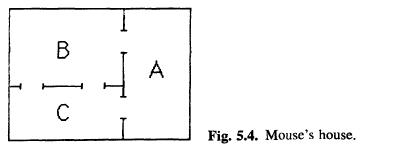
Problem 5.4. The doors of the mouse's house in Fig. 5.4 are fixed so that they periodically get larger and smaller. This causes the mouse's transition probability between rooms to become time periodic. Let the stochastic variable Y have the same meaning as in Problem 5.3. The transition matrix is
Problem 5.3. A trained mouse lives in the house shown in the Fig. 5.4. A bell rings at regular intervals (short compared to the mouses lifetime). Each time it rings, the mouse changes rooms. When he changes rooms, he is equally likely to pass through any of the doors of the room he is in. Let the
Problem 5.2. Three boys, A, B, and C, stand in a circle and play catch (B stands to the right of A). Before throwing the ball, each boy flips a coin to decide whether to throw to the boy on his right or left. If "heads" comes up, the boy throws to his right. If "trials" comes up, he throws to his
Problem 5.1. Urn A initially has one white and one red marble, and urn B initially has one white and three red marbles. The marbles are repeatedly interchanged. In each step of the process one marble is selected from each urn at random and the two marbles selected are interchanged. Let the
EXERCISE 5.8. Consider the "short-time" relaxation of a free Brownian particle. The Langevin equation for the velocity is m(dv/dt) = -v(t). (a) Find the Fokker-Planck equation for the probability P(v, t)dy to find the Brownian particle with velocity vv + dv at time t. (b) Solve the Fokker-Planck
EXERCISE 5.7. Let us consider a stochastic variable Y with three realizations, y(1), y(2), and y(3). Let us assume that the transition probabilities between these states are Q1,1(s) = Q2,2(s) = 23,3(s) = 0, Q1,2(s) = 22,3(5)=23,1(s) = cos (2s/3), and 21,3(s) = 22,1(s) = Q3,2(s) sin (2s/3). If
EXERCISE 5.6. Compute the spectral density, S,,,(w), for the harmonically bound Brownian particle considered in Exercise 5.5. Plot the velocity correlation function, Cv, v(7), and spectral density Sv,,(w) for the case wo(this corresponds to an underdamped Brownian particle).
EXERCISE 5.5. Consider a Brownian particle of mass m which is attached to a harmonic spring with force constant k and is constrained to move in one dimension. The Langevin equations arewhere wok/m. Let xo and vo be the initial position and velocity, respectively, of the Brownian particle and assume
EXERCISE 5.4 Consider an asymmetric random walk on a lattice with five lattice sites. Assume that the fifth site, P, absorbs the walker. The transition rates w1,2 = W1,3 = W1,4 = W1, p = , W2,1 = W2,3 = W2, p = , W3,1 = W3,2 = W3,4 = , W4,1 = W4,3 = w4, p = , WP,1 = WP,2 = WP,4 and wij 0 for all
EXERCISE 5.3 Consider an asymmetric random walk on a periodic lattice with four lattice sites. The transition rates are w,2 W2,3 W3,4 =W4,1 W2,1 W3,2 =W4,3 = W,4 = 1, and wij = 0 for all other transitions. Write the transition matrix, W, and show that this system does not obey detailed balance.
EXERCISE 5.2 Consider an asymmetric random walk on an open- ended lattice with four lattice sites. The transition rates are W1,2 W4,3 1, W2,3 = W3,4 =, W2,1 = w3,2 =, and w = 0 for all other transitions. (a) Write the transition matrix, W, and show that this system obeys detailed balance. (b)
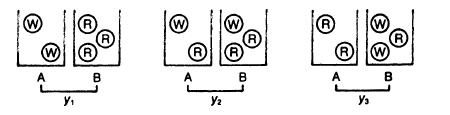
EXERCISE 5.1. Consider two pots, A and B, with three red balls and two white balls distributed between them so that A always has two balls and B always has three balls. There are three different configurations for the pots, as shown in the figure below. We obtain transitions between these three
A die is loaded so that even numbers occur three times as often as odd numbers. (a) If the die is thrown N = 12 times, what is the probability that odd numbers occur three times? If it is thrown N = 120 times, what is the probability that odd numbers occur thirty times? Use the binomial
Consider the gamma distribution function for stochastic variable X:and F(x)=0 for x (a) Find the characteristic function for this distribution. (b) Write the Levy-Khintchine formula for the characteristic function. That is, find a and G(x). Is X infinitely divisible? [Hint: First find F(x) and use
A stochastic variable X has characteristic function fx (k) = 1/(1+k). (a) Compute the probability density, Px(x), the average, (x), and variance. (b) Write Kolmogorov's formula for this characteristic function. What is K(u)? Is the stochastic variable X infinitely divisible?
Consider a Rayleigh-Pearson random walk in which the walker has a probability P(r)dr=rdr/(1+2)3/2 to take a step of length rr+ dr. If the walker starts at the origin, compute the probability PN(R) to find the walker within a circle of radius R after N steps.
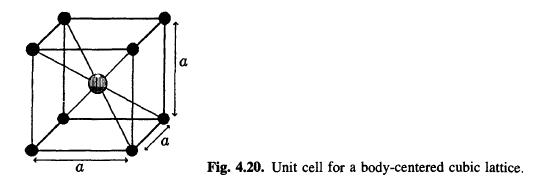
Consider a random walk along nearest neighbors on an infinite, periodic body-centered three-dimensional (d = 3) cubic lattice. A unit cell is shown in Fig. 4.20. Assume that the lattice spacing is a = 2 and that the walker starts at site,(1=0,2 = 0,3 = 0). Compute the generating function. U(1,0),
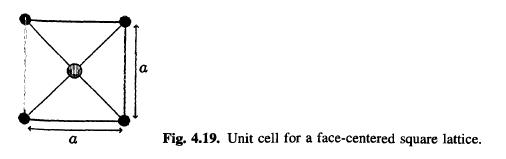
Consider a random walk along nearest neighbors on an infinite, periodic face centered two-dimensional (d = 2) square lattice. A unit cell is shown in Fig. 4.19. Assume that the lattice spacing is a = 2 and that the walker starts at site = 0,2 = 0. (a) By counting paths (draw them), find the
Consider a random walk on an infinite one dimensional (d =1) lattice where the walker starts at site 1 = 0. (a) Compute the generating functions U(2, 1) and V(z,). (b) Compute the probability to reach site, I, during the random walk. (c) Compute the probability that the walker reaches site != 0 and
Consider a random walk for which the probability of taking of step of length, xx+dx, is given by P(x)dx=(a/(x + a2))dx. Find the probability density for the displacement of the walker after N steps. Does it satisfy the Central Limit Theorem? Should it?
Consider a random walk in one dimension for which the walker at each step is equally likely to take a step with displacement anywhere in the interval d-a
Consider a random walk in one dimension. In a single step the probability of a displacement between x and x + dx is given byAfter N steps the displacement of the walker is SX++XN, where X, is the displacement during the ith step. Assume the steps are independent of one another. After N steps, (a)
Three old batteries and a resistor, R, are used to construct a circuit. Each battery has a probability p to generate voltage V = vo and has a probability 1 -p to generate voltage V = 0. Neglect any internal resistance in the batteries. Find the average power, (V2)/R, dissipated in the resistor if
A book with 700 misprints contains 1400 pages. (a) What is the probability that one page contains 0 misprints? (b) What is the probability that one page contains 2 misprints?
The stochastic variables X and Y are independent and Gaussian distributed with first moment (x) = (y) = 0 and standard deviations x=oy = 1. Find the characteristic function for the random variable Z = x + y, and compute the moments (z), (2), and (z). Find the first three cumulants.
A stochastic variable X can have values x = 1 and x = 3. A stochastic variable Y can have values y = 2 and y = 4. Denote the joint probability density Pxy(x,y)=-13-24 Pij6(xi)6(y-j). Compute the covariance of X and Y for the following two cases: (a) P1,2 = P1,4 P32 = P3,4 = and (b) P1,2 = P3,4 = 0
Fifteen boys go hiking. Five get lost, eight get sunburned, and six return home without problems. (a) What is the probability that a sunburned boy got lost? (b) What is the probability that a lost boy got sunburned?
Various six digit numbers can be formed by permuting the digits 666655. All arrangements are equally likely. Given that a number is even, what is the probability that two fives are together? (Hint: You must find a conditional probability.)
Three coins are tossed. (a) Find the probability of getting no heads. (b) Find the probability of getting at least one head. (c) Show that the event "heads on the first coin" and the event "tails on the last two coins" are independent. (d) Show that the event "only two coins heads" and the event
In how many ways can five red balls, four blue balls, and four white balls be placed in a row so that the balls at the ends of the row are the same color?
Find the number of permutations of the letters in the word MONOTONOUS. In how many ways are four O's together? In how many ways are (only) 3 O's together?
Find the number of ways in which eight persons can be assigned to two rooms (A and B) if each room must have at least three persons in it.
A bus has nine seats facing forward and eight seats facing backward. In how many ways can seven passengers be seated if two refuse to ride facing forward and three refuse to ride facing backward?
Consider the characteristic function, f(k) = (1-b)/(1-bik)(0
Show that the characteristic function, f(k) = [(1b)/(1+a)][(1+aek)/(1 - be-ik)] (0
Consider the characteristic function f(k) = (1b)/(1-bek)(0
Show that the characteristic function for an divisible distribution has no real zeros. infinitely
Compute the generating function, U(z, 0), for the probability to be at site = 0, at time s, given that the walker was at site 1=0 at times = 0.
A thin sheet of gold foil (one atom thick) is fired upon by a beam of neutrons. The neutrons are assumed equally likely to hit any part of the foil but only "see" the gold nuclei. Assume that for a beam containing many neutrons, the average number of hits is two. (a) What is the probability that no
The probability of an archer hitting his target is . If he shoots five times, what is the probability of hitting the target at least three times?
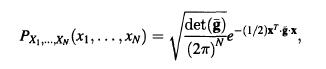
The multivariant Gaussian distribution with zero mean can be writtenwhere is a symmetric N x N positive definite matrix, x is a column vector, and the transpose of x, x = (x1,...,xw), is a row vector. Thus, xgx=18xx;. (a) Show that Pxx(x1,...,xN) is normal- ized to one. (b) Compute the
The stochastic variables, X and Y, are independent and are Gaussian distributed with first moments, (x) = (y) = 0, and standard deviations, x=oy = 1. Find the joint distribution function for the stochastic variables, V = X + Y and W - X - Y. Are Vand Windependent?
Show that the correlation function, Cor (X, Y), is a measure of the degree to which X depends on Y.
Consider a system with stochastic variable, X, which has probability density, Px (x), given by the circular distribution; Px(x) = 1-2 for x1, and Px(x) = 0 for |x| > 1. Find the characteristic function and use it to find the first four moments and the first four cumulants.
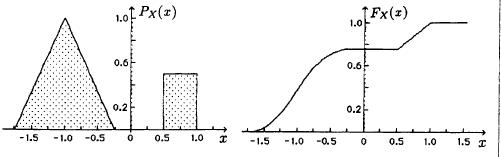
Locate (x), xp, and xm for the probability density, Px(x), and the probability distribution, Fx(x), shown below. 0.6 0.2 [Px(2) Fx (2) 1.0 0.6- 0.2- -1.5 -1.0 -0.5 0 0.5 1.0 I -1.5 -1.0 -0.5 0 0.5 1.0 1.5 T
Plot the probability density, Px(x), and the distri- bution function, Fx(x), for the Gaussian probability density, Px(x) = (1/22)ex/8
Consider a weighted six-sided die. Let x = i (i=1,2,..., 6) denote the realization that the ith side faces up when the die is thrown. Assume that pi =p2 = P3 P4 P5 =121 in Eqs. (4.8) and (4.9). Plot Px(x) and Fx(x) for this system. = = 12 P6=12
Consider a sample space consisting of events A and B such that P(A) = P(B), and P(AUB) = 1. Compute P(ANB), P(BA), and P(A|B). Are A and B independent?
Find the number of permutations of the letters in the word, ENGINEERING. In how many ways are three E's together? In how many ways are (only) two E's together.
Consider a mixture of molecules of type A and B to which a small amount of type C molecules is added. Assume that the Gibbs free energy of the resulting tertiary system is given by= where n = n+ng+nc, nc nA, and ncThe quantities (P,T), =(P,T), and = (P,T) are the chemical potentials of pure A, B,
For a binary mixture of particles of type 1 and 2, the Gibbs free energy is G=n+n22 and differential changes in the Gibbs free energy are dG = -SdT+ V dP+dn +dn2. The Gibbs free energy of the mixture is assumed to be= where are the chemical potentials of the pure substances. In the region in which
Prove that at the tricritical point, the slope of the line of first-order phase transitions is equal to that of the line of continuous phase transitions.
Assume that two vessels of liquid He4, connected by a very narrow capillary, are maintained at constant temperature; that is, vessel A is held at temperature TA, and vessel B is held at temperature Tg. If an amount of mass, AM, is transferred reversibly from vessel A to vessel B, how much heat must
Showing 2700 - 2800
of 5757
First
21
22
23
24
25
26
27
28
29
30
31
32
33
34
35
Last
Step by Step Answers

 Get 50% OFF
Claim Now
Get 50% OFF
Claim Now