







Question: Consider the function (a) Show that as (x, y) (0, 0) along any line y = mx, the limit equals 0. (b) Show that
Consider the function 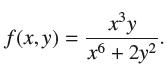
(a) Show that as (x, y) → (0, 0) along any line y = mx, the limit equals 0.
(b) Show that as (x, y) → (0, 0) along the curve y = x3, the limit does not equal 0, and hence, 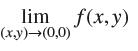 does not exist.
f(x, y) = xy + 2y x
Step by Step Solution
★★★★★
3.29 Rating (152 Votes )
There are 3 Steps involved in it
1 Expert Approved Answer
Step: 1 Unlock

a Along the line y mx the limit is If m0 this simplifies to x mx lim x0 x 2mx mx x0 x4 2m lim 0 l... View full answer
Question Has Been Solved by an Expert!
Get step-by-step solutions from verified subject matter experts
Step: 2 Unlock
Step: 3 Unlock
 Study Help