







Question: Let (mathbf{A}) be the vector potential and (mathbf{B}) the magnetic field of the infinite solenoid of radius (R) in Example 4 . Use Stokes' Theorem
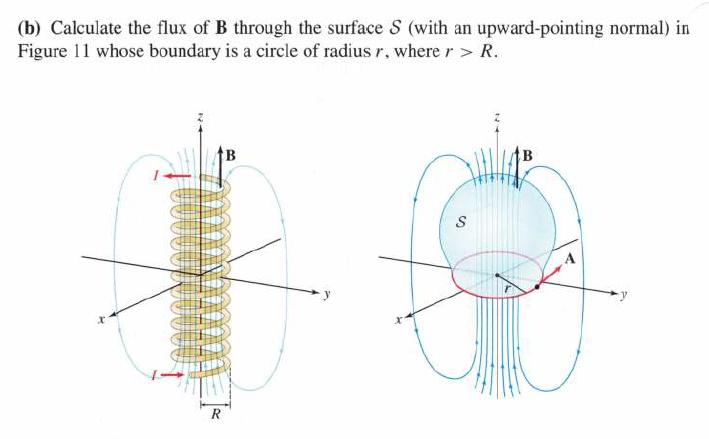
Let \(\mathbf{A}\) be the vector potential and \(\mathbf{B}\) the magnetic field of the infinite solenoid of radius \(R\) in Example 4 . Use Stokes' Theorem to compute:
(a) The flux of \(\mathbf{B}\) through a circle in the \(x y\)-plane of radius \(r
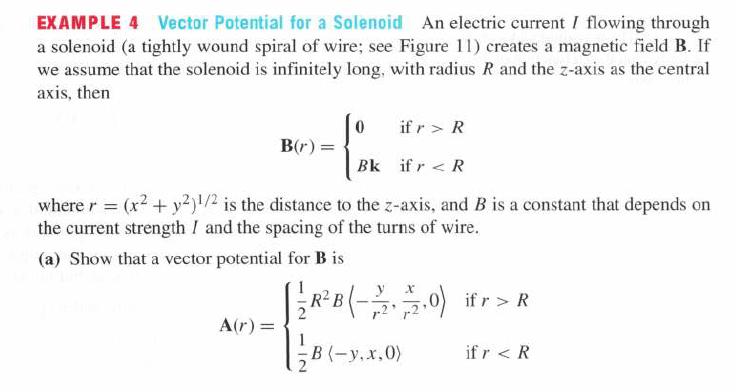
EXAMPLE 4 Vector Potential for a Solenoid An electric current I flowing through a solenoid (a tightly wound spiral of wire; see Figure 11) creates a magnetic field B. If we assume that the solenoid is infinitely long, with radius R and the z-axis as the central axis, then B(r) = A(r) = 0 Bk ifr < R where r = = (x + y2)/2 is the distance to the z-axis, and B is a constant that depends on the current strength I and the spacing of the turns of wire. (a) Show that a vector potential for B is B if r > R 21 B (-y.x,0) X ifr > R if r < R
Step by Step Solution
3.45 Rating (148 Votes )
There are 3 Steps involved in it

Get step-by-step solutions from verified subject matter experts
 Study Help