







Question: Prove that if r(t) takes on a local minimum or maximum value at t 0 , then r(t 0 ) is orthogonal to r'(t 0
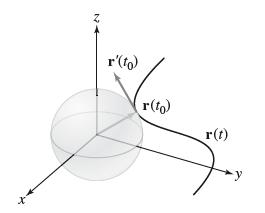
Prove that if ΙΙr(t)ΙΙ takes on a local minimum or maximum value at t0, then r(t0) is orthogonal to r'(t0). Explain how this result is related to Figure 11. Observe that if r(t0) is a minimum, then r(t) is tangent at t0 to the sphere of radius ΙΙr(t0)ΙΙcentered at the origin.
N r'(to) r(to) r(t)
Step by Step Solution
★★★★★
3.33 Rating (144 Votes )
There are 3 Steps involved in it
1 Expert Approved Answer
Step: 1 Unlock

Suppose that rt takes on a minimum or maximum value at ... View full answer
Question Has Been Solved by an Expert!
Get step-by-step solutions from verified subject matter experts
Step: 2 Unlock
Step: 3 Unlock
 Study Help