







Question: Show that the Lagrange equations for (x, y) = 2x + y subject to the constraint g(x, y) = x 2 y 2 =
Show that the Lagrange equations for ƒ(x, y) = 2x + y subject to the constraint g(x, y) = x2 − y2 = 1 have a solution but that f has no min or max on the constraint curve. Does this contradict Theorem 1?
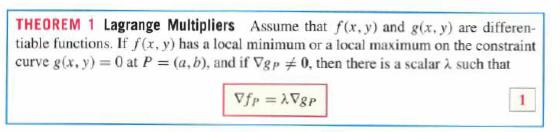
THEOREM 1 Lagrange Multipliers Assume that f(x, y) and g(x, y) are differen- tiable functions. If f(x, y) has a local minimum or a local maximum on the constraint curve g(x, y) = 0 at P = (a, b), and if Vgp #0, then there is a scalar such that Vfp = Vgp
Step by Step Solution
3.36 Rating (149 Votes )
There are 3 Steps involved in it
or and hence Using the methods of Lagrange we can write Vf Vg and see 2 1 2x 2y 2 21x Ev... View full answer

Get step-by-step solutions from verified subject matter experts
 Study Help