



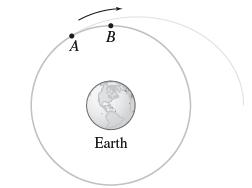
Question: Two space shuttles A and B orbit the earth along the solid trajectory in Figure 9. Hoping to catch up to B, the pilot of
Data From Exercise 20
Show that a planet in an elliptical orbit has total mechanical energy E = −GMm/2a, where a is the semimajor axis. Use Exercise 19 to compute the total energy at the perihelion.
Data From Exercise 19
The perihelion and aphelion are the points on the orbit closest to and farthest from the sun, respectively (Figure 8). The distance from the sun at the perihelion is denoted rper and the speed at this point is denoted vper. Similarly, we write rap and vap for the distance and speed at the aphelion. The semimajor axis is denoted a.
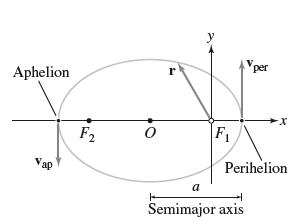
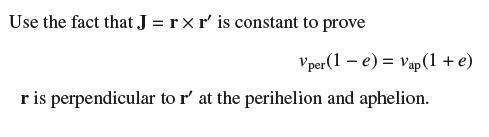
Prove that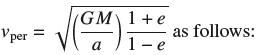
(a) Use Conservation of Energy (Exercise 17) to show that
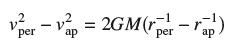
Data From Exercise 17
The total mechanical energy (kinetic energy plus potential energy) of a planet of mass m orbiting a sun of mass M with position r and speed v = ΙΙr'ΙΙ is
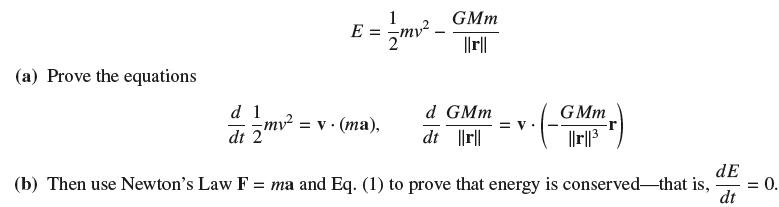
(b) Show that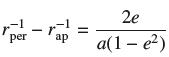 using Exercise 13.
Data From Exercise 13
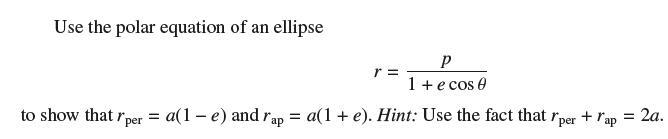
(c) Show that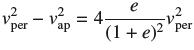 using Exercise 15. Then solve for vper using (a) and (b).
Data From Exercise 15
A B Earth
Step by Step Solution
3.39 Rating (143 Votes )
There are 3 Steps involved in it
In Exercise 20 we showed that the total mechanical energy E of a planet in an el... View full answer

Get step-by-step solutions from verified subject matter experts