







Question: An object in free fall may be modeled by assuming that the only forces at work are the gravitational force and resistance (friction due to
An object in free fall may be modeled by assuming that the only forces at work are the gravitational force and resistance (friction due to the medium in which the object falls). By Newton’s second law (mass × acceleration = the sum of the external forces), the velocity of the object satisfies the differential equation
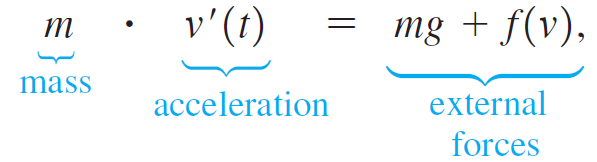
where f is a function that models the resistance and the positive direction is downward. One common assumption (often used for motion in air) is that f(v) = -kv2, where k > 0 is a drag coefficient.
a. Show that the equation can be written in the form v'(t) = g - av2, where a = k/m.
b. For what (positive) value of v is v'(t) = 0? (This equilibrium solution is called the terminal velocity.)
c. Find the solution of this separable equation assuming v(0) = 0 and 0 < v(t)2 < g/a, for t ≥ 0.
d. Graph the solution found in part (c) with g = 9.8 m/s2, m = 1 kg, and k = 0.1 kg/m, and verify that the terminal velocity agrees with the value found in part (b).
v'(t) mg + f(v), mass external acceleration forces ||
Step by Step Solution
3.38 Rating (157 Votes )
There are 3 Steps involved in it
a We have mu t mg kv so v t g av with a km b We solve av g to obtain ... View full answer

Get step-by-step solutions from verified subject matter experts
 Study Help