







Question: Consider the conditional symmetry (CS) model (10.28). a. Show that it has the loglinear representation log ab = min(a, b), max(a, b) +
Consider the conditional symmetry (CS) model (10.28).
a. Show that it has the loglinear representation
log µab = λmin(a, b), max(a, b) + τI( a
where I(·) is an indicator.
b. Show that the likelihood equations are

c. Show that τ̂ = log [(∑ ∑a nab)/(∑ ∑a > b nab)], µ̂aa = naa, a = 1,..., I, µ̂ab = exp[τ̂I(a ab + nba)/[exp(τ̂) + 1] for a ≠ b.
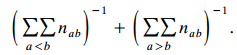
d. Show that the estimated asymptotic variance of τ̂ is
e. Show that residual df = (I + 1)(I – 2)/2.
f. Show that conditional symmetry + marginal homogeneity = symmetry. Explain why G2(S | CS) tests marginal homogeneity (df = 1). When the model holds G2(S | CS) is more powerful asymptotically than G2(S | QS). Why?
Step by Step Solution
3.33 Rating (156 Votes )
There are 3 Steps involved in it
a The conditional symmetry CS model 1028 is given by log ab a b Ia b ab where ab is the expected cel... View full answer

Get step-by-step solutions from verified subject matter experts
 Study Help