



Question: Lloyd (1999, Chapter 6) examines the following data on the relationship of age and marital status from a survey of 185 people in Denmark over
Lloyd (1999, Chapter 6) examines the following data on the relationship of age and marital status from a survey of 185 people in Denmark over the age of 16. A respondent is classified as divorced if the person had been divorced at any time prior to the survey, regardless of whether or not that person is currently remarried. A respondent is classified as single if that person has never married, and a respondent is classified as married if that person has married and never been divorced. At the time of the survey, the legal age of marriage in Denmark was 16.
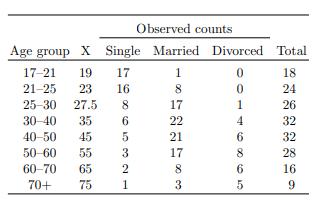
Use proc logistic to fit logistic models to these data, with a multicategory response variable corresponding to the three marital status categories. Use the X variable in the second column of the table as a quantitative explanatory variable representing age.
a. Using marriage as the baseline category, consider the following logistic regression model:
log πsingle πmarried
= α1 + β1(x − 16)
log πdivorced πmarried
= α2 + β2(x − 16)
Interpret the parameters α1, α2, β1, and β2 in this model. Interpret exp(β1) and exp(β2) as odds ratios.
b. Compute the maximum likelihood estimates of the model parameters and corresponding standard errors.
c. Compute 95% confidence intervals for β1 and β2 and interpret the intervals.
d. Plot the estimated probability curves for the three response categories against age on the same plot. Describe what this plot implies about the association between marital status and age.
Observed counts Age group X Single Married Divorced Total 17-21 19 17 1 0 18 21-25 23 16 8 0 24 25-30 27.5 8 17 1 26 30-40 35 6 22 4 32 40-50 45 50-60 55 60-70 65 70+ 75 5321 21 6 32 17 8 28 8 6 16 3 5 9
Step by Step Solution
There are 3 Steps involved in it

Get step-by-step solutions from verified subject matter experts