



Question: a. Discard the data point for the size 14 screen in Example 17-9, and find (G) and (n^{circ}). Example 17-9 b. Is the error larger
a. Discard the data point for the size 14 screen in Example 17-9, and find \(G\) and \(n^{\circ}\).
Example 17-9
b. Is the error larger for \(\mathrm{G}\) or for \(\mathrm{n}^{0}\) ? Why?
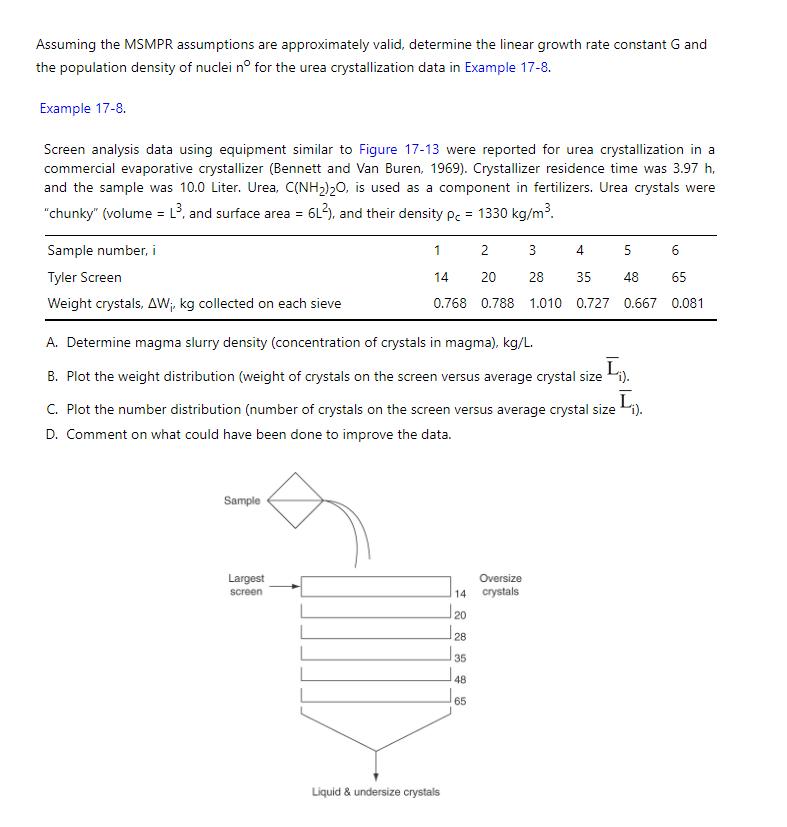
Assuming the MSMPR assumptions are approximately valid, determine the linear growth rate constant G and the population density of nuclei n for the urea crystallization data in Example 17-8. Example 17-8. Screen analysis data using equipment similar to Figure 17-13 were reported for urea crystallization in a commercial evaporative crystallizer (Bennett and Van Buren, 1969). Crystallizer residence time was 3.97 h, and the sample was 10.0 Liter. Urea, C(NH2)20, is used as a component in fertilizers. Urea crystals were "chunky" (volume = L, and surface area = 6L), and their density Pc = 1330 kg/m. Sample number, i Tyler Screen Weight crystals, AW;, kg collected on each sieve 1 2 3 4 5 6 14 20 28 35 48 65 0.768 0.788 1.010 0.727 0.667 0.081 A. Determine magma slurry density (concentration of crystals in magma), kg/L. B. Plot the weight distribution (weight of crystals on the screen versus average crystal size Li). C. Plot the number distribution (number of crystals on the screen versus average crystal size Li). D. Comment on what could have been done to improve the data. Sample Largest screen Oversize 14 crystals 20 28 35 48 65 Liquid & undersize crystals
Step by Step Solution
3.37 Rating (153 Votes )
There are 3 Steps involved in it

Get step-by-step solutions from verified subject matter experts