







Question: a. In Table (18-8), the column labeled (Delta mathrm{G} / Delta mathrm{t}), which is a measure of the acceleration of G, was calculated from a
a. In Table \(18-8\), the column labeled \(\Delta \mathrm{G} / \Delta \mathrm{t}\), which is a measure of the acceleration of G, was calculated from a larger spreadsheet table with values spaced at \(2 \%\) from \(0 \%\) to \(100 \%\) of \(\% \mathrm{t}_{\mathrm{C}, \text { max }}\). Create this entire spreadsheet and calculate the values of \(\Delta \mathrm{G} / \Delta \mathrm{t}\).
b. When more than \(90 \%\) of the total changes in \(\mathrm{T}_{\mathrm{C}}\), Const2, G, and \(\mathrm{U}\) have occurred, the pseudo-steady-state assumption becomes reasonable. Use the enhanced Table 18-8 spreadsheet with rows at intervals of \(2.0 \%\) of \(\mathrm{t}_{\mathrm{C}, \text { max }}\) to determine when the pseudo-steadystate assumption is probably accurate, and add one or two rows with \(1 \%\) change of \(\mathrm{t}_{\mathrm{C}, \max }\) to obtain more accuracy.
c. Determine the arithmetic average and the geometric average of \(\mathrm{G}\) from numbers at 0,10 , \(20, \ldots, 90,100 \%\) of max crystal thickness.
Numbers in Table 18-8 are correct, but not enough data are given in Table \(18-8\) to obtain the solution for most rows. Calculations were done with a \(2 \%\) change in \(\%\) of \(\mathrm{t}_{\mathrm{C}, \text { max }}\) for all of the entries from \(0 \%\) to \(100 \%\), and with a \(1 \%\) change close to the solution (see part b).
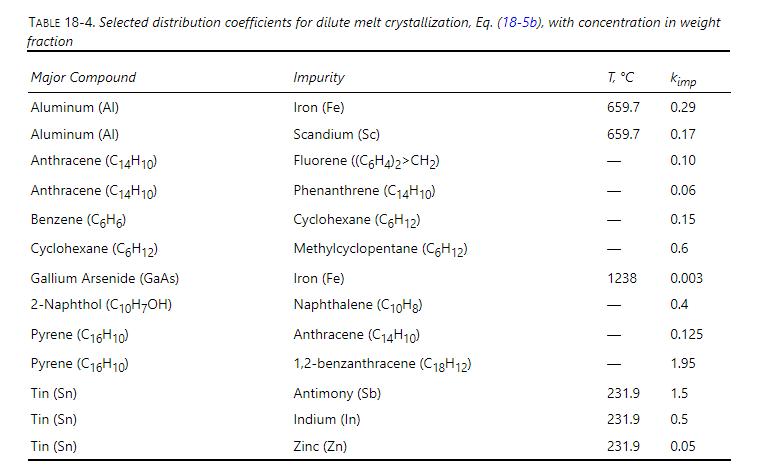
TABLE 18-4. Selected distribution coefficients for dilute melt crystallization, Eq. (18-5b), with concentration in weight fraction Major Compound Aluminum (Al) Aluminum (Al) Anthracene (C14H10) Anthracene (C14H10) Benzene (C6H6) Cyclohexane (C6H12) Gallium Arsenide (GaAs) 2-Naphthol (C10H7OH) Pyrene (C16H10) Pyrene (C16H10) Tin (Sn). Tin (Sn) Tin (Sn) Impurity Iron (Fe) Scandium (Sc) Fluorene ((C6H4)2>CH2) Phenanthrene (C14H10) Cyclohexane (C6H12) Methylcyclopentane (C6H12) Iron (Fe) Naphthalene (C10H8) Anthracene (C14H10) 1,2-benzanthracene (C18H12) Antimony (Sb) Indium (In) Zinc (Zn) T. C Kimp 659.7 0.29 659.7 0.17 - 0.10 0.06 0.15 - 0.6 1238 0.003 0.4 0.125 1.95 231.9 1.5 231.9 0.5 231.9 0.05
Step by Step Solution
3.44 Rating (157 Votes )
There are 3 Steps involved in it

Get step-by-step solutions from verified subject matter experts
 Study Help